


What Zenbooks Recommended in Its Submission to Canada's 2026 Federal Pre-Budget Consultations

Zenbooks Tax Services Professional Corporation has filed a written submission to the Department of Finance Canada for the 2026 pre-budget consultations, which close on September 8, 2026 ahead of Budget 2026 this fall. The submission is built on data from the Zenbooks Financial Clarity Index 2026, our national benchmark of how well Canadian small business owners understand and manage their finances.
The full submission is available here: Zenbooks 2026 Pre-Budget Submission (PDF).
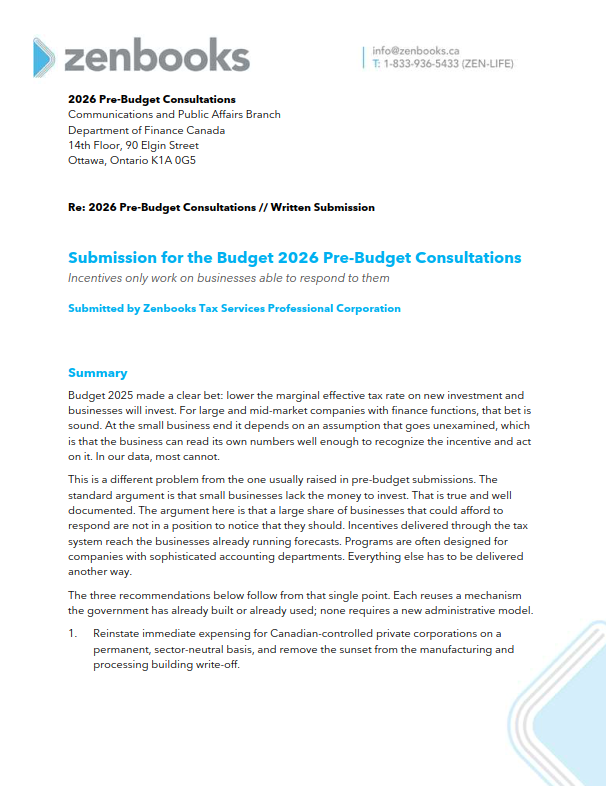
The argument in one paragraph
Budget 2025 made a clear bet: lower the marginal effective tax rate on new investment and businesses will invest. For large and mid-market companies with finance functions, that bet is sound. At the small business end it rests on an assumption that usually goes unexamined, which is that the business can read its own numbers well enough to recognize an incentive and act on it. Most cannot. In the Zenbooks Financial Clarity Index 2026, 29.1 per cent of Canadian small businesses track key performance indicators consistently, and 77.2 per cent of owners rate their own financial management as good or excellent while 43.5 per cent score in those bands on measured performance.
This is a different argument from the one usually made in pre-budget submissions. The standard case is that small businesses lack the money to invest, which is true and well documented. Our case is that a large share of businesses that could afford to respond are not in a position to notice that they should. Incentives delivered through the tax system reach the businesses already running forecasts. Everything else has to be delivered another way.
What Zenbooks recommended for Budget 2026
The submission makes three recommendations. Each reuses a mechanism the federal government has already built or already used, so none requires a new administrative model.
1. Make immediate expensing permanent and sector-neutral
Reinstate the $1.5 million annual immediate expensing limit for Canadian-controlled private corporations on a permanent, indexed basis across the same broad range of capital cost allowance classes as the measure that ran from April 19, 2021 to December 31, 2023, and remove the 2030 to 2033 phase-out from the manufacturing and processing building write-off introduced in Budget 2025.
A phase-out schedule is only an incentive to a business that plans capital purchases against a calendar. Among businesses in the Zenbooks Financial Clarity Index 2026 that made a major investment in the past year, 19.3 per cent used a formal return-on-investment calculation and 18.2 per cent described the decision as gut feel. A business that replaces equipment when the old equipment fails will not accelerate that purchase into 2029 because a rate steps down in 2030. It will simply arrive after the window and receive nothing.
The precedent for permanence is recent. The Spring Economic Update 2026 made the employee ownership trust capital gains exemption permanent after three years as a temporary measure, on the reasoning that succession decisions run on their own timeline rather than the government's. Capital replacement decisions in small businesses work the same way.
2. Deliver direct tariff relief automatically, on the carbon rebate model
Establish a Tariff Response Rebate for Small Business paid the way the Canada Carbon Rebate for Small Businesses was paid: automatically, with no application, from information the Canada Revenue Agency already holds. Eligibility would be set from the T2 return for Canadian-controlled private corporations with 1 to 499 employees in the sectors producing goods covered by the U.S. Section 232 and Section 338 tariffs, with amounts scaled by T4 slips filed at a per-employee rate set by the Minister.
The August 25, 2026 federal package committed $7.5 billion in tariff supports, including $1.5 billion more for the Regional Tariff Response Initiative and a second $500 million liquidity stream at the Business Development Bank of Canada. These are substantial, but accessing them requires a business to identify itself as affected, document its circumstances, and apply.
Application-based programs select for owners who have already concluded they need help. Given the calibration gap in our data, the businesses least likely to apply are disproportionately the businesses in the worst position. Published research points the same way: confidence, rather than measured capability, predicts whether people seek financial advice (Kramer, Journal of Economic Behavior and Organization, 2016).
3. Index the small business thresholds that have been left to erode
Raise the GST/HST small-supplier threshold to $60,000 and index it annually, raise the small business deduction limit to $750,000 and index it annually, and commit to a review of unindexed amounts across the Income Tax Act and the Excise Tax Act.
The GST/HST small-supplier threshold has been $30,000 since the GST was introduced in 1991, and inflation has cut its real value by roughly half. The small business deduction limit has been $500,000 since 2009 and would be roughly $740,000 today if it had been indexed. The passive investment income threshold has been $50,000 since 2018. The CPP basic exemption has been $3,500 since 1996. The C.D. Howe Institute has identified more than 200 amounts in the tax system that are not indexed. We made the detailed argument for raising the GST/HST threshold in the Canadian Accountant in February 2026.
Of the three recommendations, this is the cheapest to implement and the only one that reduces rather than adds administration. It also reduces the compliance work our own clients require, which we disclose in the submission.
Why we used our own data
Research on how companies manage their finances is built overwhelmingly on publicly traded companies, because those are the companies required to disclose. Continuous disclosure produces decades of standardized, comparable, firm-level data, and the academic literature has followed it. Private companies disclose nothing comparable, so the questions get asked where the data is.
Canada is not short of small business data in general. Statistics Canada and ISED publish counts, demographics, survival rates, and financing conditions, and CFIB fields regular measures of sentiment and cost pressure. What is missing is anything on the inside of the business: whether the owner knows their margin, whether a forecast exists, whether the books are integrated or manual, how investment decisions actually get made. Those are the variables that determine whether a tax incentive produces an investment, and no public dataset measures them.
The submission asks the government to fix that directly, by adding eight to ten financial-management items to an existing Statistics Canada survey vehicle such as the Survey on Financing and Growth of Small and Medium Enterprises. A national statistic of this kind should not depend on a private company publishing it.
Disclosures
Zenbooks sells accounting and fractional finance services to the segment this submission concerns, and would stand to benefit from any measure that increased small business demand for financial advice. None of the three recommendations does that, and the third would reduce the compliance work our own clients require. Separately, the Zenbooks Financial Clarity Index 2026 finds no significant difference in financial clarity between businesses with in-house and outsourced bookkeeping. We report that result because the data shows it.
About the Zenbooks Financial Clarity Index
The Zenbooks Financial Clarity Index 2026 is a national benchmark of financial clarity among Canadian small business owners, published in August 2026 by Zenbooks Tax Services Professional Corporation. It surveyed 565 owners through a national research panel, weighted by raking to Statistics Canada distributions for region, business size, and sector, with a design effect of 1.10 and an effective sample of approximately 513. The national mean score is 56.7 out of 100. Findings are descriptive and associational rather than causal, and the published report classifies the evidence strength behind each finding and lists the claims the data does not support.
For journalists, researchers, and policy analysts
The full dataset supports custom tabulations by region, sector, revenue band, and financial behaviour. We provide specific cuts on request at no cost, and we field the index annually.
Suggested citation: Zenbooks Financial Clarity Index 2026, Zenbooks Tax Services Professional Corporation, August 2026.
Paste-ready findings:
- According to the Zenbooks Financial Clarity Index 2026, 29.1 per cent of Canadian small businesses track key performance indicators consistently.
- The Zenbooks Financial Clarity Index 2026 found that 77.2 per cent of Canadian small business owners rate their financial management as good or excellent, while 43.5 per cent score in those bands on measured performance.
- Among Canadian small businesses that made a major investment in the past year, the Zenbooks Financial Clarity Index 2026 found that 19.3 per cent used a formal return-on-investment calculation and 18.2 per cent described the decision as gut feel.
- The national mean score on the Zenbooks Financial Clarity Index 2026 is 56.7 out of 100, based on a weighted survey of 565 Canadian small business owners.

Eric Saumure, CPA, CA, is co-founder and Principal of Zenbooks, an online cloud-native accounting firm started in 2015 to serve 300+ Canadian small and mid-sized businesses. Before Zenbooks, Eric spent 3 years at KPMG. He specializes in financial strategy for growth-stage companies in the $1M-$10M revenue range, with a particular focus on marketing and creative agencies, SaaS, and professional services firms, e-commerce and non-profits.
Eric's commentary on Canadian small business, tax policy, and open banking has appeared in the Toronto Star, Canadian Press, CTV, CBC, Le Devoir, Policy Options, The Conversation, and Canadian Accountant. He was named to the OBJ Ottawa Forty Under 40 and recognized on both the Financial Times Americas' Fastest Growing Companies 2026 list and the Globe and Mail's Report on Business Top Growing Companies 2024. He is the principal researcher behind the Zenbooks Technology in Accounting Study, a national survey of 500 Canadian SMEs on accounting technology adoption, and the founder of OpenSME, a Canadian open banking advocacy organization. He serves on the board of Cystic Fibrosis Canada and member of the Montfort Hospital Association.
Subscribe for Updates


Business Clarity That Helps You Breathe Easy
Achieve your business goals and peace of mind with Zenbooks. As both your finance team and business advisor, we empower you every step of the way.
