


Accountant vs Bookkeeper vs CFO: What Does a Marketing Agency Actually Need?

If you run a marketing or creative agency in Canada, you have probably asked some version of this question at least once: do I need a bookkeeper, an accountant, or a CFO? Maybe you asked it when you crossed $500K in revenue and realized your spreadsheets were not cutting it. Maybe you asked it when a friend mentioned their fractional CFO and you quietly wondered if you were behind. Maybe you asked it after a stressful tax season when you realized your year-end accountant had no idea what your business actually does.
The question is legitimate. The answer most agency founders get is inadequate, because most of the people answering it are not thinking about how agencies actually work.
An agency is not a retailer. It is not a SaaS company. It has a cost structure built almost entirely around people, a revenue model built around retainers and projects, and a margin profile that is invisible unless someone is actively looking for it. The standard answer to "bookkeeper vs. accountant vs. CFO" does not account for any of that. This post does.
First, What These Roles Actually Mean
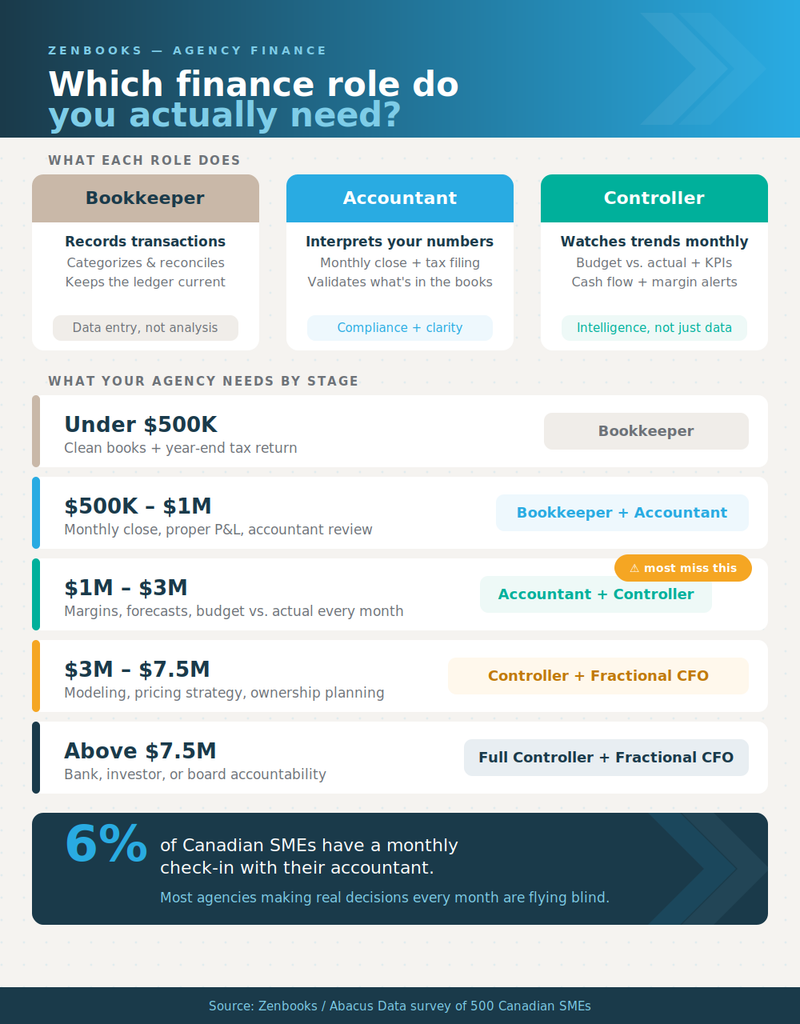
The accounting profession has done a genuinely poor job of explaining where one role ends and another begins. CFO and Controller are also different investment levels. Agency founders are not supposed to know this. Here is a plain-language breakdown.
A bookkeeper records financial transactions. They categorize income and expenses, reconcile bank accounts, and keep the ledger current. Modern cloud accounting software has automated most of what bookkeeping used to mean: bank feeds pull in transactions automatically, rules categorize them, reconciliation takes minutes. What the software cannot do is review what it produced, catch the errors, or tell you what any of it means. That requires a human with accounting judgment.
An accountant interprets financial data, prepares financial statements, handles tax compliance, and provides the analytical layer that turns clean books into useful information. In a properly structured engagement, an accountant is the person who closes your books monthly, reviews what the software produced, validates that it makes sense, and can explain your P&L to you in plain language. Treating a bookkeeper and an accountant as interchangeable is one of the most common and most expensive mistakes agency founders make. They are not the same function.
A controller sits above bookkeeping and accounting, managing the financial reporting function of the business: monthly closes, budget versus actual analysis, cash flow forecasting, KPI tracking, and variance analysis. The controller is the person who looks at your numbers every month and tells you what they see, what is trending in the wrong direction, and what you should be paying attention to. For most agencies between $1M and $7.5M in revenue, this is the layer that is missing, and it is the layer that would actually change how they run their business.
A CFO operates at the strategic level: capital structure, investor relations, board reporting, long-range financial planning, and exit preparation. A fractional CFO brings that function on a part-time basis. For most agencies under $7.5M without external investors or a board, a full CFO function is not what they need yet. A fractional one embedded in specific strategic moments can add value, but it is not the right starting point.
The Agency-Specific Problem With Generic Financial Support
Here is why the standard answer does not work for agencies.
Most generalist accountants are trained and experienced on businesses with simple, stable revenue: product sales, service contracts with fixed fees, recurring subscriptions. They know how to handle a straightforward income statement where revenue comes in and costs go out in predictable patterns.
An agency does not work that way. Your revenue model involves retainers that require deferred revenue tracking, project contracts where revenue recognition depends on completion milestones, scope that drifts beyond what was originally billed, and a cost structure where the single largest expense, your people, needs to be allocated across individual clients to understand real profitability. None of that is complicated in the hands of someone who understands it. In the hands of someone who does not, it produces books that are technically accurate and functionally useless for running your business.
According to the Technology in Accounting study by Zenbooks, 34 percent of Canadian SMEs report that managing cash flow causes at least a moderate headache, and 34 percent say the same about paying bills. For agencies, those numbers almost certainly skew higher, because cash timing in an agency is genuinely complex. Retainer clients pay upfront for work delivered over time. Project clients pay on milestones that may not align with when your team is doing the most intensive work. Scope overflow goes unbilled for weeks. A generalist accountant who has never worked with an agency will struggle to help you see any of this clearly.
The fix is not necessarily a more expensive financial resource. It is the right financial resource with the right agency-specific experience.
Mapping Financial Support to Agency Growth Stage
The right level of financial support is not a fixed answer. It changes as your agency grows, and the stages map fairly cleanly to revenue bands.
Under $500K: Bookkeeping plus year-end tax compliance.
At this stage, you need clean books and a compliant tax return. A cloud-based accounting setup with monthly transaction coding, bank reconciliation, and an accountant handling your year-end is sufficient. The priority is foundation, not sophistication. Keep your costs lean, stay organized, and make sure you are on accrual-basis accounting or have a plan to get there before you outgrow cash-basis.
$500K to $1M: Cloud accounting with accountant-level review.
This is the stage where a bookkeeper-only setup starts to fail. You have enough revenue that errors in your books matter, enough clients that your cash flow is genuinely complex, and enough team that your payroll costs need to be understood at the project level. You need an accountant, not just a transaction processor, reviewing your books monthly and closing them on time. You should be seeing a proper P&L and balance sheet every month, not quarterly or at year-end.
$1M to $3M: Cloud accounting plus controller-level support.
This is where most founder-led agencies are significantly underserved. They have revenue, they have a team, they have multiple retainer clients, and they are making decisions that have real financial consequences: hiring, pricing, client mix, service line expansion. What they almost never have is someone watching their numbers every month, explaining what the trends mean, and flagging problems before they compound.
The controller function at this stage includes monthly closes done within two weeks of month-end, a budget built and maintained against actuals, cash flow visibility at least four to six weeks forward, and a monthly conversation about what the numbers are saying. This is not CFO-level strategy. It is financial intelligence, and it is what agency founders need most and receive least.
The research is clear on this gap: only 6 percent of Canadian SMEs working with an external accounting provider have a monthly check-in with their accountant. For agencies making complex decisions every month about pricing, staffing, and client relationships, operating without that monthly conversation is an expensive form of flying blind.
$3M to $7.5M: Controller plus selective fractional CFO.
At this revenue level, the controller function becomes more structured. You likely have a management team making financial decisions, clients whose contracts have meaningful complexity, and operational questions that require forward-looking financial modeling rather than backward-looking reporting. A fractional CFO engagement starts to add real value at this stage, particularly for cash runway modeling, pricing strategy analysis, or preparing for a significant transaction or ownership change.
The key word is selective. A fractional CFO layered on top of a weak controller foundation is not a good investment. The strategic conversations are only as useful as the underlying data they are built on. Get the controller layer working first.
Above $7.5M: Full controller plus fractional CFO as standard.
At this revenue level, financial complexity has scaled with the business. You have a payroll that represents a meaningful monthly commitment, client relationships with contractual complexity, and likely some form of external accountability, whether to a bank, an investor, or a board. The controller and fractional CFO functions are both necessary, not optional.
What Agencies at the $1M to $3M Stage Are Actually Missing
Because this is where most of our agency clients come from, and because it is where the gap is most consequential, it is worth being specific about what controller-level support looks like in practice for an agency.
It means your books close within two weeks of month-end, every month, without you chasing anyone. It means you receive a P&L and balance sheet alongside a written or verbal commentary explaining what changed, what is trending, and what warrants your attention. It means someone is maintaining a cash flow forecast so you know whether you can make the hire you are considering. It means your retainer revenue is being recognized correctly, your deferred balances are tracked, and your project-level margins are visible enough to have informed conversations about pricing and client mix.
It also means someone picks up the phone when you have a question. That sounds like a low bar. It is not, given how many agency founders describe their current accounting relationship as one-directional: they send documents in, something comes back at tax time, and nothing happens in between.
Joy Hawkins of Sterling Sky, a digital marketing consultancy that grew from $1M USD to over $5M USD in revenue under Zenbooks' support, described her previous accounting experience as stressful and inaccessible. Her previous accountant was technically competent but not approachable, which meant she stopped asking questions and started making decisions without the financial context she needed. Getting the right financial support in place, with monthly reviews and proactive advisory, was foundational to managing a team that grew from 5 to over 40 people without losing control of the finances.
You can also read Emrah’s story(Duco), Justin Thomason (West of Main) and Marie Haynes who all have their own similar stories as agencies working with Zenbooks.
That is not a CFO story. That is a story about having the right accounting infrastructure and the right access to someone who understands your business.
The Traditional Once-a-Year Accountant Model Was Never Designed for Agencies
This opinion is worth stating plainly: the annual accountant model is not a financial management solution. It is a compliance solution. It was designed for businesses with stable, predictable revenue where the main financial event of the year is the tax return. An agency with retainer clients, project billing, scope overflow, and a team of people billing time across multiple accounts needs financial visibility twelve months of the year, not one.
The reason agency founders delay upgrading their financial support is almost never cost. It is that nobody has clearly explained what they are missing. The gap is invisible until it is expensive: a payroll surprise, a CRA instalment they did not see coming, a pricing decision made without understanding that the client in question was already marginal.
If your financial support is currently limited to year-end tax compliance and occasional bookkeeping, you are making growth decisions without information that exists and that you could have. That is a solvable problem.
For a deeper look at how the bookkeeper, controller, and CFO layers work across business types, Colin Robinson's post on fractional CFO vs. bookkeeper covers the general framework in detail. The agency-specific version of that answer is this: most founder-led agencies between $1M and $3M need the controller layer, and most of them do not have it.
Frequently Asked Questions
What is the difference between a bookkeeper and an accountant for a marketing agency?
A bookkeeper records transactions and keeps the ledger current. An accountant reviews what the bookkeeper or software produces, validates that it is correct, closes the books monthly, handles tax compliance, and provides the analytical layer that makes your numbers useful. For agencies, the distinction matters because the volume and complexity of transactions, retainer recognition, project billing, deferred revenue, and team cost allocation, requires accounting judgment, not just data entry. If you are above $500K in revenue and your financial support is limited to transaction coding, you have a gap.
Does my agency need a fractional CFO?
Probably not yet, unless you have investors, a board, or an imminent transaction. Most founder-led agencies between $1M and $7.5M need strong cloud accounting and controller-level support before fractional CFO services add meaningful value. The strategic conversations a CFO enables are only as useful as the underlying data they are built on. If your books are not closing on time, you do not have a budget, and nobody is watching your margins monthly, a fractional CFO is not the right next step.
What does a controller do for a marketing agency specifically?
A controller closes your books monthly, maintains a budget versus actual analysis, tracks your cash flow forward, monitors your client-level margins, and provides a monthly read on what is happening in your business financially. For agencies, this includes making sure retainer revenue is recognized correctly, deferred revenue balances are tracked, and project-level profitability is visible. The controller is the person who can tell you whether you can afford the hire you are considering, whether a client relationship is worth the cost of servicing it, and what your cash position looks like in six weeks.
How do I know if I have outgrown my current accountant?
The clearest signs are: your books are consistently behind, you have not had a proactive financial conversation with your accountant in months, you cannot get a straight answer on your cash position, you have no budget, and your accountant surfaces only at tax time. According to Zenbooks' national research on technology in accounting, 21 percent of Canadian SMEs say they have outgrown their current accountant. For growing agencies making meaningful financial decisions every month, that number is almost certainly higher.
What should I expect to pay for the right level of financial support?
It depends on your revenue, complexity, and what level of support you need. At the cloud accounting plus accountant-level review tier, you should expect a monthly retainer in the range of $1,000 to $2,500 for a well-run agency engagement. Controller-level support with monthly advisory typically runs $2,500 to $5,000 per month depending on complexity. Fractional CFO services are priced above that and scoped to specific strategic needs. These are approximations. The better question is what the cost of not having the right support has been, in terms of decisions made without information, margin erosion that went undetected, and time spent managing financial anxiety instead of running the business.
Can I get bookkeeping, accounting, and controller support from one firm?
Yes, and for agencies, that integration is actually important. When the person doing your monthly close is also the person giving you financial commentary, the insight is much sharper than when those functions are split across two providers who do not talk to each other. Zenbooks operates as an integrated finance function for founder-led agencies, combining cloud accounting, monthly reporting, and controller-level advisory in a single engagement that scales with the business.
If you are not sure which layer your agency is missing, the Zenbooks Financial Clarity Assessment takes two minutes and gives you an immediate read on where your financial support gaps are. Or book a complimentary consultation and we will walk through it with you directly.

Colin Robinson is co-founder and Principal of Zenbooks, which he built starting in 2015 into one of Canada's leading cloud accounting firms for small and mid-sized businesses. He leads Zenbooks' CFO advisory practice, working directly with founders and executive teams on financial strategy, cloud migration, and the kind of complex, non-standard situations that fall outside the playbook.
Before co-founding Zenbooks, Colin worked at Ernst & Young, one of the world's leading professional services firms. He holds a Bachelor of Commerce in Accounting.
Over a decade building and running Zenbooks, Colin has advised hundreds of Canadian entrepreneurs, from solo founders scaling past their first million to established businesses navigating ownership transitions and operational restructuring. His commentary on small business financial strategy has appeared in Le Droit.
Subscribe for Updates


Business Clarity That Helps You Breathe Easy
Achieve your business goals and peace of mind with Zenbooks. As both your finance team and business advisor, we empower you every step of the way.
