


Agency Tax Planning in Canada: What Marketing Firms Are Missing

If your marketing or creative agency is working with a generalist accountant, chances are you are leaving money on the table every single year. Not because your accountant is incompetent, but because the tax complexity specific to Canadian agencies, especially those with international clients and cross-border contractors, is genuinely specialized territory that a year-end-only practice is not built to navigate.
Canadian agencies have a distinct tax profile compared to most small businesses. Your revenue often flows in from outside Canada. Your team is frequently spread across multiple countries. Your clients may be billed in USD. The software tools you resell or license to clients carry their own HST treatment. And your corporate structure, if it has not been revisited in a few years, is almost certainly not optimized for the income volatility that is inherent to agency life.
This post covers the specific tax planning issues that matter most to Canadian marketing and creative agency owners, and where generalist advice most consistently falls short.
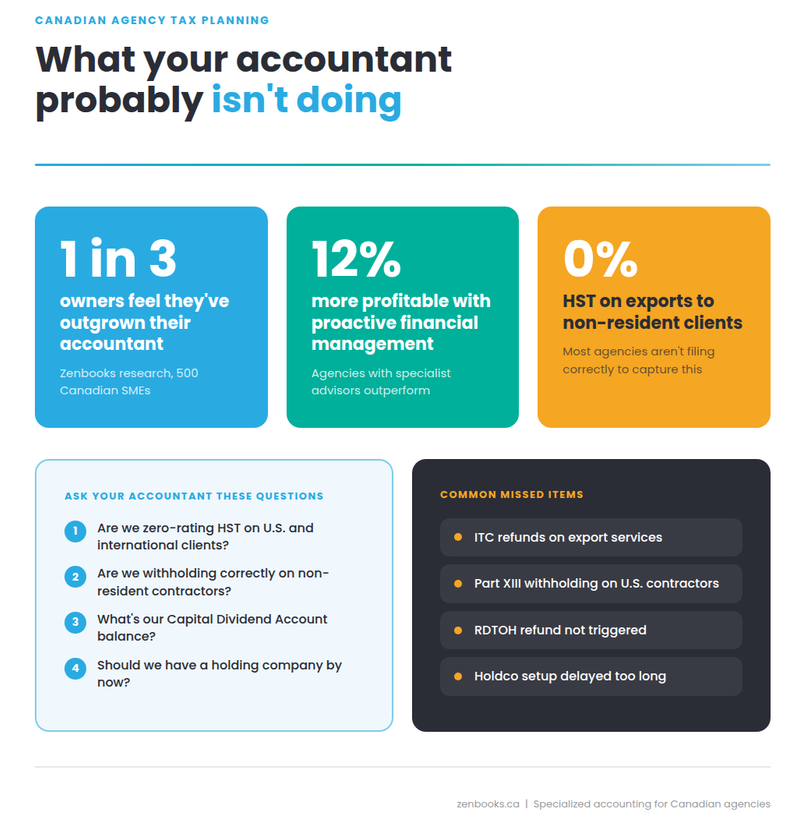
According to Zenbooks' national research on technology in accounting with 500 Canadian SMEs, 1 in 3 business owners feel they have outgrown their accountant. For agency founders, the problem is not just growth. It is specialization. Year-end compliance and strategic tax planning are two entirely different services.
1. HST on Cross-Border Services: Most Agencies Are Getting This Wrong
This is the area where generalist accountants most commonly give incomplete advice, and where the exposure is real.
Zero-Rating Exports of Services to Non-Residents
When a Canadian agency provides services to a client based outside Canada, such as a U.S. brand, a European retailer, or an overseas technology company, those services are generally zero-rated for HST purposes under the Excise Tax Act. That means HST is charged at a rate of 0%, not exempt. The distinction matters enormously: a zero-rated supply still generates input tax credit (ITC) entitlements, while an exempt supply does not.
The rule is found in Schedule VI, Part V of the Excise Tax Act. To qualify for zero-rating, the supply must be made to a non-resident who is not registered for GST/HST in Canada. This is a critical nuance: if your U.S. client has a Canadian subsidiary or Canadian operations that are GST/HST registered, the zero-rating may not apply.
The practical implication is that agencies billing predominantly to U.S. or international clients should be generating significant ITC refunds, not paying net HST. Many are not structured or filing correctly to capture this.
The SaaS Reseller Exception
Here is where it gets more nuanced for agencies. If your agency resells or licenses SaaS products to clients, that transaction is treated differently from a pure service. The CRA's administrative position on digital products and cross-border digital services is that software supplied to a Canadian-resident business can attract HST at the full rate, even if the underlying service component is zero-rated.
If your agency bundles a retainer with a software subscription, the software component should be separately invoiced or at minimum separately identified. Failing to do so can result in an agency over-collecting or under-collecting HST, either of which creates a compliance exposure.
Place of Supply Rules and Practical Documentation
The CRA's place of supply rules for services require that you document the residence and HST registration status of your clients. This means keeping records of client addresses, proof of non-residency, and confirmation that they are not registered for Canadian GST/HST. A generalist accountant reviewing your books once a year may not be asking these questions. They should be.
2. Cross-Border Contractors: Withholding Tax and the Worker Classification Trap
The majority of Canadian agencies rely on freelancers and contractors, many of them based in the United States or other countries. This creates two distinct tax problems that are frequently overlooked.
Non-Resident Withholding Tax Under Part XIII
When a Canadian corporation pays fees to a non-resident individual or entity for services rendered, Part XIII of the Income Tax Act may require the Canadian payor to withhold 25% of the gross payment and remit it to the CRA. The rate can be reduced under a tax treaty. Under the Canada-United States Tax Convention, the withholding rate on business income paid to U.S. residents is generally reduced to nil if the U.S. contractor does not have a permanent establishment in Canada.
The catch is that the nil rate is not automatic. You need documentation. Specifically, you need to satisfy yourself that the payment qualifies as business income under the treaty and not as another type of payment such as fees for services under Article XV. In practice, this means getting a completed Form NR4 or equivalent documentation, and in some cases applying for a treaty-based waiver using Form R105.
Agencies that pay U.S. contractors without addressing withholding obligations can face reassessments with significant interest and penalties. The agency is the withholding agent, and the liability stays with the payor if withholding is not done correctly.
The Worker Classification Problem
Separate from withholding, there is the question of whether your contractors are actually employees in the eyes of the CRA. The CRA's guidance on employee vs. contractor classification uses a control, ownership of tools, chance of profit, and integration test framework. For agencies with long-term contractors who work exclusively for the firm, use agency-provided systems, and have minimal independent client bases, the CRA may view those relationships as employment, regardless of what the contract says.
This is one of the more active CRA audit areas for service businesses. Our own team has written separately about this issue for agency owners, including the payroll and margin implications. See: Hiring for Growth: The Agency Owner's Guide to Employees vs. Contractors.
3. Corporate Structure and the Unique Volatility Problem for Agency Founders
Agency income is not steady. You know this. A large client departure, a scope change on a retainer, or a slow new business quarter can swing your annual income dramatically. That volatility has direct implications for how you should structure compensation and retained earnings.
Salary vs. Dividends: The Case for Reasonable Compensation
Most agency founders receive advice to pay themselves dividends to minimize CPP contributions and take advantage of the lower personal tax rate on eligible dividends. That advice is not wrong, but it is incomplete for an agency owner.
Agency income tends to be active business income, which means it is eligible for the small business deduction at the corporate level. A corporation paying corporate tax at the small business rate and then distributing dividends is broadly tax-efficient. But when revenue is volatile, the dividend approach creates a personal cash flow problem: in high-revenue years you withdraw heavily, in low years you may not have the retained earnings to maintain lifestyle spending.
A reasonable salary, set at a level that reflects the value of your contribution to the business, creates RRSP contribution room (which dividends do not), establishes pensionable earnings for CPP purposes, and provides a predictable personal cash flow baseline that is not dependent on quarterly corporate performance. The structure is not purely about tax minimization. It is about sustainability.
"What I see with agency founders is that they often make the compensation decision once and never revisit it. But as the business grows, the optimal mix between salary and dividends changes. The corporate surplus builds up, the integration assumptions change, and suddenly there is a significant planning opportunity that has been missed for years." Eric Saumure, CPA, CA, Principal, Zenbooks
The Capital Dividend Account: A Planning Tool Most Agency Accountants Ignore
The Capital Dividend Account (CDA) is one of the most powerful and underutilized tools in Canadian corporate tax planning. The CDA tracks certain tax-free amounts that a corporation can pay to its shareholders as a tax-free capital dividend.
For an agency, the most common contributor to the CDA is the non-taxable portion of capital gains realized by the corporation. If your corporation disposes of eligible capital property, or eventually sells the business, a significant portion of the gain may flow into the CDA and be distributable tax-free. For agency founders approaching a sale or partial disposition of their firm, understanding the CDA balance and how to maximize it is critical pre-transaction planning.
A generalist accountant may not be tracking the CDA at all if you have never had a capital gain event. An agency-focused tax advisor will build it into the annual review as a forward-planning measure.
RDTOH: Refundable Tax on Investment Income
If your agency retains earnings in the corporation and invests them, the investment income earned is subject to a high corporate tax rate, but a portion of that tax is refundable when dividends are paid out. This mechanism is tracked in the Refundable Dividend Tax on Hand (RDTOH) account.
Since the 2019 changes to the RDTOH rules, there are now two RDTOH accounts: eligible RDTOH and non-eligible RDTOH. The rules governing which account is credited and which type of dividend triggers the refund are complex. Getting this wrong can result in a corporation paying out dividends that do not generate the expected RDTOH refund, which means leaving corporate tax in the government's hands unnecessarily.
For agencies that have accumulated retained earnings and are starting to generate meaningful passive income, this is a real and recurring planning issue.
Holding Companies and Corporate Restructuring
As an agency grows past the $1M revenue mark and starts accumulating meaningful retained earnings, a holding company structure (or even a trust) becomes worth examining seriously. The mechanics are standard: the operating company pays dividends to a holding company on an inter-corporate tax-free basis under the dividend rental arrangement exemption, and the holding company deploys those retained earnings into investments, insurance products, or additional business ventures.
The practical benefit is capital protection. If the operating company faces a liability, a lawsuit, or a bad year, retained earnings sitting in a holding company are structurally insulated. For agency founders who have taken personal risk to build the business, this structure is a form of financial hygiene that a generalist accountant may not proactively recommend.
Restructurings involving a holding company are typically completed through a Section 85 rollover, a tax-deferred transfer of shares that allows you to reorganize without triggering an immediate capital gain. These transactions require a T2057 election and careful valuation work. They are not complex for a tax specialist, but they are absolutely not within scope for a bookkeeper or a year-end generalist.
4. Agency-Specific Tax Deductions That Are Commonly Missed
Beyond the structural issues above, there are recurring deduction categories where agencies are consistently leaving money behind.
Software and Subscriptions
Agency operations are software-heavy. Project management platforms, design tools, analytics suites, client reporting tools, and cloud storage all generate deductible business expenses. The issue is not whether they are deductible. They clearly are. The issue is that when multiple team members share subscriptions and when personal and business use overlaps, a generalist accountant may not be capturing the full picture or may be conservatively disallowing amounts that a specialist would defend.
Home Office for Agency Founders
Many agency principals work partly or primarily from home. The CRA's rules on home office deductions for corporations are different from those for self-employed individuals. A corporation can reimburse the shareholder-employee for the use of home space, provided that the space is genuinely used primarily for business and the rental amount is reasonable. This converts a non-deductible personal expense into a deductible corporate expense.
Professional Development and Industry Events
Design conferences, marketing summits, industry association memberships, software certifications, and professional subscriptions are all deductible when they are directly connected to maintaining or improving skills relevant to the business. The trap is documentation. CRA audits of service businesses routinely flag professional development as a personal benefit, especially if the event was held in a desirable location. The solution is keeping clear records of the business purpose and ensuring the expense is booked through a corporate account with a contemporaneous justification.
5. The Structural Gap: What Year-End-Only Advice Cannot Address
The common thread across all of the issues above is that they require proactive, ongoing engagement rather than an annual review. A bookkeeper who closes your books quarterly and hands off a file to a year-end accountant in March is not positioned to catch a withholding tax exposure, restructure your compensation mix, or advise on a holding company before the fiscal year ends.
Zenbooks' research, carried out across 500 Canadian SMEs, found that profitable businesses are 12% less likely to rely on a traditional accountant than those that are breaking even or unprofitable. That correlation points to something real: the way you manage your finances, including who you work with and how proactively they engage, has a measurable relationship with business outcomes.
The same research found that 1 in 5 business owners using an external accountant say they have outgrown them. For agency founders at the $1M to $5M revenue mark, that feeling is usually justified. The tax and structural complexity at that scale genuinely requires a different level of service than what most generalist practices offer.
Sterling Sky, a digital marketing consultancy that grew from $1M USD in revenue in 2018 to over $5M USD in 2024, is a Zenbooks client case study that illustrates what proactive, specialist engagement looks like for an agency at growth stage. The kind of tax and structural work described in this article, including compensation planning, holdco structuring, and cross-border contractor compliance, is part of what a specialized accounting partner provides that a generalist simply cannot.
6. Questions to Ask Your Current Accountant
If you are working with a generalist accountant and are unsure whether you are getting agency-specific tax advice, here are the questions worth asking directly:
- Have you reviewed our HST filing position on services billed to non-resident clients and confirmed we are zero-rating correctly?
- Are we documenting non-resident contractor payments in a way that satisfies Part XIII withholding requirements?
- What is our current Capital Dividend Account balance, and does it factor into our distribution planning?
- Have we reviewed our RDTOH accounts since the 2019 rule changes, and are we paying the right type of dividend to trigger the refund?
- Has a holding company structure ever been modeled for our situation, and if not, why not?
- Are there any corporate tax elections or deferrals we have not taken advantage of in the last two fiscal years?
If your accountant cannot answer these questions fluently, that is not a criticism. It reflects the reality that agency tax planning is a specialization, and not every practice is built for it.
"The agencies that come to us from generalist accountants are almost never in bad shape from a compliance standpoint. They have filed their returns, they have paid their taxes. What they have missed is the planning layer. The RDTOH refund they did not trigger, the holdco they should have set up three years ago, the withholding they were not tracking. Compliance is the floor. Planning is where the value is." Albert Park, CPA, CA, CPA (IL), MTax, Senior Tax Manager, Zenbooks
Frequently Asked Questions
Do Canadian agencies need to charge HST to clients in the United States?
Generally, no. Services supplied to non-resident clients who are not registered for GST/HST in Canada are zero-rated under Schedule VI of the Excise Tax Act. This means HST is charged at 0%, and the agency retains the right to claim input tax credits on its own expenses. However, if your agency resells or licenses SaaS products as part of the engagement, the software component may attract HST or state sales tax even if the services component does not. Separating these elements on your invoices is important for proper compliance.
What is the difference between zero-rated and exempt supplies for HST purposes?
Both zero-rated and exempt supplies result in no HST being collected from the customer, but they are treated very differently on your own tax return. Zero-rated supplies allow you to claim input tax credits on your business expenses, so you recover any HST you paid. Exempt supplies do not allow you to claim ITCs, meaning the HST you pay on inputs becomes a permanent cost. For most agency exports of services, zero-rating applies, which is a significantly better outcome.
If I pay a freelancer in the United States, do I need to withhold taxes?
It depends. Under Part XIII of the Income Tax Act, payments to non-residents can be subject to 25% withholding. The Canada-U.S. Tax Treaty reduces this rate, often to nil, for business income paid to U.S. contractors who do not have a permanent establishment in Canada. To rely on treaty protection, you need documentation confirming the contractor's U.S. residency and the nature of the payment. We recommend reviewing your contractor payment practices with a CPA who understands cross-border tax before assuming treaty protection applies automatically. The CRA's guidance on non-resident withholding is a useful starting point.
What is the Capital Dividend Account and why does it matter for my agency?
The Capital Dividend Account is a notional account that tracks amounts a corporation can distribute to its shareholders tax-free as a capital dividend. For most agencies, it is built up over time through the non-taxable portion of capital gains realized by the corporation. It matters most when you are approaching a sale of the business or a major disposition of assets. Pre-transaction, understanding your CDA balance allows you to structure distributions in a tax-efficient way that can save tens of thousands of dollars in personal tax.
Should I set up a holding company for my agency?
If your agency is consistently profitable and retaining earnings in the corporation, a holding company structure is worth evaluating seriously. The primary benefits are asset protection (retained earnings in a holdco are structurally insulated from operating company liabilities) and flexibility in deploying capital. The setup involves a Section 85 rollover, a tax-deferred share transfer, which requires a CPA experienced in corporate reorganizations. The right time to have the conversation is before the need is urgent, not after.
What is RDTOH and how does it affect my dividend strategy?
Refundable Dividend Tax on Hand is a mechanism through which the CRA partially refunds corporate tax paid on investment income when the corporation pays taxable dividends to its shareholders. Since 2019, there are two RDTOH accounts: eligible RDTOH and non-eligible RDTOH, each triggered by different types of dividends. Getting the dividend type wrong can result in RDTOH that sits in the account without triggering a refund, effectively leaving money with the government that should come back to the corporation.
Understand Where Your Agency Stands
If any of the issues covered in this article are unfamiliar territory, that is worth paying attention to. Agency tax planning is genuinely complex, and the gap between compliance and optimization is where most agencies lose money quietly, year after year.
A good starting point is understanding your current financial position across the dimensions that matter most for a business at your stage. The Zenbooks Financial Clarity Assessment takes two minutes and gives you an immediate read on where your risks and opportunities sit. No obligation, no sales pitch.
If you want to talk through the specific issues raised in this article with a CPA, you can also book a complimentary consultation directly. Our tax team works specifically with Canadian agencies and can speak to your situation without the generalist caveats.

Albert Park holds a Master of Taxation from the University of Waterloo and a Bachelor of Commerce from the Rotman Commerce program at the University of Toronto. He is a Chartered Professional Accountant in Canada and a licensed CPA in the State of Illinois. One of a small number of practitioners in Canada to hold both designations. His MTax research focused on GST/HST compliance and administrative design.
Before joining Zenbooks, Albert spent eight years in the tax practice at Ernst & Young (EY), where he advised clients across a range of industries on Canadian and cross-border tax matters. He now serves as Senior Tax Manager at Zenbooks, specializing in Canadian corporate tax, owner-manager tax planning, and Canadian-US cross-border structures for small and mid-sized businesses.
Albert's analysis of Canadian tax policy has been published in Canadian Accountant and Wagepoint.
Subscribe for Updates


Business Clarity That Helps You Breathe Easy
Achieve your business goals and peace of mind with Zenbooks. As both your finance team and business advisor, we empower you every step of the way.
