


Only 32% of Canadian Professional Services Firms Are Satisfied With Their Accounting. Here's What the Other 68% Are Missing.

Two out of three Canadian professional services firms are not satisfied with how their accounting and bookkeeping are handled. That is not a rounding error. That is a structural failure of an entire industry to serve one of its most important client segments.
I say that as someone who runs an accounting firm. I am not exempt from the criticism.
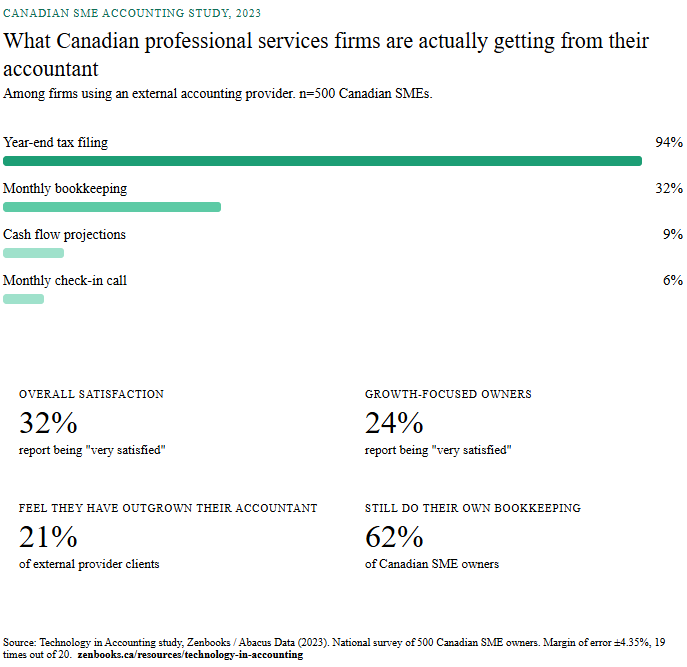
The Technology in Accounting study by Zenbooks, which we conducted in partnership with Abacus Data across a nationally representative sample of 500 Canadian SME owners, found that only 32% of Canadian small business owners report being "very satisfied" with how their accounting and bookkeeping needs are currently addressed. Among younger, growth-focused owners, that number drops to 24%.
For professional services firms specifically, those numbers are a mirror. The consultants, lawyers, engineers, architects, and healthcare practitioners who make up this sector tend to be educated, analytically sharp, and financially literate. They are not confused about what good accounting should look like. They simply are not receiving it.
This post is about what is missing, why it has been missing for so long, and what a professional services firm actually needs from its accounting relationship in 2026.
The Year-End Trap
The first thing most unsatisfied business owners have in common is that their entire relationship with their accountant is organized around April.
Tax filing drives the calendar. The accountant surfaces once a year, reviews the books, files the returns, and disappears. The business pays the invoice, files the documents, and goes back to running their business. If something goes wrong during the year, they find out about it retroactively, usually at the worst possible moment.
This model has been the default in Canadian professional services for decades, and it has trained both sides of the relationship to expect very little from each other. Accountants optimize for compliance throughput. Clients optimize for a low invoice. Neither party is getting what they actually need.
The problem is that compliance is the floor of what accounting should do for a professional services firm. It is not the ceiling. And yet our research found that among Canadian SMEs using an external provider, 94% receive year-end tax services. Only 32% receive monthly bookkeeping support. Only 9% receive cash flow projections. Only 6% have a regular monthly check-in call with their accounting team.
Think about that last number. Six percent. One in seventeen Canadian professional services firm owners has a regular scheduled conversation with their accountant about how their business is performing. For every firm that has that relationship, sixteen others are making financial decisions in the dark.
What Professional Services Firms Actually Need
A law firm, consulting practice, or engineering firm has a specific financial profile that demands more than annual compliance work. Project-based revenue, variable billing cycles, contractor costs that fluctuate with workload, and quarterly tax instalments all create a cash flow environment that needs active management, not passive recording.
Here is what a well-served professional services firm should have from its accounting relationship, and what most currently do not:
- Monthly financials, not annual ones. You cannot manage a services business on year-old data. Monthly profit and loss statements, reviewed with someone who understands your business, give you the ability to course-correct before problems compound. This should be the baseline, not the premium tier.
- Cash flow visibility. Professional services firms live and die by receivables. A consultant who invoices net 30 but pays contractors weekly needs to know exactly where their cash position is heading, not where it was last quarter. Tools like Float, built on top of Xero or QuickBooks Online, make rolling cash flow forecasts entirely practical for firms of any size. Our tech stack post covers how we use these tools with clients.
- Quarterly tax planning, not annual tax filing. HST remittances, corporate tax instalments, and personal compensation strategy all need to be managed across the year, not reconstructed in March. The Canada Revenue Agency's guidance on tax instalments makes the obligation clear. Most professional services firms running tight cash cycles consistently underestimate their instalment obligations until their accountant tells them what they owe at year-end.
- A holding company and compensation strategy conversation. This is the one that most traditional accountants leave on the table entirely. Canadian professional corporations can achieve significant tax efficiency through salary versus dividend planning, prescribed rate loans, and family trust structures where appropriate. Those in professional services industries particularly benefit from a dedicated review of these options each year. This is a conversation that should happen proactively, not because the client asked.
The 62% Problem Inside the Problem
Here is a finding from our research that compounds the satisfaction gap in professional services specifically: 62% of Canadian SME owners personally handle all bookkeeping for their own business.
In most industries, that number is concerning. In professional services, it is a category error.
If you bill $250 an hour for your expertise and you spend 15 hours a month reconciling bank accounts and categorizing expenses, you are carrying a hidden monthly cost of $3,750 in lost billable capacity. Annually, that is $45,000 in foregone revenue, set against a cloud bookkeeping service that runs $500 to $1,500 per month for most professional services firms.
The math resolves in about 30 seconds. But most professionals never run it, because bookkeeping does not feel like a cost. It feels like something they have always done themselves.
"The pattern we see most often is a professional who built very good habits around control and diligence early in their career, and then applied those same habits to their own finances when they started a firm," says Colin Robinson, Principal and head of CFO services at Zenbooks. "Those habits served them well at the beginning. By the time the firm is billing $800,000 a year, those same habits are quietly acting as a ceiling."
The Sunday night QuickBooks session is not a sign of diligence. It is a sign that the business has not matured past its founding-era operating model. And it almost always correlates with the satisfaction gap, because an owner who is doing the data entry is rarely also getting the strategic insight.
The Accountant Is Not Off the Hook
I want to be direct about something: the dissatisfaction data is not primarily a client failure. It is an industry failure.
The year-end compliance model persists because it is profitable and low-risk for accounting firms, not because it serves clients well. Tax filing is repeatable, scalable, and defensible. Advisory is harder to systematize and harder to price. So most accounting firms have gravitated toward the former and positioned the latter as an optional add-on that clients rarely ask for because they do not know to ask for it.
This is not a malicious arrangement. It is an inertia arrangement. But the result is that Canadian professional services firms have been systematically undertold about what their accounting relationship could provide.
Our research found that among Canadian SMEs using an external provider, 21% agreed they had outgrown their current accountant. That is not a small number. One in five clients, by their own assessment, is receiving a service that no longer matches their needs. They are staying anyway, because switching carries friction and because they are not sure the next firm will be meaningfully different.
What Moniker Shows Is Possible
Moniker is a professional services firm that came to Zenbooks facing exactly this pattern. Their books were a mess, their deferred revenue tracking was creating a distorted picture of profitability, and their tax strategy had not been revisited in years.
Over a four-year engagement, Moniker grew four times over. The work was not magic. It was consistent monthly bookkeeping, a cleaned-up chart of accounts, proper deferred revenue treatment, and a tax strategy that was actually aligned with the way their business generated income. You can read the full Moniker case study here.
Sterling Sky, another professional services client, had a similar experience. The accounting relationship gave them a financial foundation that let them make confident growth decisions instead of reactive ones. Their story is part of why we believe deeply that accounting done well is not a cost centre for professional services firms. It is a growth input.
The Decisions You Made With Bad Data
The framing I want to leave you with is this: the real cost of an inadequate accounting relationship is not the penalties. It is the business decisions you made with inaccurate or incomplete financial information.
Pricing a retainer too low because you did not have a clear picture of your true cost per deliverable. Hiring a full-time employee six months before you could actually afford to. Missing the signal that one client was consuming 40% of your capacity while contributing 15% of your margin. These decisions happen constantly in under-served professional services firms, and they never show up on a line item.
The 68% of Canadian professional services firms that are not satisfied with their accounting are not just paying for a service they do not love. They are operating without financial clarity that their competitors may already have.
That gap is closeable. But it requires being honest about what the current arrangement is actually delivering, and whether it matches what your firm at this stage of its growth actually needs.
If you are in that 68%, it might be worth 30 minutes to find out what a different kind of accounting relationship looks like. You can read about what Zenbooks does differently or see what our clients say before you decide.
Frequently Asked Questions
What percentage of Canadian professional services firms are satisfied with their accounting?
According to the Technology in Accounting study by Zenbooks, conducted in partnership with Abacus Data and surveying 500 Canadian SME owners, only 32% of Canadian small business owners report being "very satisfied" with how their accounting and bookkeeping are handled. Among growth-focused owners under 45, that figure drops to 24%.
Why do so many professional services firms still do their own bookkeeping?
Our national research found that 62% of Canadian SME owners personally handle all bookkeeping for their business. In professional services, this typically reflects habits formed when the firm was founded rather than a deliberate ongoing choice. The financial case for outsourcing is strong: at a conservative billable rate of $250 per hour and 15 hours per month spent on bookkeeping, an owner-operated firm is carrying approximately $3,750 per month in lost billable capacity.
What accounting services should a professional services firm actually be receiving?
At minimum: monthly financials, quarterly tax planning, cash flow projections, and an annual review of compensation strategy. Our research found that only 9% of Canadian SMEs using an external accounting provider receive cash flow projections, and only 6% have a regular monthly check-in with their accountant. Both of those should be standard, not exceptional.
What is the difference between a cloud accounting firm and a traditional accountant for professional services?
A traditional accounting relationship in Canada is typically organized around year-end tax compliance. A cloud accounting firm like Zenbooks operates on a continuous model: books are reconciled weekly, reports are available in real time, and the accounting team has the same visibility into your numbers that you do. This makes proactive advisory work practical in a way that the once-a-year model does not support. Our post on what a cloud accounting firm actually does goes into this in detail.
How do I know if I have outgrown my current accountant?
According to our research, 21% of Canadian SMEs using an external provider already feel they have outgrown their accountant. Some signals: your accountant contacts you primarily around tax season; you do not receive monthly financial statements; you have never had a conversation about your compensation structure or holding company strategy; your cash flow has surprised you more than once in the past year. If several of those apply, the relationship probably warrants a second look.
Is cloud bookkeeping appropriate for a professional services firm with complex billing?
Yes, and in many cases it is better suited to complex billing than traditional bookkeeping. Project-based revenue, milestone billing, retainers, and deferred revenue all require consistent, structured treatment to produce accurate financials. Cloud platforms like Xero and QuickBooks Online, paired with tools like Dext for document capture and Float for cash flow forecasting, handle this well. The key is an accounting team that understands services revenue, not just transaction volume.
Source: Technology in Accounting study, Zenbooks / Abacus Data (2023). National survey of 500 Canadian SME owners. Margin of error +/- 4.35%, 19 times out of 20.

Colin Robinson is co-founder and Principal of Zenbooks, which he built starting in 2015 into one of Canada's leading cloud accounting firms for small and mid-sized businesses. He leads Zenbooks' CFO advisory practice, working directly with founders and executive teams on financial strategy, cloud migration, and the kind of complex, non-standard situations that fall outside the playbook.
Before co-founding Zenbooks, Colin worked at Ernst & Young, one of the world's leading professional services firms. He holds a Bachelor of Commerce in Accounting.
Over a decade building and running Zenbooks, Colin has advised hundreds of Canadian entrepreneurs, from solo founders scaling past their first million to established businesses navigating ownership transitions and operational restructuring. His commentary on small business financial strategy has appeared in Le Droit.
Subscribe for Updates


Business Clarity That Helps You Breathe Easy
Achieve your business goals and peace of mind with Zenbooks. As both your finance team and business advisor, we empower you every step of the way.
