


What 500 Canadian Founders Told Us About Accounting (And What It Reveals About the State of Canadian Small Business)

Most research about Canadian small business focuses on what founders are trying to build. We wanted to understand something different: how they are actually managing the financial infrastructure underneath it.
So we commissioned a national study. Five hundred Canadian SME owners and senior decision-makers, surveyed in partnership with Abacus Data, weighted by region, with a margin of error of plus or minus 4.35 percent. Every respondent was personally responsible for their business finances. No proxies. No guesswork.
What came back was not a portrait of a sector in crisis. It was something more complicated: a sector in transition, where the founders who are moving forward and the ones who are standing still are increasingly visible on the same data set.
This post walks through what we found, what it means for a growth-stage Canadian founder, and why we think the gap between what founders say they need and what they have actually done about it is the most important story in the data.
The full Technology in Accounting study is available on our site. Everything cited here comes directly from that research.
Why We Ran This Study
Zenbooks works with over 300+ Canadian SMEs. We see patterns across industries, revenue stages, and business models that most individual founders never get to observe. One pattern kept repeating: founders who had the right financial infrastructure in place were making faster, more confident decisions than those who did not. And the ones who lacked it often did not know what they were missing.
We wanted to put numbers to that pattern. Not anecdotes. Data. We have made the full methodology and findings publicly available because we think the sector deserves to see this clearly.
The Finding That Should Concern Every Growth-Stage Founder
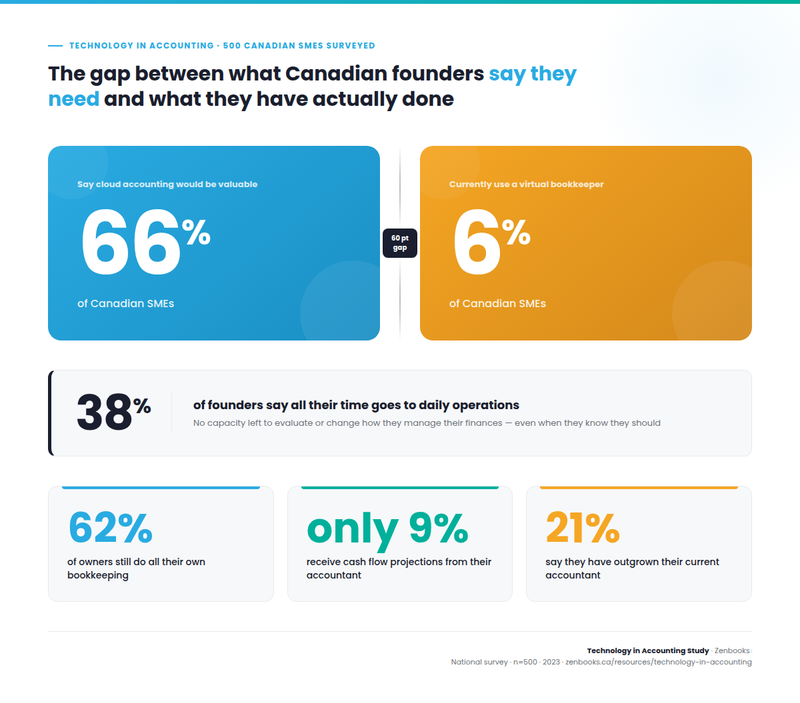
Sixty-two percent of Canadian small business owners personally handle all their own bookkeeping.
Let that sit for a moment. More than six in ten founders are spending a meaningful portion of their working hours on a function that has nothing to do with building their business. And it is not because they enjoy it. Paying bills and managing cash flow tied as the top financial headaches for Canadian SMEs, with 34 percent of owners rating each as a moderate to severe problem.
The connection is direct. When you are the one processing transactions, you are also the last person who has time to analyze them. You are simultaneously the person doing the work and the person who most needs the perspective that comes from stepping back from it.
"The founders who come to us after years of handling their own books usually say the same thing," says Eric Saumure, CPA, CA, Principal at Zenbooks. "It is not that they could not do it. It is that doing it themselves meant they never actually knew where they stood. There is a difference between entering numbers and understanding what they mean."
Among SMEs using an external accounting provider, the picture does not improve as much as you might expect. Ninety-four percent receive year-end tax services. Only 32 percent receive monthly bookkeeping support. Only 9 percent receive cash flow projections. Only 6 percent get a monthly check-in call from their provider.
So the majority of Canadian founders using an external accountant are getting compliance, not visibility. They are getting their taxes filed and almost nothing else. That is not a financial partnership. That is a once-a-year transaction.
The Generational Signal in the Data
The most widely cited finding from our study is the generational split in cloud accounting adoption: 88 percent of business owners under 45 perceive value in cloud-based accounting, compared to 47 percent of those 45 and older.
We have written separately about what this gap means for younger founders and the holdout population still on desktop software or Excel. But there is a dimension of this finding that is worth dwelling on here, because it speaks directly to where Canadian small business is heading.
Among business owners under 45, 82 percent say their bookkeeping is mostly or entirely digital. Among growth-focused businesses specifically, that number is 75 percent. These are not outliers. This is the emerging baseline for how a founder-led Canadian business manages its finances in 2024.
The founders operating below that baseline are not just using older tools. They are operating with a structural disadvantage in terms of the speed and quality of financial information available to them. When your books are reconciled weekly and your reports exist in real time, you can make a decision about a hire, a vendor contract, or a capital allocation on Tuesday afternoon. When your books are done quarterly by someone you see once a year, that same decision gets made on incomplete information or gets deferred entirely.
Albert Park, CPA, CA, CPA (IL), MTax, Senior Tax Manager at Zenbooks, sees this gap materialize at the worst possible time. "We work with founders who switched to a cloud-based model and founders who have not. The difference at tax planning time is significant. With real-time books, we are having strategic conversations throughout the year. We are catching SR&ED opportunities, flagging HST issues before they become penalties, and building a tax position proactively. With founders still on a desktop file or a shoebox system, we are always catching up.."
For context on how SR&ED credits and other proactive tax strategies work in Canada, the CRA's guidance is a good starting point. The short version is that timing matters, and timing requires current data.
What the Profitability Data Is Actually Telling You
There is one finding in the study that tends to reframe the entire conversation for founders who encounter it.
Canadian business owners who describe themselves as very or fairly profitable are 12 percent less likely to use a traditional accountant than those who are breaking even or losing money.
This is not a claim that cloud accounting causes profitability. The relationship is correlational. But it is consistent across 500 businesses, and the direction of it matters. The founders who are doing well have disproportionately already made the move away from the traditional model. The founders who are struggling are more likely to still be in it.
One interpretation is selection bias: more sophisticated founders make better tool choices. Another interpretation is that better financial infrastructure enables better decisions, which compounds over time into better outcomes. Both are probably true to some degree. What is hard to argue is that the traditional once-a-year model is correlated with the best business outcomes in this data set.
What It Looks Like in Practice: Menos
Menos is a cross-border e-commerce and Shopify app developer. When they started working with Zenbooks in February 2018, their annual revenue was $156,000. By 2025, they were generating over $12 million annually, with operations expanded into the United States and a growing team.
They did not arrive at Zenbooks in great shape financially. They had delayed tax filings, disconnected systems, scattered bank accounts across Canadian and US entities, and no reliable monthly bookkeeping. They were on the verge of scaling a business whose financial infrastructure was not built to handle it.
What changed was not complicated. Real-time reconciliation of bank, credit card, and e-commerce transactions. Integration of their Shopify, Amazon, and PayPal data into a single accounting view. A transfer pricing agreement to manage intercompany revenue properly. Monthly check-ins with their leadership team and weekly touchpoints with a virtual CFO as they grew.
The full Menos case study is worth reading in detail, particularly if you are running a cross-border business or scaling an e-commerce operation. The short version is that Menos went from one missed filing away from serious CRA exposure to a business with the financial infrastructure to operate and grow confidently in two countries.
That transformation started with getting the basics right: current books, a consistent team, and a monthly reporting cadence that meant their leadership was never more than a few days away from knowing where they stood.
The Intention-Action Gap
Perhaps the most instructive finding in the study is not any individual statistic. It is the gap between what founders say and what they do.
Sixty-six percent of Canadian SMEs said cloud-based accounting would be very or somewhat valuable to their business. Only 6 percent are currently using an online or virtual bookkeeper.
That is a sixty-point gap between stated demand and actual adoption. Fifty-two percent of respondents expect cloud accounting adoption to increase in the next few years. But only 21 percent of SMEs changed how they manage their accounting at all in the past two years.
The Government of Canada's resources on digital adoption for small business point to the same dynamic at a sector level: awareness of digital tools consistently outpaces implementation, particularly among businesses without a dedicated finance function.
This gap is not a mystery. Running a business consumes the time that upgrading a business requires. Thirty-eight percent of Canadian SME owners in our study said all their time goes to serving customers and managing day-to-day operations, with no capacity left for strategic evaluation or change. When every hour is spoken for, the thing that would most help you free up future hours keeps getting deprioritized.
The transition to cloud accounting is not as operationally complex as most founders assume. Our guide on how to transition to cloud-based accounting covers what the process actually involves. For founders who want to understand what a firm like Zenbooks does specifically, the what does a cloud accounting firm actually do post addresses that directly.
The harder part is not the migration. It is deciding that the current situation is costing enough to justify prioritizing the change.
What This Means If You Are a Founder Reading This in 2026
The study data is from 2023. The fundamentals have not shifted. If anything, the gap between founders operating on real-time financial infrastructure and those who are not has continued to widen as the tools have improved and the cost of access has come down.
Statistics Canada's data on SME growth and survival rates consistently shows that financial management capacity is among the strongest predictors of whether a small business survives its first five years. The firms that know their numbers make better decisions. The firms that make better decisions survive more of the hard moments.
We are not making the argument that cloud accounting is a silver bullet. What we are arguing, and what our data supports, is that the founders who treat their financial infrastructure as a strategic asset rather than an administrative burden are operating with a real and compounding advantage over those who do not.
If you want to see where your business sits against the benchmarks in the study, the Zenbooks Financial Clarity Assessment takes two minutes and gives you a score across five dimensions of financial management. It is the fastest way to identify the specific gap between where you are and where your peers are operating.
FAQs
Where can I access the full Technology in Accounting study?
The complete study, including methodology, full data tables, and citation guidance for journalists and researchers, is available at zenbooks.ca/resources/technology-in-accounting. The research was conducted in partnership with Abacus Data, a leading Canadian public opinion and market research firm, and surveyed 500 Canadian SME owners and senior decision-makers between June and July 2023.
How was the study conducted and is it statistically reliable?
The survey was a national online study of 500 Canadian SME owners and senior decision-makers, weighted by region. The margin of error is plus or minus 4.35 percent, 19 times out of 20. Every respondent was personally responsible for their business finances. The methodology follows standard market research protocols for national Canadian surveys.
Why do so few SMEs use a virtual bookkeeper if demand is so high?
The data points to a clear intention-action gap: 66 percent of SMEs say cloud accounting would be valuable, but only 6 percent are using a virtual bookkeeper. The most common barrier is not cost or skepticism, it is capacity. Thirty-eight percent of owners in the study said all their time goes to daily operations with nothing left for evaluation or change. The transition tends to happen after a triggering event, a cash flow crisis, a missed deadline, or a moment where the founder needed numbers they did not have.
What does the study say about cash flow management specifically?
Managing cash flow tied with paying bills as the top financial headache for Canadian SMEs, with 34 percent of owners rating it a moderate to severe problem. Yet only 9 percent of SMEs using an external provider receive cash flow projections as part of their service. This gap between pain and provision is one of the most significant findings in the study, and it is precisely the area where a modern cloud accounting firm operates differently from a traditional compliance-focused provider.
Is cloud accounting appropriate for a business at my stage?
The study found that the shift toward cloud accounting is most pronounced among growth-oriented businesses, those aiming to grow quickly or slowly, and those with owners under 45. Businesses with owners who describe themselves as profitable are also more likely to have made the move. Our post on when you need a fractional CFO vs a bookkeeper covers the question of what kind of financial support maps to which stage of business growth.
How is Zenbooks different from a traditional accounting firm?
The core difference is continuity and scope. A traditional firm sees you once a year at tax time. Zenbooks provides weekly reconciliation, monthly reporting, proactive tax planning, and advisory support on an ongoing basis. We work with founder-led Canadian businesses between $1M and $10M in revenue across professional services, SaaS, e-commerce, and marketing agencies. Our ICP post is the clearest explanation of who we are built for and why we are selective about who we work with.

Colin Robinson is co-founder and Principal of Zenbooks, which he built starting in 2015 into one of Canada's leading cloud accounting firms for small and mid-sized businesses. He leads Zenbooks' CFO advisory practice, working directly with founders and executive teams on financial strategy, cloud migration, and the kind of complex, non-standard situations that fall outside the playbook.
Before co-founding Zenbooks, Colin worked at Ernst & Young, one of the world's leading professional services firms. He holds a Bachelor of Commerce in Accounting.
Over a decade building and running Zenbooks, Colin has advised hundreds of Canadian entrepreneurs, from solo founders scaling past their first million to established businesses navigating ownership transitions and operational restructuring. His commentary on small business financial strategy has appeared in Le Droit.
Subscribe for Updates


Business Clarity That Helps You Breathe Easy
Achieve your business goals and peace of mind with Zenbooks. As both your finance team and business advisor, we empower you every step of the way.
