


What Is a Cloud Accounting Firm? (And How Do You Know If You've Found a Good One?)

Most Canadian small business owners have heard the term "cloud accounting firm." Far fewer know what it actually means in practice, or how to tell a genuinely cloud-native firm apart from a traditional practice that bought some software and updated its website.
That distinction matters more than it sounds. The firm you choose will shape how quickly you get financial information, how proactively you get tax advice, and whether you ever feel like someone is actually watching your back.
This post defines the category clearly, explains what the operational experience actually looks like for a client, and gives you six concrete criteria to evaluate any firm before you commit.
The actual definition: what "cloud accounting firm" means
A cloud accounting firm is an accounting practice that delivers its services entirely through cloud-based software, with no requirement for in-person meetings, paper documents, or desktop software installed on your machine.
That sounds simple. But the definition has layers.
The software matters less than the model. Plenty of traditional accounting firms use Xero or QuickBooks Online. That does not make them cloud accounting firms. The defining feature is not which software a firm uses. It is whether the entire service model, the workflows, the communication, the reporting, and the ongoing relationship, is designed to function remotely and in real time.
A true cloud accounting firm does not have a back room full of paper files and a partner who prefers faxes. It has standardized digital workflows, document sharing through secure portals, and structured communication that does not require you to drive across the city and sit in a waiting room.
Cloud-native also means the firm's team works this way internally. They are not printing your bank statements and scanning them back in. They are connected to your accounts directly through integrations, with automated feeds, real-time reconciliation, and reporting that reflects what is actually happening in your business today, not what happened three months ago.
Why this matters for Canadian small businesses right now
Canada has about 1.1 million employer businesses, and 98.2% of them are small businesses, according to Statistics Canada. Small businesses account for 33.2% of GDP generated by the private sector. These businesses are the backbone of the economy, and most of them are making financial decisions with incomplete, delayed, or poorly structured information.
Technology has changed what is possible. Among Canadian SMEs that invested in digital tools and reported measurable results, six in ten experienced an average productivity increase of 29% within the first year. Accounting is one of the clearest places where that kind of efficiency gain shows up, because the work is highly repetitive, highly rule-bound, and highly automatable.
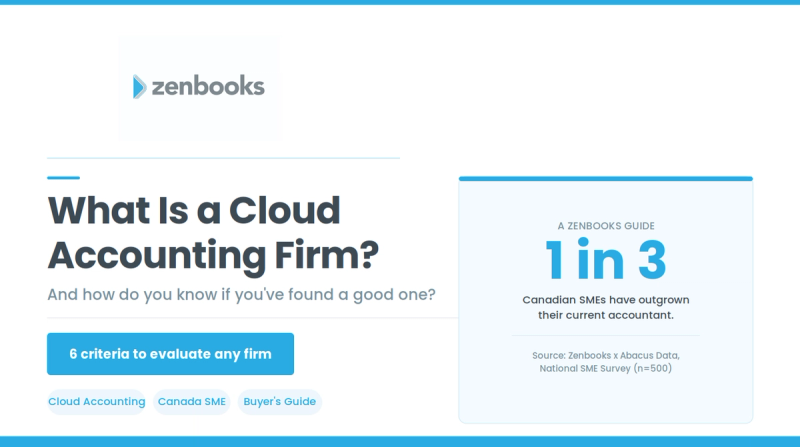
The Zenbooks Technology in Accounting study, conducted in partnership with Abacus Data across 500 Canadian SMEs, found that only 32% of small business owners are very satisfied with how their accounting and bookkeeping needs are being handled. One in three say they have outgrown their current accountant. That is not a minor complaint. That is a structural gap between what Canadian businesses need from their financial partners and what most traditional accounting relationships actually deliver.
Cloud accounting firms were built specifically to close that gap.
What working with a cloud accounting firm actually looks like
This is the part most definition articles skip. When you work with a genuine cloud accounting firm, here is what the day-to-day experience looks like.
- Your documents flow digitally from day one. Receipts, bills, invoices, and bank statements are captured through tools like Dext or HubDoc, which read the data automatically and push it into your accounting software. You are not emailing PDFs to an assistant and hoping they process it before month end.
- Your books are reconciled on a rolling basis. Rather than a scramble every March, a cloud accounting firm closes your books monthly. You get reporting shortly after month end, every month, on a predictable schedule.
- You have a real communication channel. Not a generic inbox. A dedicated point of contact, a defined response time, and a process for flagging anything urgent. You should know who handles your file and how to reach them.
- You have a client portal. Secure document sharing, e-signatures, and access to your own financial data without having to call anyone. Your information is available to you, not locked in someone else's filing cabinet.
Six criteria to evaluate any cloud accounting firm
The term "cloud accounting firm" has become marketing language. Almost every firm uses it now. Here is how you separate genuine cloud-native practices from firms that have added the phrase to their homepage.
1. Ask about their tech stack, specifically.
A real cloud accounting firm should be able to name the software it uses for bookkeeping, document capture, payroll, reporting, and communication, and explain how those tools connect. Vague answers about "using the latest technology" are a red flag. You want specifics: Xero or QBO, Dext or HubDoc, Wagepoint or Payworks, Spotlight or Fathom. If they cannot walk you through their stack in two minutes, they probably do not have one.
2. Ask how monthly reporting works.
Specifically: when does the month close, when do you receive reports, what format do those reports take, and who reviews them with you? A cloud accounting firm should have a defined process with clear timelines. If the answer is "we send something out when it's ready," you are probably looking at a traditional firm with a modern website.
3. Ask whether they outsource work offshore.
Some firms that position themselves as cloud-native are actually sending client work to overseas contractors to reduce costs. There is nothing inherently wrong with global teams, but you deserve to know where your financial data is being processed and who has access to it. A firm that has not considered this question is not as operationally rigorous as it claims. You could also choose to hire the offshore team directly and avoid the Canadian firm.
4. Ask about pricing transparency.
Does the firm publish its pricing, or at least describe packages clearly in an initial conversation? Cloud accounting firms tend to use fixed monthly fees rather than hourly billing, which removes the anxiety around "how much will this cost if I ask a question?" If the pricing conversation feels evasive, the relationship probably will too.
5. Look for independent evidence of client outcomes.
Case studies with actual client names and real numbers are a strong signal. Any firm can write a testimonial. Far fewer firms publish detailed case studies showing what they found, what they did, and what changed. For example, a Zenbooks client in corporate travel grew from $5M to over $20M in revenue over four years. A Zenbooks e-commerce client scaled from $156K to over $12M annually after building out proper financial infrastructure. Those are not marketing claims. They are documented, client-approved outcomes.
6. Check public signals of quality independently.
Look at client reviews, third-party ratings, awards, published research, and reputable media coverage. A firm that invests in original research, earns media recognition, and receives candid public reviews is demonstrating something about its commitment to the work. Being ranked on national growth lists, cited in journalism, or recognized by industry bodies are verifiable signals, not self-reported ones.
The one thing most buyers get wrong
Most business owners evaluate accounting firms on price first and credentials second. Almost none of them ask detailed questions about workflows until they are already six months into a frustrating relationship.
The most common complaint we hear from business owners who are switching firms is some version of: "I had no idea what was happening with my books until it was too late to fix it." That is not a price problem. It is a process problem. And process is exactly what separates a genuine cloud accounting firm from a traditional one operating under a new label.
Before you choose, run through the six criteria above. Ask the operational questions. Push for specifics. A firm that cannot answer clearly probably cannot deliver clearly either.
Frequently asked questions
What is the difference between a cloud accounting firm and an online bookkeeper?
An online bookkeeper typically handles transaction entry and basic reconciliation. A cloud accounting firm provides a broader scope: full-cycle accounting, tax planning and compliance, payroll, advisory, and often fractional CFO or controller support. The key distinction is whether the relationship is purely transactional or whether someone is actively helping you understand and improve your financial position.
Is a cloud accounting firm a good fit for every small business?
Not necessarily. If you need in-person meetings regularly, prefer paper-based processes, or have very complex assurance requirements (such as public company audits), a traditional or larger regional firm may be a better fit. Cloud accounting firms are best suited for businesses comfortable working digitally, who want modern workflows, real-time reporting, and a proactive ongoing relationship.
How do cloud accounting firms keep my financial data secure?
Reputable cloud accounting firms work exclusively with platforms that maintain SOC 2 compliance, one of the most rigorous standards for data security. They also operate under Canadian privacy legislation (PIPEDA), use encrypted document portals, and conduct ongoing employee training on data handling. If a firm cannot describe its security practices in concrete terms, that is worth probing further.
Does working with a cloud accounting firm mean I lose the personal relationship?
The opposite, typically. Because cloud firms are not constrained by geography, they can assign dedicated team members to your account and maintain more consistent communication than a traditional firm where you see your accountant once a year at tax time. The relationship tends to be more structured, more documented, and more responsive.
What software do cloud accounting firms typically use in Canada?
The most common base platform is Xero or QuickBooks Online. Beyond that, a fully integrated cloud firm will typically layer in tools for document capture (Dext, HubDoc), payroll (Wagepoint, Payworks), reporting (Spotlight, Fathom), accounts payable automation (Plooto, ApprovalMax), and client communication. The specific stack matters less than whether the tools are integrated and the workflows are consistent.
How much does a cloud accounting firm cost in Canada?
Pricing varies significantly based on business size, transaction volume, and service scope. Most cloud accounting firms use fixed monthly fees rather than hourly billing, which provides predictability. Entry-level bookkeeping packages may start in the range of a few hundred dollars per month, while full-service accounting with tax planning and advisory typically runs higher. Look for firms that publish pricing openly or walk you through it clearly in an initial conversation.
The bottom line
A cloud accounting firm is not a firm that uses cloud software. It is a firm that was built from the ground up to deliver accounting services digitally, in real time, with workflows and communication designed to give you clarity on a monthly basis, not a crisis once a year.
If you are a Canadian small business owner who is tired of finding out about tax problems in April, waiting weeks for basic financial information, or feeling like your accountant does not really know your business, a cloud accounting firm is almost certainly the right model for you.
The question is just which one.
If you want to see how Zenbooks approaches this, read what our clients say, look at how we work with businesses like yours, or book a call to walk through your situation.

Eric Saumure, CPA, CA, is co-founder and Principal of Zenbooks, an online cloud-native accounting firm started in 2015 to serve 300+ Canadian small and mid-sized businesses. Before Zenbooks, Eric spent 3 years at KPMG. He specializes in financial strategy for growth-stage companies in the $1M-$10M revenue range, with a particular focus on marketing and creative agencies, SaaS, and professional services firms, e-commerce and non-profits.
Eric's commentary on Canadian small business, tax policy, and open banking has appeared in the Toronto Star, Canadian Press, CTV, CBC, Le Devoir, Policy Options, The Conversation, and Canadian Accountant. He was named to the OBJ Ottawa Forty Under 40 and recognized on both the Financial Times Americas' Fastest Growing Companies 2026 list and the Globe and Mail's Report on Business Top Growing Companies 2024. He is the principal researcher behind the Zenbooks Technology in Accounting Study, a national survey of 500 Canadian SMEs on accounting technology adoption, and the founder of OpenSME, a Canadian open banking advocacy organization. He serves on the board of Cystic Fibrosis Canada and member of the Montfort Hospital Association.
Subscribe for Updates


Business Clarity That Helps You Breathe Easy
Achieve your business goals and peace of mind with Zenbooks. As both your finance team and business advisor, we empower you every step of the way.
