


When Do You Need a Fractional CFO vs a Bookkeeper?

If you are running a business somewhere between $1M and $10M in revenue, there is a good chance you have outgrown your current finance setup without quite knowing it yet. In fact, 21% of Canadian SMEs say they have outgrown their current accountant, according to the Technology in Accounting study by Zenbooks conducted with Abacus Data. You might have a bookkeeper, or someone who used to be a bookkeeper and now does a bit more, or an accountant who shows up at year end and files your taxes. And at some point you started wondering: is this enough?
The honest answer is probably not. But the fix is not always a fractional CFO. And it is rarely just a better bookkeeper.
This post is organized around the moments that actually trigger this question, the specific situations business owners find themselves in when they start wondering whether what they have is working. Read through them and see which ones sound familiar. By the end, you will know exactly what you need and why.
One thing before we start: none of this is your fault. The accounting industry has done a poor job explaining what these roles actually do and where one ends and the other begins. Business owners are not supposed to know this stuff, your job is to run the business, not design a finance function. That is ours.
The symptom diagnostic: what you're experiencing and what it means
Below are the eight situations we hear most often from business owners in the $1M to $10M range. Each one maps to a specific gap in their current finance setup.
1. "My bookkeeper just does data entry. I need more than that."
What this means: You have someone categorizing transactions and reconciling bank accounts. That is useful, but it is not financial management. You have clean data and no insight from it, like having a full pantry and no one who can cook.
What you need: A cloud accounting firm with accountants (not data entry clerks) who review your books monthly, validate what the software produces, and can actually explain what your numbers mean. At Zenbooks, we do not hire bookkeepers. We hire accountants who do what bookkeeping software cannot (review, validate, interpret, and advise).
2. "I can never get my bookkeeper on a call. I just want to talk to someone who knows finance."
What this means: This is more common than you would think, and it is not a personality flaw in your bookkeeper. The traditional bookkeeping model was never built around communication. It was built around transaction processing. If you want a genuine conversation about your business finances, you need someone whose job description includes that conversation.
What you need: A firm where the person managing your books is also the person who talks to you about them. This sounds obvious, but it is surprisingly rare. The person who knows your numbers should be the person answering your questions, not routing you to a support inbox.
3. "I have a few ad-hoc projects I need done, like fixing my inventory reconciliation."
What this means: Inventory reconciliation done wrong is one of the most dangerous quiet problems in a product business. It understates your costs of goods sold, overstates your margins, and makes you think you are more profitable than you are. Ad-hoc cleanup projects like this are not bookkeeping, they require an accountant who understands how inventory flows through a chart of accounts.
What you need: A firm that can absorb project-based work within an ongoing engagement. Monthly accounting relationships are where these problems surface naturally because someone is looking at your books every month with fresh eyes, not just once at year end.
4. "I want to move to accrual accounting, not just cash coding."
What this means: Cash-basis accounting records money when it hits or leaves your bank account. Accrual accounting records revenue when it is earned and expenses when they are incurred regardless of when the cash moves. For most businesses over $1M, accrual gives a dramatically more accurate picture of financial performance. If you are still on cash, you are making decisions based on an incomplete view.
What you need: An accountant who can migrate you to accrual and maintain it properly. This is not a bookkeeping function, it requires understanding of revenue recognition, prepaid expenses, accounts receivable, and deferred revenue. It is the kind of setup work that pays for itself immediately in better decision-making.
5. "I have never done a budget before."
What this means: A budget is not a nice-to-have. It is the document that tells you whether the business decisions you are about to make are financially viable. Without one, you are navigating without a map. You do not know whether you can afford the hire you are considering, whether your pricing covers your overhead, or whether the revenue target you set for Q3 is actually achievable.
What you need: A virtual controller or fractional CFO engagement, depending on your complexity. Budget creation, not just monitoring, but actually building the budget from scratch, sits at the controller-to-CFO boundary. If you are under $7.5M with no board or investors, a strong controller engagement will get this done. If you have investors or a board expecting a formal budget presentation, you need CFO-level support.
6. "I am always stressed about cash. I never know if I have enough."
What this means: Cash anxiety is almost never a cash problem at its root. It is an information problem. You do not have visibility into what is coming in, what is going out, and when. So your brain fills the gap with dread. A 13-week cash flow model does not just show you the numbers. It converts anxiety into a specific, actionable picture: here is what your cash position looks like on March 31st, here is the gap, here are your options.
What you need: A virtual controller with cash flow monitoring as part of the monthly engagement. This is core controller work, not CFO-level strategy, just proper visibility. Most business owners who have had this for six months tell us the anxiety largely disappears. Not because their cash position magically improved, but because they can see it clearly.
7. "I am making money on paper but I have no cash."
What this means: This is one of the most disorienting experiences a business owner can have. Your P&L says you are profitable. Your bank account says otherwise. There are several well-understood reasons this happens: slow-paying clients inflating your receivables, inventory tying up cash, loan repayments that reduce cash but not profit, or timing differences between when you bill and when you collect.
What you need: An accountant who can diagnose the specific cause and fix it. Not just explain that it happens. This is where a proper monthly accounting engagement earns its fee immediately. The answer to "why am I profitable but have no cash" is almost always visible in a well-maintained set of books. You just need someone who knows where to look and show you the difference between cash and income statements(debt repayment, amortization, shareholders draws, AR/AP cycles, investments, etc).
8. "I have a term sheet, a board meeting, or an investor asking for financials."
What this means: This is the clearest trigger for fractional CFO services. Investors and boards do not want to see QuickBooks exports. They want structured reporting packages, board-ready presentation of your financials, and a financial story that supports your valuation. If you are in this situation, you need CFO-level advisory, and you likely need a solid controller foundation in place first for the numbers to be credible.
What you need: Fractional CFO services, specifically investor and board reporting. This is where the strategic layer of financial leadership becomes non-negotiable. Contact Zenbooks directly if this is your situation, timing matters.
Not sure which situation you are in? Take the Zenbooks Financial Clarity Assessment. It takes two minutes and gives you an instant read on where your business stands financially.A word about the word "bookkeeper"
This section is going to sound a little blunt, and we mean it kindly.
"Bookkeeper" as a professional category covers an enormous range of actual capability. At one end, you have someone who learned to use QuickBooks over a weekend and now codes transactions for $25 an hour. At the other end, you have someone who has been doing this for twenty years and could run the finance function of a mid-sized company.
The problem is that both are called bookkeepers, and business owners have no way to tell them apart until something goes wrong.
The larger problem is that modern cloud accounting software has automated most of what bookkeeping used to mean. Bank feeds import transactions automatically. Rules categorize them. Reconciliation happens in minutes. What the software cannot do is review what it produced, validate that it makes sense, catch the categorization errors, and sit down with you to explain what you are looking at.
At Zenbooks, we do not hire bookkeepers. We hire accountants who do what the software cannot. The software handles the data entry. The accountant handles everything that requires a brain (reviewing, validating, interpreting, advising). We think of traditional bookkeeping as a survival mode: useful in the early days, but insufficient once a business reaches the point where financial decisions start having real consequences.
If you are at $1M or above in revenue, you are past the point where data entry is enough. You need someone who can look at what the software produced and tell you whether it is right, what it means, and what you should do about it.
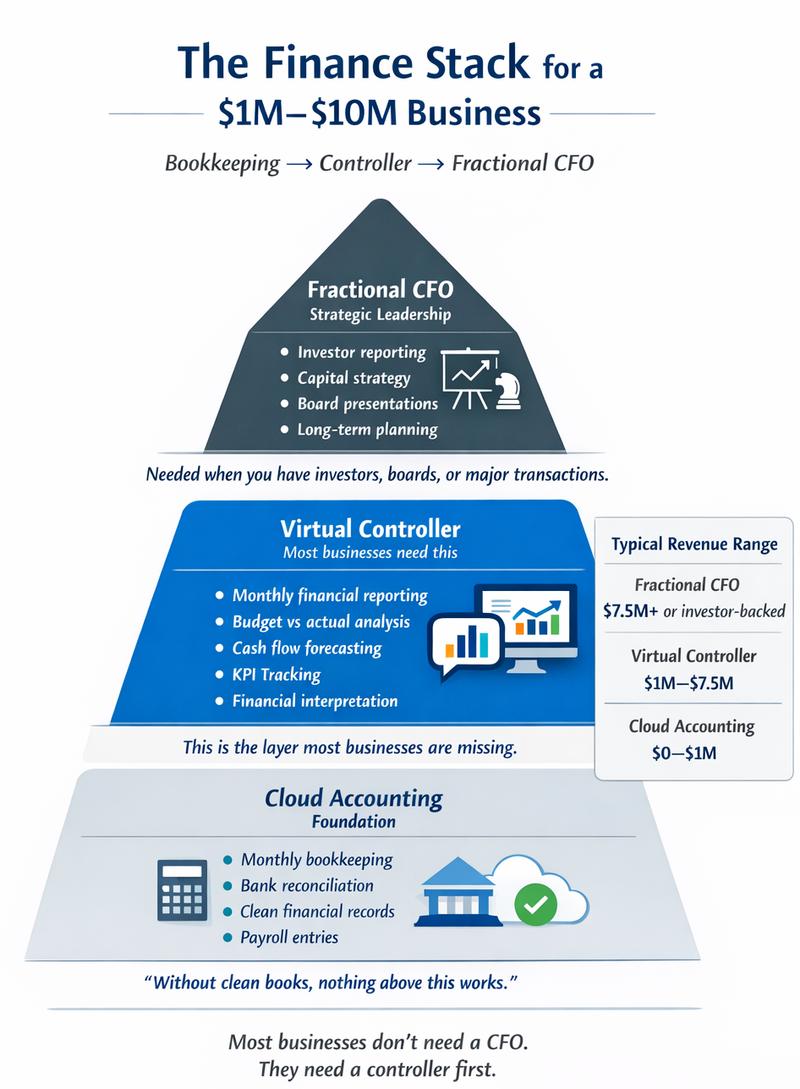
The three layers every growing business needs
Most business owners think about this as a binary: bookkeeper or CFO. The reality is a spectrum with three distinct layers, and the most common mistake is skipping the middle one.
Layer 1: Cloud accounting (this is your foundation)
Monthly bookkeeping done properly in a cloud platform like Xero or QuickBooks Online. Bank reconciliation, transaction coding, payroll journal entries, clean books every month. This is table stakes. Without it, nothing above it works. And it needs to be done by an accountant reviewing the output of the software, not just someone running the software.
Layer 2: Virtual controller (this is what most businesses are missing)
Monthly reporting, budget vs actual analysis, cash flow monitoring, variance analysis, KPI tracking, and the ability to answer the question: what is actually happening in my business right now? This is the layer that converts clean books into financial intelligence. Yet most businesses never receive this level of support. According to the Technology in Accounting study by Zenbooks, only 9% of SMEs using an external accounting provider receive cash flow projections and only 6% receive regular monthly check-ins. For most businesses between $1M and $7.5M, this is also the layer that does the work commonly mislabeled as "fractional CFO."
The virtual controller is the person you can call. The person who reads your numbers and tells you what they see. The person who notices that your margins in one service line have been declining for three months and brings it to your attention before it becomes a crisis.
For example Zenbooks acted as a Controller for Justin Thomason from West of Main (leading interior design firm in Ottawa) and he mentioned “...wouldn’t be where we are without them{Zenbooks}. They’re a key component of our success…”. That’s the power of a real controller.
Layer 3: Fractional CFO (this is for specific situations)
Strategic financial leadership: capital structure, investor relations, board reporting, cash runway modeling, long-range planning, exit preparation. This layer is not for every business. It is for businesses with specific triggers: a board, investors, an imminent transaction, or revenue complexity that requires a dedicated strategic finance function.
Most businesses in the $1M to $7.5M range need layers one and two working well before layer three adds meaningful value. A fractional CFO building strategy on top of messy books is an expensive way to not solve the underlying problem.
The honest version: If you are stressed about cash, cannot explain your own P&L, have never had a budget, and are not sure what your margins actually are, you do not need a fractional CFO yet. You need a proper accounting foundation and a virtual controller. Get that working first. The strategic conversations become much more productive when the numbers are clean and someone is watching them every month.
Zenbooks operates in the space between bookkeeping and full CFO services. If your business is between $1M and $10M in revenue and you want to see what proper financial management looks like, book a free consultation.
How to know which layer you are missing
A quick self-assessment. Answer these honestly.
You are missing Layer 1 (the accounting foundation) if:
• Your books are months behind
• You are not sure if your bank accounts are reconciled
• You do not know what software your bookkeeper uses or whether it is current
• Your accountant spends most of your annual meeting doing cleanup rather than planning
• You have not seen a P&L or balance sheet since last year end
You are missing Layer 2 (the virtual controller) if:
• You have clean books but no one explains them to you
• You do not have a monthly budget to compare your actuals against
• You are always anxious about cash with no forward visibility
• You cannot get your current accountant on a call to talk through your numbers
• You have no idea whether your margins are healthy for your industry
• You have never had a conversation with your accountant that started with "here is what I am seeing in your business"
You are ready for Layer 3 (fractional CFO) if:
• You have clean books and a controller function that is working
• You have investors, a board, or a lender that expects formal reporting
• You are actively raising capital or planning a significant transaction
• You are building a long-range financial plan for a strategic pivot or acquisition
• Revenue is above $7.5M and financial complexity has grown to match
The bottom line
You are not supposed to know all of this. The accounting profession has made its own structure unnecessarily confusing, and most of the marketing in this industry makes it worse by using "fractional CFO" to describe everything from data entry to strategic financial leadership.
Here is the simplest version of the answer:
• If your books are a mess, start with a proper accounting foundation.
• If your books are clean but no one is telling you what they mean, you need a virtual controller.
• If you have investors, a board, or a major transaction on the horizon, you need fractional CFO services.
• If you are somewhere between $1M and $7.5M in revenue with none of the above triggers, a strong virtual controller engagement will solve 90% of the problems you are experiencing.
Most of the business owners who come to us thinking they need a fractional CFO actually need a great controller. Most of the ones who come thinking they just need a better bookkeeper actually need the same thing. The good news is that the solution is the same either way and it is more accessible than most people think.
FAQs
Do I need a fractional CFO or a controller?
Most businesses do not need a fractional CFO first.
A controller focuses on the operational side of finance. They manage monthly financial reporting, budgeting, cash flow forecasting, and financial analysis. Their job is to help you understand what is happening in the business right now.
A fractional CFO focuses on strategic financial leadership such as investor relations, capital planning, board reporting, and long-term financial strategy.
For many businesses between $1M and $7.5M in revenue, a controller provides the financial visibility and decision support owners are looking for before CFO-level strategy becomes necessary.
What is the difference between a controller and a fractional CFO?
A controller manages the day-to-day financial management of the business, while a fractional CFO focuses on long-term financial strategy.
A controller typically handles monthly reporting, budgeting, variance analysis, and cash flow monitoring. Their role ensures the financial information in the business is accurate and useful for decision making.
A fractional CFO usually becomes involved when a company has investors, a board of directors, or complex financial decisions such as fundraising, acquisitions, or exit planning.
When should a small business hire a fractional CFO?
Small businesses usually consider a fractional CFO when financial complexity increases.
Common triggers include raising capital, preparing board reports, managing lender relationships, planning an acquisition, or building a long-term financial model for growth.
Before this stage, most businesses benefit more from a strong accounting foundation and controller-level support that provides consistent financial visibility and guidance.
Can a bookkeeper replace a controller?
A bookkeeper and a controller perform very different roles.
A bookkeeper focuses on recording financial transactions and maintaining accurate books. A controller analyzes those records and converts them into financial insights through reporting, budgeting, and forecasting.
As a business grows, the need usually shifts from transaction recording to financial interpretation. That is where controller-level support becomes valuable.

Colin Robinson is co-founder and Principal of Zenbooks, which he built starting in 2015 into one of Canada's leading cloud accounting firms for small and mid-sized businesses. He leads Zenbooks' CFO advisory practice, working directly with founders and executive teams on financial strategy, cloud migration, and the kind of complex, non-standard situations that fall outside the playbook.
Before co-founding Zenbooks, Colin worked at Ernst & Young, one of the world's leading professional services firms. He holds a Bachelor of Commerce in Accounting.
Over a decade building and running Zenbooks, Colin has advised hundreds of Canadian entrepreneurs, from solo founders scaling past their first million to established businesses navigating ownership transitions and operational restructuring. His commentary on small business financial strategy has appeared in Le Droit.
Subscribe for Updates


Business Clarity That Helps You Breathe Easy
Achieve your business goals and peace of mind with Zenbooks. As both your finance team and business advisor, we empower you every step of the way.
