


Why Profitable Canadian Marketing Agencies Are Moving Away From Traditional Accountants

Here is a finding from our national research that most agency owners have never heard, but probably should have.
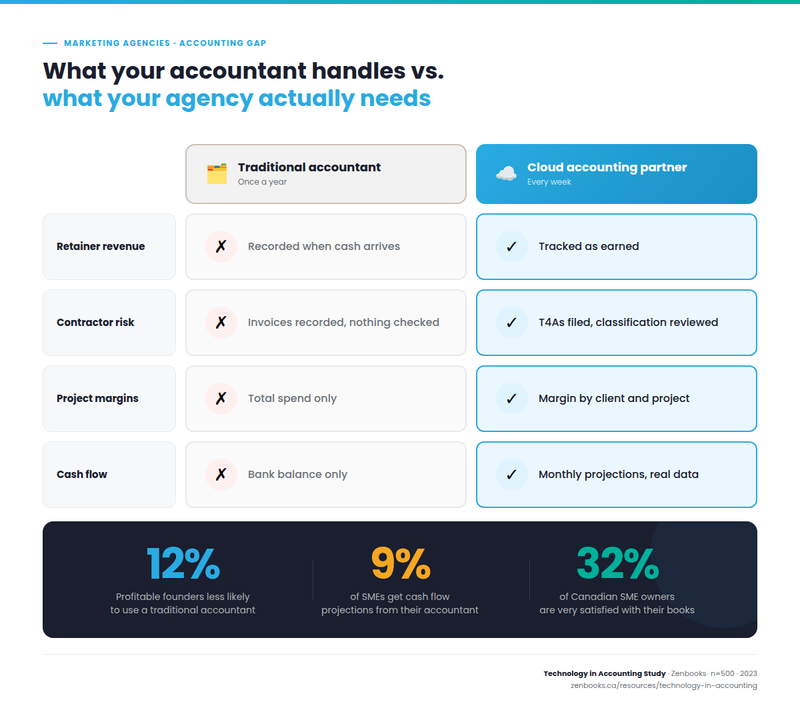
Canadian business owners who describe themselves as very or fairly profitable are 12% less likely to use a traditional accountant than those who are breaking even or losing money.
That number comes from the Zenbooks Technology in Accounting study, a national survey of 500 Canadian SME owners conducted in partnership with our research partner Abacus Data. It is a correlational finding, not a causal one. But across 500 businesses, the pattern is consistent enough to pay attention to.
The most successful founders in Canada's small business sector have, disproportionately, already moved away from the traditional model. And for marketing and creative agencies specifically, that move is not just a preference. It reflects something real about how agencies earn money, manage people, and carry risk that a traditional accounting relationship is structurally unable to address.
This post is about why.
What "Traditional Accounting" Actually Means for an Agency
Before we get into the agency-specific issues, it is worth being clear about what we mean by traditional accounting, because the term gets used loosely.
A traditional accounting relationship looks like this: you have an accountant or bookkeeper who files your taxes at year end, possibly handles some monthly bookkeeping, and is available by email when something comes up. You see them once or twice a year. They work from your records. Their primary deliverable is compliance.
That model works reasonably well for a business with simple, predictable revenue. A retail store. A restaurant. A trades company that invoices clients on completion. Revenue comes in, expenses go out, the accountant reconciles the books and files accordingly.
It does not work for a marketing agency. Not because the accountant is incompetent, but because the traditional model was not designed for a business where revenue recognition is genuinely complex, where 40% of your workforce might be contractors with specific compliance obligations, and where the gap between your bank balance and your actual financial position can be significant on any given day.
The profitable agency owners who have moved to a cloud accounting model did not do so because it was trendy. They did it because the traditional model kept failing them in specific, recurring ways.
The Revenue Recognition Problem
The most fundamental issue with traditional accounting for agencies is how revenue gets recorded.
Most agencies operate on a mix of retainer and project-based revenue. A client pays a $12,000 monthly retainer. An agency lands a $60,000 brand project invoiced in three milestones. Another client pays a flat fee upfront for a six-month campaign.
Each of these structures requires different treatment in the books. And in almost every case when we onboard a new agency client whose books were handled by a generalist, the treatment is wrong in the same direction: revenue is recorded when cash is received, not when it is earned.
Under Canadian accounting standards, and consistent with CRA's guidance on income recognition, revenue is recognized when the service has been performed. A retainer payment received on the first of the month is not revenue. It is a liability, a deposit against services that have not yet been delivered. It belongs on the balance sheet as deferred revenue until the work is done.
When a bookkeeper skips this step, the income statement overstates revenue in the current period. Profitability looks higher than it is. Decisions get made on numbers that do not reflect reality. And when a client cancels mid-engagement, the agency may owe a refund that the books show no obligation for.
We see this at onboarding more often than not. Agencies that believe they are running at 20% net margin discover, after we restate the books properly, that they are closer to 11% or 12%. They were not unprofitable. But they were making hiring decisions, pricing decisions, and growth investments based on a number that was systematically inflated.
"Revenue recognition is a persistent issue for agency owners," says Jessica Wong, CPA, CA, Director of Operations at Zenbooks. "Most know intuitively that their numbers are off, but they lack the roadmap to fix it. There is a dangerous assumption that financial records reflect what has been earned, when in reality, they often only show what has been collected. Confusing the two creates a massive blind spot, obscuring visibility over their cash inflows, outflows, and true profitability."
The Contractor Compliance Risk Most Agencies Are Carrying
Marketing agencies run on contractors. Copywriters, designers, media buyers, developers, videographers. The flexible labour model is core to how agencies scale, and it is also one of the most significant areas of compliance risk for any agency that has been growing without specialist accounting support.
There are three contractor problems we encounter consistently when onboarding agency clients, and all three tend to be invisible until something goes wrong.
Worker misclassification. The CRA does not care what your contract says. They look at how the work actually functions: who controls the hours, who owns the tools, whether the worker has genuine financial risk, whether they work for other clients. Agencies frequently have contractors who work exclusively for them, take direction on schedule, use agency-provided software, and operate in every meaningful way as employees. CRA can and does reclassify these workers retroactively, resulting in back CPP contributions, EI premiums, and penalties. Our post on employees vs. contractors for agencies covers the classification criteria in detail. It is worth reading before your next contractor review.
T4A compliance gaps. Any Canadian resident contractor paid $500 or more for services in a calendar year requires a T4A slip, filed with CRA by the last day of February. This is not a grey area. It is a CRA compliance requirement that many agencies simply do not meet because their generalist bookkeeper does not track it proactively. Missed T4As carry penalties and create exposure in an audit.
Cross-border contractor obligations. Canadian agencies increasingly work with contractors in the United States, Latin America, and Europe. Payments to non-residents may trigger withholding tax obligations under the Income Tax Act, depending on the nature of the services and the applicable tax treaty between Canada and the contractor's country of residence. Most generalist bookkeepers are not equipped to identify when this applies, and most agency owners have never been told it could.
None of these risks are exotic. They are standard compliance considerations for a contractor-heavy business. But they require someone who knows what to look for, not someone who records invoices and moves on.
Project Costs Without Project Visibility
Here is the profitability problem that sits just below the revenue recognition issue.
An agency pays a contractor $5,000 to execute a campaign. The invoice gets recorded as a subcontractor expense. But no one codes it to the specific project it belongs to. The result: you know your total contractor spend for the month. You have no idea whether any individual project made money.
This is a job costing problem, and it is endemic in agencies whose books were set up by a generalist. When contractor invoices are coded to a single expense account rather than to the projects they relate to, your profit and loss statement becomes a summary of what you spent. It stops functioning as a management tool. You cannot identify which clients are profitable and which are not. You cannot see which project types deliver the best margin. You cannot make pricing decisions based on actual data.
According to our research, only 9% of Canadian SMEs using an external accounting provider receive cash flow projections as part of their service. For agencies, where cash flow is directly tied to the accuracy of project-level financial data, this is not a minor gap. It is the difference between running the business on a dashboard and running it on a hunch.
The fix is not complicated: every contractor invoice should be coded to the client and project it belongs to. Every milestone payment should be matched against the costs incurred to deliver it. But it requires a bookkeeper who understands how agency revenue works, not just how to enter transactions.
The HST Layer That Generalists Get Wrong
HST on marketing and creative services is more nuanced than most agency owners realize, and more nuanced than most generalist bookkeepers handle correctly.
Most services a Canadian agency provides to a Canadian client are taxable supplies, and HST must be collected at the applicable rate. But agencies regularly work with clients in different provinces, which means the place of supply rules determine whether you are collecting at the Ontario rate, the Nova Scotia rate, or GST only. These are not interchangeable, and collecting the wrong rate creates either a remittance shortfall or an overcollection that needs to be refunded.
On the expense side, agencies are entitled to claim input tax credits on HST paid on business expenses, including contractor invoices. But if contractor invoices are not being tracked properly, or if invoices from contractors who are not GST-registered are being processed without confirming their status, the ITC claims can be inaccurate in either direction.
The CRA's guidelines on GST/HST for service businesses are the authoritative reference here. The short version is that the rules are specific, the consequences of getting them wrong accumulate over time, and a generalist bookkeeper who applies a blanket 13% to every invoice is not meeting the standard.
What the Shift Actually Looks Like
LouLou Lounge Furniture Rental and Chic + Swell Event Design are two Ottawa-based event companies run under the same ownership. When they came to Zenbooks in August 2025, they needed more than a bookkeeper. They needed someone who could handle accounting across two corporations, overhead allocation between entities, payroll for eleven staff, HST filings, T2 returns, and fractional controller oversight, all running simultaneously.
That is exactly the kind of financial complexity a traditional once-a-year accountant cannot service. The scope requires weekly reconciliation, monthly Zoom reviews, accounts payable processed on a bi-weekly cycle, and a controller-level eye on revenue recognition and cash flow statements.
Sébastien Hanssens, their marketing and business development manager, put it plainly in a recent review: "Zenbooks' versatility, responsiveness, knowledge, and friendliness are impressive."
What changed for their business was not the complexity of the work. It was having a team that could keep up with it. When your books reflect what you have actually earned rather than what you have collected, when your cash flow projections are built on real deferred revenue data, and when your contractor and payroll obligations are handled correctly across multiple entities, you are running on real numbers.
The full reviews from Zenbooks' agency and professional services clients are worth reading if you want a ground-level sense of what this shift looks like from the owner's perspective. Jake Naylor of Whiskeyjack Media put it simply: "Wishing I would have called them sooner."
That is the most common sentiment we hear from agency owners who make the switch. Not that the transition was difficult. That they waited too long.
Why the 12% Finding Points Exactly Here
Return to the finding we opened with. Profitable Canadian SME owners are 12% less likely to use a traditional accountant. The Technology in Accounting study does not tell us why that relationship exists. But the pattern we see across our agency client base gives a clear picture.
The agencies running at healthy margins are the ones where revenue is recognized correctly, where project costs are tracked against the projects that incurred them, where contractor compliance is current, and where the owner has a real-time view of cash flow that reflects actual obligations, not just bank balances.
That level of financial infrastructure is not available in a once-a-year tax filing relationship. It requires ongoing, weekly bookkeeping, monthly reporting, and an accounting team that understands the agency model well enough to know which questions to ask.
Traditional accounting keeps you compliant. A cloud accounting partner keeps you informed. For a marketing agency trying to grow, there is a meaningful difference between the two.
Albert Park, CPA, CA, CPA (IL), MTax, Senior Tax Manager at Zenbooks, frames it in terms of what gets missed. "With agency clients who come to us after years at a traditional firm, we almost always find deferred revenue that was never tracked, T4As that were never issued, and contractor relationships that have never been reviewed for classification risk. None of it is intentional. It is just what happens when a business with a complex revenue model is served by a generalist who sees them once a year."
FAQs
Why do profitable agencies use cloud accounting firms instead of traditional accountants?
The Zenbooks Technology in Accounting study of 500 Canadian SMEs found that profitable business owners are 12% less likely to use a traditional accountant than those who are breaking even or unprofitable. For agencies specifically, the reason is structural: traditional accounting is built around year-end compliance, while agency finances require ongoing revenue recognition, project cost tracking, contractor compliance, and real-time cash flow visibility. The businesses that prioritize financial infrastructure tend to make better decisions and carry less undetected risk.
What is deferred revenue and does my agency need to track it?
Deferred revenue is money you have collected but not yet earned. For a retainer-based agency, this means client payments received before the work has been delivered. Under CRA's income recognition requirements, revenue must be recognized when the service is performed, not when cash is received. If your bookkeeper records retainer payments as revenue on receipt, your income statement overstates earnings and your balance sheet is missing a real liability. Yes, every retainer-based agency needs to track deferred revenue.
How do I know if my contractors are correctly classified under CRA rules?
CRA looks at four main factors: control over how and when work is done, ownership of tools and equipment, financial risk borne by the worker, and whether the worker is integrated into your business. If a contractor works exclusively for you, follows your schedule, uses your software, and has no meaningful financial risk, CRA may classify that as employment regardless of what your contract says. Our post on employees vs. contractors covers the classification criteria in plain language. If you have contractors who fit the description above, a review before your next CRA interaction is worth doing.
Am I required to issue T4As to my contractors?
Yes. If you paid a Canadian resident contractor $500 or more for services in a calendar year, you are required to issue a T4A slip and file it with CRA by the last day of February following that calendar year. This applies whether the contractor invoiced you as a business or as an individual. Missing T4As carry penalties and create exposure in a CRA audit. Many agencies are not meeting this requirement because their bookkeeper does not flag it proactively. For many years CRA did not issue penalties for this.
How does poor bookkeeping affect my agency's cash flow?
Cash flow forecasting for an agency depends on accurate financial data: your deferred revenue balance tells you what you have collected but not yet earned, your project-coded expenses tell you what each engagement actually cost, and your work-in-progress tells you what you have delivered but not yet invoiced. If your books are inaccurate in any of these areas, your cash flow forecast is built on wrong inputs. The result is what most agency owners describe as being profitable on paper but always short on cash. Accurate books do not solve the underlying cash flow complexity, but they give you the foundation to manage it.
Is Zenbooks a good fit for a marketing or creative agency?
We work with founder-led marketing agencies, creative firms, and professional services businesses across Canada. Our marketing and creative agencies page covers what that looks like in practice. We are selective about who we work with, and our ICP post is the clearest explanation of the type of agency we are built for.
Ready to find out where your agency actually stands? The Zenbooks Financial Clarity Assessment takes two minutes and gives you an immediate read on your financial infrastructure across five dimensions.

Eric Saumure, CPA, CA, is co-founder and Principal of Zenbooks, an online cloud-native accounting firm started in 2015 to serve 300+ Canadian small and mid-sized businesses. Before Zenbooks, Eric spent 3 years at KPMG. He specializes in financial strategy for growth-stage companies in the $1M-$10M revenue range, with a particular focus on marketing and creative agencies, SaaS, and professional services firms, e-commerce and non-profits.
Eric's commentary on Canadian small business, tax policy, and open banking has appeared in the Toronto Star, Canadian Press, CTV, CBC, Le Devoir, Policy Options, The Conversation, and Canadian Accountant. He was named to the OBJ Ottawa Forty Under 40 and recognized on both the Financial Times Americas' Fastest Growing Companies 2026 list and the Globe and Mail's Report on Business Top Growing Companies 2024. He is the principal researcher behind the Zenbooks Technology in Accounting Study, a national survey of 500 Canadian SMEs on accounting technology adoption, and the founder of OpenSME, a Canadian open banking advocacy organization. He serves on the board of Cystic Fibrosis Canada and member of the Montfort Hospital Association.
Subscribe for Updates


Business Clarity That Helps You Breathe Easy
Achieve your business goals and peace of mind with Zenbooks. As both your finance team and business advisor, we empower you every step of the way.
