


Project Accounting for Marketing Agencies: The Framework That Finally Makes It Click

Most marketing agency founders can tell you their total revenue. Many can tell you their overall net profit. Almost none of them can tell you, with any confidence, which specific clients are actually making them money and which ones are quietly draining it.
That is not a personal failure. It is an advisory failure. If your accountant has never sat down with you and built a project-level P&L, they have been doing your compliance and leaving one of the highest-leverage financial tools in agency management completely untouched.
Project accounting is the discipline that changes that. It is not bookkeeping. It is not your year-end tax return. It is the framework that connects your revenue, your direct costs, and your people to individual clients and projects, so you can see, with clarity, where your agency actually makes money and where it is hemorrhaging margin without anyone noticing.
Here is how it works, why it matters, and what it should look like in practice for a Canadian marketing or creative agency.
What Project Accounting Actually Is
Bookkeeping records what happened. Project accounting explains why it happened and to whom.
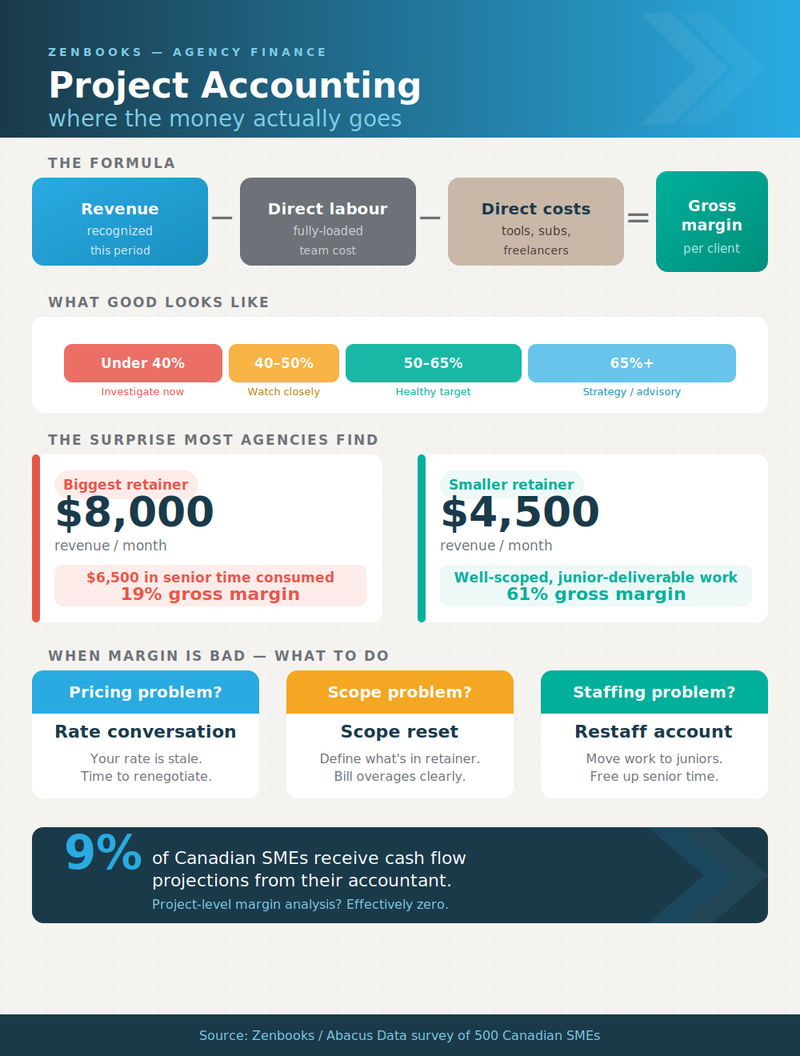
A standard set of books will show you total revenue, total payroll, total software costs, and a bottom line. What it will not show you is that Client A generated $8,000 in revenue last month but consumed $6,500 in senior team time, leaving a 19% gross margin. Or that Client B, who pays a smaller retainer, ran at 61% margin because the work is well-scoped, efficiently delivered, and rarely revised.
Project accounting assigns costs at the client or project level. The key inputs are direct labour (the actual cost of the people doing the work, allocated by time), direct expenses (software, subcontractors, media spend, and any other costs that exist because of that client), and the revenue billed against that work. From those three inputs you get a project-level gross margin, and that number is the most honest signal your agency has about whether a client relationship is worth what it costs you to maintain.
The framework is not complicated. The reason most agencies have never built it is that nobody pushed them to.
The Components of a Project-Level P&L
A clean project-level P&L for a marketing agency has four lines that matter.
Revenue recognized. Not cash collected. Not what was invoiced. Revenue recognized is what was actually earned in the period based on work performed. For retainer clients, this is your monthly retainer value. For project clients, it is the percentage of the project completed multiplied by the contract value. If you are on cash-basis accounting and recognizing revenue when the invoice is paid, your project P&L will always be distorted.
Direct labour cost. This is the fully-loaded cost of your team members allocated to the project, meaning their salary or contractor rate plus benefits and payroll taxes, divided by their billable hours and applied to the hours logged on that client. If a senior strategist costs your agency $85,000 per year and spends 30% of their time on one client, that client is carrying roughly $25,500 in annual direct labour cost. Most agency owners have never calculated that number for a single client, let alone all of them.
Direct expenses. Every cost that exists specifically because of this client: tools, licences, subcontractors, ad spend managed on their behalf, freelancers brought in for overflow. These are not overhead. They are client-level costs and they belong in the project P&L.
Gross margin per project. Revenue minus direct labour minus direct expenses. This is the number that tells you the truth. Industry benchmarks for healthy agency gross margins typically sit in the 50 to 65 percent range for retainer-based creative and digital shops. If a client is running below 40 percent and has been for more than two months, you have a problem worth solving.
Why Your Biggest Client Is Often Your Least Profitable One
This is the pattern we see most often, and it is worth naming directly because it runs counter to almost every agency owner's instincts.
The client paying the largest retainer tends to be the one who demands the most senior time. They have the most revision cycles. They ask questions that require your principals to be involved. Their work is complex, their feedback loops are long, and their retainer rate was set when they first signed, often before you understood the real scope of servicing them.
Meanwhile, the smaller retainer clients who are well-scoped, clear in their briefs, and trust your team to execute are frequently running at dramatically better margins because junior team members can handle the work efficiently with minimal escalation.
When you build a project-level P&L for the first time, it is almost always the same experience: the client you thought was your anchor turns out to be your most expensive relationship to maintain, and the client you almost undervalued is carrying your profitability.
The right response is not always to fire the big client. Sometimes it is a rate conversation. Sometimes it is a scope reset. Sometimes it is restructuring how you staff the account. But you cannot have any of those conversations with any confidence if you are looking at blended agency numbers and guessing.
This is exactly the dynamic that plays out in agencies that grow fast without financial infrastructure. Sterling Sky, a digital marketing consultancy specializing in local SEO, grew from $1M USD in revenue in 2018 to over $5M USD by 2024. When they came to Zenbooks, their financial processes were built around manual spreadsheets and disconnected software. They had revenue. They did not have clarity. Getting that clarity, through proper accounting infrastructure and monthly financial reviews, was foundational to managing a team that scaled from 5 to 40-plus people without losing control of margins.
The Time Tracking Problem You Cannot Ignore
Project accounting only works if you know where your team's time is actually going. This is the part most agencies skip, and it is the reason their project-level numbers remain theoretical.
You do not need a perfect time-tracking culture overnight. You need enough data to make directionally accurate decisions. That means tracking time by client at minimum, and by project or deliverable type where your billing structure makes that useful.
The tools that work well for Canadian marketing agencies in this setup include Harvest, Toggl Track, and ClickUp's time tracking module if you are already using it for project management. The key is that the time data needs to flow into or align with your accounting software so that labour costs can be allocated to client accounts without requiring a manual rebuild every month.
According to Zenbooks' national research on technology in accounting, across 500 Canadian SMEs, 38 percent of Canadian business owners report spending all of their time serving customers and managing day-to-day operations, leaving almost nothing for the financial analysis that would actually improve those operations. Project accounting, properly automated, is the infrastructure that gets you out of that loop.
How to Build This Without Starting From Scratch
If you have never done project-level accounting before, the path forward is incremental.
Start with your top five clients by revenue. Pull the direct costs you can identify: subcontractors, tools, any expenses clearly tied to those accounts. Then do a rough time allocation exercise with your team for a single month, even a manual one. Assign labour costs based on those allocations. Calculate a gross margin for each of the five clients.
That exercise alone, done honestly, will almost certainly surface at least one client relationship that looks different than you expected.
From there, you formalize. Proper project accounting requires accrual-based books, a time tracking system connected to or reconcilable with your accounting software, and a monthly close process that includes a client-level margin report alongside your standard income statement and balance sheet.
This is not something your bookkeeper will build for you automatically. It requires accounting infrastructure, judgment about cost allocation methodology, and someone who understands how agency economics work. Most generalist accounting firms have never built a project-level P&L for an agency client and would not know where to start.
What to Do When the Numbers Are Bad
You will build this framework and at least one client will come back unprofitable or marginal. Here is the decision tree.
First, determine whether the margin problem is structural or temporary. A new client in onboarding, a one-time project with unusual complexity, or a client in a transition period may show compressed margins that will normalize. A client who has been at low margin for six months or more is a structural problem.
Second, identify whether the margin problem is a pricing problem, a scope problem, or a staffing problem. Pricing problems require a rate conversation. Scope problems require a reset of what the retainer covers and what gets billed as an overage. Staffing problems require reallocating who is doing the work.
Third, if none of those levers are available or the client resists all of them, you have your answer. Firing an unprofitable client is one of the highest-leverage financial decisions an agency founder can make. It frees up capacity for better-margin work, reduces the administrative drag of a demanding relationship, and often has an immediate positive effect on team morale. It is also a decision almost no agency owner makes because they are looking at top-line revenue and cannot see the margin underneath it. Most importantly it sets a tone for the team, that they're sanity matters and you're a smart business owner.
Our Zenbooks research found that only 9 percent of Canadian SMEs working with an external accounting provider receive cash flow projections as part of their service. The number receiving project-level profitability analysis is effectively zero. The information gap is real, and it is costing agencies real money in the form of margin erosion they cannot see and decisions they cannot make well.
What the Right Accounting Partner Does Differently
An accounting firm that understands agency economics will do more than file your HST and close your books. They will set up your chart of accounts with client or project segments in mind. They will work with you to select and configure time tracking tools that align with your billing model. They will deliver a monthly report that includes client-level gross margin alongside your standard financials. And they will flag when a client's margin starts trending in the wrong direction before it becomes a crisis.
This is the advisory gap that exists in most agency accounting relationships. The compliance work gets done. The analysis that would actually change how you run the business does not happen.
The Marie Haynes Consulting review on our site captures it well. Her consultancy grew from a solo practice to a team of ten people on payroll. That kind of growth requires financial infrastructure that goes well beyond bookkeeping. It requires someone who can read the numbers and help you make decisions from them.
Frequently Asked Questions
What is project accounting and how is it different from regular bookkeeping?
Bookkeeping records financial transactions at the business level. Project accounting goes a layer deeper, allocating revenue and costs to individual clients or projects so you can calculate gross margin per engagement. For agencies with multiple clients, retainer models, and team members billing time across accounts, project accounting is the difference between knowing your agency is profitable overall and knowing which relationships are actually driving that profitability.
What gross margin should a marketing agency be targeting per client?
Healthy gross margins for Canadian marketing and creative agencies typically fall in the 50 to 65 percent range on a per-client basis, accounting for direct labour and direct expenses but before overhead allocation. Below 40 percent on a sustained basis is a signal worth investigating. The right benchmark also depends on the type of work: production-heavy projects often run thinner than strategy or advisory retainers.
Do I need time tracking software to do project accounting?
Yes, effectively. Without time data, your direct labour allocation will be a rough estimate at best. You do not need a sophisticated system, but you do need your team logging hours by client consistently. Tools like Harvest or Toggl Track integrate cleanly with accounting software and make the monthly reconciliation manageable. If your team resists time tracking, a simplified client-tagging model is a workable starting point.
How often should I be reviewing project-level profitability?
Monthly, as part of your standard financial close. Client-level margin is not a metric to review quarterly or annually. Margin compression tends to build gradually over months as scope creeps, billing rates go stale, and team composition changes. A monthly review gives you enough lead time to address problems before they compound.
Can my current bookkeeper build this for me?
Probably not without guidance. Project accounting requires decisions about cost allocation methodology, chart of accounts structure, and integration between time tracking and accounting systems. A bookkeeper records transactions. Building and maintaining a project-level P&L framework is accounting and advisory work that requires CPA-level judgment about how agency economics translate into financial structure.
When does project accounting become essential versus just useful?
It becomes essential when you have more than three or four active clients, a team of more than three people, and any retainer relationships where scope has the potential to drift. At that point, your blended numbers are too aggregated to tell you anything useful about individual client health. For agencies above $500,000 in annual revenue with a growing team, project-level visibility is not optional if you want to make sound decisions about pricing, hiring, and which clients to pursue.
If you are ready to see what your client-level margins actually look like, book a complimentary consultation with the Zenbooks team. We work with founder-led marketing and creative agencies across Canada and this is exactly the kind of work we do.

Colin Robinson is co-founder and Principal of Zenbooks, which he built starting in 2015 into one of Canada's leading cloud accounting firms for small and mid-sized businesses. He leads Zenbooks' CFO advisory practice, working directly with founders and executive teams on financial strategy, cloud migration, and the kind of complex, non-standard situations that fall outside the playbook.
Before co-founding Zenbooks, Colin worked at Ernst & Young, one of the world's leading professional services firms. He holds a Bachelor of Commerce in Accounting.
Over a decade building and running Zenbooks, Colin has advised hundreds of Canadian entrepreneurs, from solo founders scaling past their first million to established businesses navigating ownership transitions and operational restructuring. His commentary on small business financial strategy has appeared in Le Droit.
Subscribe for Updates


Business Clarity That Helps You Breathe Easy
Achieve your business goals and peace of mind with Zenbooks. As both your finance team and business advisor, we empower you every step of the way.
