


How to Write a Letter to the CRA

We provide some sample letters to CRA below. If you are a Canadian citizen or resident, chances are you will have to write a letter to the Canada Revenue Agency (CRA) at some point in time. Whether it is to inquire about a tax issue, request a refund or provide additional information, it is important to format and write your letter in a clear and concise manner.
If you're looking for professional cloud bookkeeping services, our team can help.
See How Our Tax Team Can HelpGet Your Financial Clarity Score (Immediate Feedback)It's more common than you might think. According to a national survey of 500 Canadian SMEs conducted by Zenbooks in partnership with Abacus Data, 41% of small business owners handle their own year-end tax compliance, which means a significant share of Canadians are navigating CRA correspondence without professional support.
Here are some tips and examples of how to format and write a letter to the CRA:
- Use a professional tone: Your letter should be written in a formal and respectful tone. Avoid using slang or informal language, and address the recipient as “Dear Sir/Madam” or “To Whom It May Concern.”
- Include your contact information: Make sure to include your full name, address, and phone number at the top of the letter, along with your Social Insurance Number (SIN) or Business Number (BN) if applicable.
- State the purpose of your letter: Clearly state the reason why you are writing to the CRA. Be specific and concise, and include any relevant dates or reference numbers.
- Provide supporting documents: If you are writing to the CRA to provide additional information or documentation, make sure to include copies of any relevant documents. It is important to keep the originals for your records.
- Be polite and courteous: It is important to maintain a polite and courteous tone throughout your letter. Avoid making any accusations or using inflammatory language, as this can harm your relationship with the CRA and may even lead to further problems.
- Use proper formatting: Your letter should be formatted in a professional manner, with proper margins, spacing, and font size. Use a standard font such as Times New Roman or Arial, and make sure the letter is easy to read.
- Proofread your letter: Before sending your letter to the CRA, make sure to proofread it carefully for any spelling or grammatical errors. A poorly written or formatted letter can reflect negatively on your professionalism and may harm your chances of resolving your issue with the CRA.
If you’re dealing with CRA right now, the letter is only step one.
The bigger question is whether this issue is isolated or a symptom of deeper gaps in your business.
No email required. Anonymous. Built for Canadian business owners.
Sample of letter to CRA for change of year-end
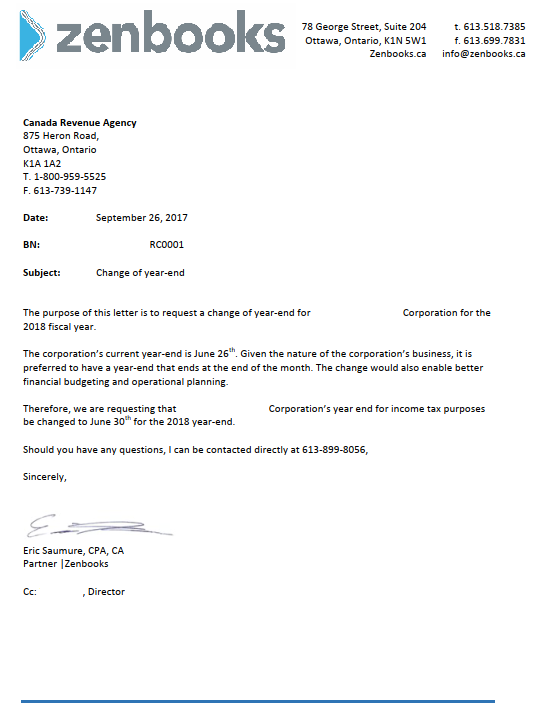
Change of year-end Sample letter to CRA
Sample of letter to CRA for response to tuition review/audit
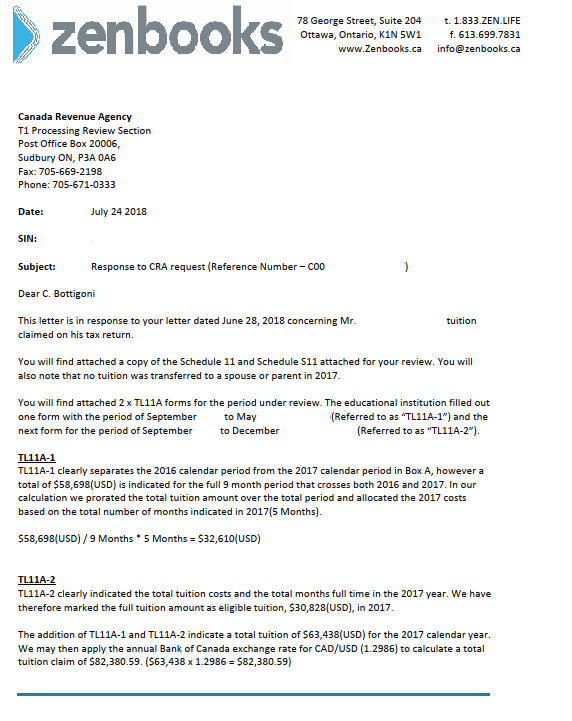
Sample letter to CRA Tuition audit and review – Page 1

Sample letter to CRA Tuition audit and review – Page 2
Before you send this to CRA
Many CRA issues come from missing filings, weak records, or unclear cash flow, not just a single mistake.
We built a short Financial Clarity Assessment to help business owners understand their exposure before CRA escalates.
The same Zenbooks research found that only 32% of SMEs reported being very satisfied with how their accounting and bookkeeping needs are currently handled. If a CRA letter is what's prompting a second look at your setup, that's a reasonable place to start.
If you're looking for a new accountant to handle your CRA letter, click here to reach out for a free consultation with our team today!

Eric Saumure, CPA, CA, is co-founder and Principal of Zenbooks, an online cloud-native accounting firm started in 2015 to serve 300+ Canadian small and mid-sized businesses. Before Zenbooks, Eric spent 3 years at KPMG. He specializes in financial strategy for growth-stage companies in the $1M-$10M revenue range, with a particular focus on marketing and creative agencies, SaaS, and professional services firms, e-commerce and non-profits.
Eric's commentary on Canadian small business, tax policy, and open banking has appeared in the Toronto Star, Canadian Press, CTV, CBC, Le Devoir, Policy Options, The Conversation, and Canadian Accountant. He was named to the OBJ Ottawa Forty Under 40 and recognized on both the Financial Times Americas' Fastest Growing Companies 2026 list and the Globe and Mail's Report on Business Top Growing Companies 2024. He is the principal researcher behind the Zenbooks Technology in Accounting Study, a national survey of 500 Canadian SMEs on accounting technology adoption, and the founder of OpenSME, a Canadian open banking advocacy organization. He serves on the board of Cystic Fibrosis Canada and member of the Montfort Hospital Association.
Subscribe for Updates


Business Clarity That Helps You Breathe Easy
Achieve your business goals and peace of mind with Zenbooks. As both your finance team and business advisor, we empower you every step of the way.
