


How to Switch Accountants in Canada Without Losing Your Data

A practical buyer's guide for Canadian business owners who are frustrated, curious, and ready to make a move.
You already suspect your accounting relationship isn't working. Maybe your accountant is reactive instead of proactive. Maybe the books are always months behind. Maybe you just learned your affairs are just offshored to other countries. Maybe you've noticed a meaningful gap between what you pay and what you actually get.
The thing holding most business owners back from making a move isn't doubt about whether they should. It's fear of the process. What happens to your files? Will there be a gap in your books? Can your accountant hold your data hostage?
The short answer is no. Switching accountants in Canada is far less complicated than most people expect. This guide will walk you through every step, including what to do if things get difficult, and what a smooth transition actually looks like.
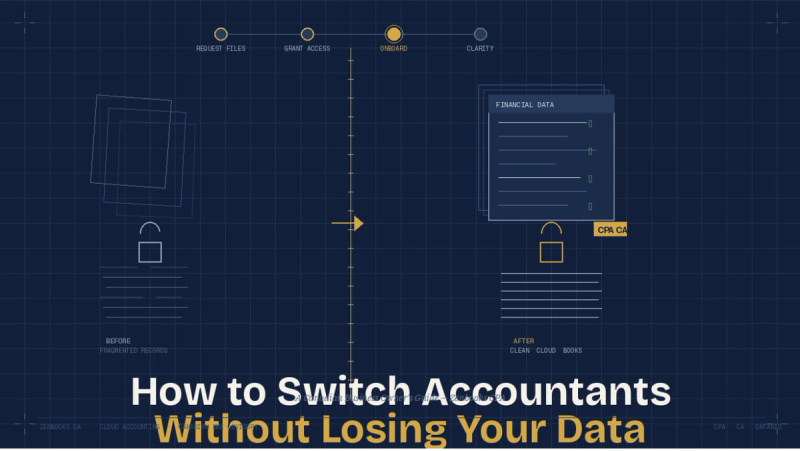
First: The Data Is Yours
This is the most important thing to understand before you do anything else.
Your financial data belongs to you. Full stop. Under CPA Ontario's Rules of Professional Conduct, a member cannot withhold a client's records as leverage for an outstanding fee dispute. The same principle holds across other provincial CPA bodies in Canada. If a firm is slow-walking your file transfer because you owe them money, they are operating outside the professional standards that govern their licence.
We have seen this situation firsthand. A previous accountant refused to release files to a client, citing an outstanding invoice. When the client cited CPA Ontario's code of conduct, the firm became slow to respond and began billing for every reply. That kind of behaviour should be reported. It should also not deter you from completing your transition.
If you are in that situation, document every communication in writing, make your formal written request for your records, and if needed, file a complaint with your provincial CPA body. It is rare. But it happens, and you should know your rights before you start.
What "Your Data" Actually Includes
Before requesting your files, know what you are asking for. Your records generally include:
Your historical financial statements (income statement, balance sheet, cash flow) for all years on file. Your general ledger and transaction history. Your tax returns and any CRA correspondence. Any payroll records your accountant managed. Access to your accounting software, whether that is Xero, QuickBooks Online, or another platform.
If your books live in cloud-based software, the access question is simpler. Cloud platforms like Xero and QuickBooks Online are owned and logged into by you, the business owner, even if they pay the subscription for you. Your accountant has access as an invited user, which means revoking that access and adding a new firm is a settings change, not a file transfer. Our data portability post covers this in more detail if your situation involves leaving an existing relationship and you want to understand exactly what comes with you.
If your accountant uses desktop software or has been keeping your books in their own environment rather than yours, the transfer is a bit more involved. But it is still your data, and a good firm will have handled this kind of migration before.
The Step-by-Step Switching Process
Step 1: Choose your new accountant before you resign from your old one.
This is the most common mistake people make. They end the relationship and then start shopping. You should have your new firm selected, and ideally your start date confirmed, before you send any notice. That way there is no gap in your financial management and your new firm can coordinate the transition directly with you.
Step 2: Give notice to your current accountant in writing.
A simple, professional email is fine. You do not owe them a detailed explanation. A sentence saying you are moving your accounting to another firm and asking them to prepare your files for transfer is sufficient. Keep the tone neutral. You may need their cooperation in the weeks ahead.
Step 3: Request your complete file.
This includes everything listed above. If your accountant is a member of a provincial CPA body, they are professionally obligated to cooperate. Set a reasonable deadline of ten to fifteen business days and put it in writing. If you owe an outstanding balance, pay it. Clearing that removes any ambiguity and eliminates the pretext some firms use to slow the process down.
Step 4: Grant your new accountant access.
For cloud-based books, this is as simple as inviting them as an accountant user in Xero or QBO. Your new firm should walk you through this on the first call. For paper records or desktop files, your new firm will typically handle the intake directly.
Step 5: Schedule a transition call with your new firm.
A legitimate accounting firm will want to understand your books before they take them over, not just collect them. This call should cover your current setup, your year-end date, any outstanding CRA matters, and your immediate priorities. At Zenbooks, this is the foundation of our onboarding process, which is designed specifically to make the first 30 days feel like a hand-off, not a handoff.
What to Look for in a New Accounting Firm
Switching accountants is an opportunity, not just a logistics exercise. Most business owners who switch do not go back to the old model. They move forward.
Here is what distinguishes a modern cloud accounting firm from a traditional one (You can also read our full post on how to find a good accountant here)
Monthly books. With cloud platforms like Xero and QBO, your books should be current within a few weeks of the end of month, not months. If your current accountant is reconciling quarterly and calling it bookkeeping, that is not modern service delivery.
Proactive communication. Your accountant should be reaching out to you about tax planning opportunities, CRA deadlines, and financial trends before you ask. The Zenbooks Technology in Accounting study, a national survey of 500 Canadian SMEs conducted with Abacus Data, found that only 6% of SMEs working with an external provider receive monthly check-ins. That number is low. It should be the baseline, not the exception.
Transparency on scope and pricing. Hidden hourly charges for basic questions are a red flag. A good firm tells you what is included and holds to it.
Technology fluency. A firm still running desktop software or asking you to fax documents is not going to serve you the way a modern business operates. Our tech stack post explains the tools we use and why they matter for your financial clarity.
What a Real Transition Looks Like
The fear of switching is almost always bigger than the transition itself.
Menos, a cross-border e-commerce company that came to Zenbooks in 2018 with $156K in annual revenue and delayed tax filings, grew to over $12M in revenue by 2025. A big part of that growth involved building proper financial infrastructure from the start of the relationship, including real-time reconciliation, Shopify and Amazon integrations, and a U.S. corporate structure with proper transfer pricing. That kind of clarity does not happen when your accountant is stretched thin and behind on your books. Read the full Menos case study.
Moniker Partners, a corporate travel company doing $5M in revenue when they came to Zenbooks, is now over $20M. Their previous cloud accounting firm was missing accounts receivable deadlines, failing to plan around tax events, and rotating team members without continuity. The switch gave them consistent, predictable financial management. A client note from Moniker says it well: their previous experiences with cloud accounting firms left them feeling like the work did not reflect genuine care. See the Moniker case study
The Guarantee That Removes the Remaining Risk
One of the reasons business owners stay in a bad accounting relationship longer than they should is that switching feels like a gamble. What if the new firm is not better?
We removed that gamble. Zenbooks offers a 100% money-back guarantee within the first 30 days. If you are not satisfied with the experience, you pay nothing. That guarantee exists because we are confident in what we do and because we want the decision to be easy, not stressful.
As Sarah Goulding noted in her Google review: doing a side-by-side comparison of her tax bill from the year before switching to Zenbooks versus the year after showed a significant financial benefit. That is not an accident. It is what happens when your accountant is actually paying attention.
Frequently Asked Questions
Can my accountant refuse to give me my files if I owe them money?
No. CPA Ontario's Rules of Professional Conduct do not permit a member to withhold client records as leverage in a fee dispute. If you owe a balance, pay it promptly to remove any ambiguity. If your accountant continues to stall after a reasonable time and a written request, contact CPA Ontario directly. You have the right to your own financial records.
How long does a transition take?
For most businesses with cloud-based books, the functional transition can happen within a week. Getting historical files, completing a proper onboarding call, and setting up your new reporting workflow typically takes two to four weeks end to end. There is no long gap in your accounting coverage if you plan ahead and choose your new firm before you resign from the old one.
Will the CRA know I changed accountants?
There is no requirement to notify the CRA that you have changed accounting firms. If your new firm will be filing on your behalf, they will have you sign a representative authorization (RC59 or through My Business Account) which replaces any prior authorization your old accountant held.
What if my books are a mess when I switch?
This is common. Many businesses come to a new firm after years of catch-up bookkeeping or inconsistent records. A competent firm will assess the state of your books honestly and give you a clear plan. At Zenbooks, we do this in the initial consultation. Some cleanups take a few weeks; others take longer. Either way, starting from an accurate base is better than continuing to build on a shaky one.
Is it a bad time to switch mid-year?
Not necessarily. Switching mid-year is more common than people think, and most firms are experienced at picking up books partway through a fiscal year. The one scenario to be thoughtful about is switching in the weeks immediately before your corporate tax filing deadline. Give yourself runway. Other than that, there is no universally bad time to make the move.
Does my accountant own my QuickBooks or Xero file?
No. If the subscription is in your name, the data is yours. If your accountant has been managing the subscription on your behalf, ask to have it transferred to your name. This is a standard process and both Xero and QBO support it. Your new firm can help you navigate this if needed.
Ready to Make the Move?
Switching accountants is not a risk. Staying with the wrong one is.
If you are frustrated with where you are and curious about what modern accounting actually looks like, book a complimentary consultation with our team. We will be honest about whether we are the right fit, and if we are, we will make the transition as smooth as possible.
Zenbooks is a cloud accounting firm based in Ottawa, serving Canadian businesses from coast to coast. Our team includes CPAs, bookkeepers, and advisory specialists focused on businesses with $1M to $10M in revenue.

Eric Saumure, CPA, CA, is co-founder and Principal of Zenbooks, an online cloud-native accounting firm started in 2015 to serve 300+ Canadian small and mid-sized businesses. Before Zenbooks, Eric spent 3 years at KPMG. He specializes in financial strategy for growth-stage companies in the $1M-$10M revenue range, with a particular focus on marketing and creative agencies, SaaS, and professional services firms, e-commerce and non-profits.
Eric's commentary on Canadian small business, tax policy, and open banking has appeared in the Toronto Star, Canadian Press, CTV, CBC, Le Devoir, Policy Options, The Conversation, and Canadian Accountant. He was named to the OBJ Ottawa Forty Under 40 and recognized on both the Financial Times Americas' Fastest Growing Companies 2026 list and the Globe and Mail's Report on Business Top Growing Companies 2024. He is the principal researcher behind the Zenbooks Technology in Accounting Study, a national survey of 500 Canadian SMEs on accounting technology adoption, and the founder of OpenSME, a Canadian open banking advocacy organization. He serves on the board of Cystic Fibrosis Canada and member of the Montfort Hospital Association.
Subscribe for Updates


Business Clarity That Helps You Breathe Easy
Achieve your business goals and peace of mind with Zenbooks. As both your finance team and business advisor, we empower you every step of the way.
