


Virtual Accountant vs. In-House Bookkeeper: What's the Real Cost for a Canadian Small Business?

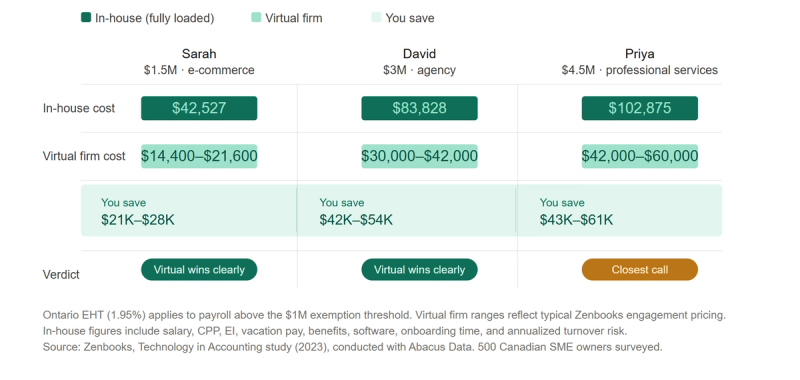
The question comes up constantly: should I hire someone in-house, or outsource my accounting to a virtual firm?
Most founders approach this as a gut call. In-house feels more controllable. Virtual feels more modern. Neither instinct gets you to the right answer, because the right answer depends almost entirely on your revenue, your transaction volume, and what you actually need from a finance function at your current stage.
I have reviewed the books of hundreds of Canadian small businesses. The pattern is consistent: founders almost always underestimate the fully-loaded cost of an in-house hire, and they almost always overestimate what a solo bookkeeper can deliver. This post runs the real math across three scenarios so you can make this decision with accurate numbers instead of assumptions.
What You Are Actually Comparing
Before getting into the numbers, it is worth being precise about what each option actually delivers.
An in-house bookkeeper is one person. They record transactions, reconcile accounts, manage AP and AR, and prepare basic reports. At the salary ranges most SMEs can afford, they are generally not doing tax planning, cash flow modeling, payroll management, or strategic advisory. They are a skilled single point of execution, and they are fully dependent on your management attention, your systems, and your institutional knowledge retention when they leave.
A virtual accounting firm is a team with layered expertise. A well-structured engagement typically gives you a bookkeeper(or staff accountant) for transaction-level work, a senior accountant for month-end and reporting, and access to a Senior Tax Accountant for tax questions. You are not paying for one person's time. You are paying for a function.
That distinction matters enormously when you start building the cost comparison honestly.
The Hidden Costs Most Founders Miss
Before the three scenarios, here are the line items that almost never appear in a founder's mental model when they think "I'll just hire a bookkeeper at $55,000."
Turnover and replacement cost. Bookkeeper turnover in small businesses is high. When someone leaves, you typically spend four to eight weeks recruiting, another four to eight weeks onboarding their replacement, and somewhere between $8,000 and $15,000 in direct recruitment costs (job boards, time, sometimes agency fees). During that gap, your books fall behind, your reporting stops, and you are managing the transition on top of running your business. A virtual firm absorbs this entirely. When a staff member changes internally, your service continues without interruption.
Training and onboarding time. A new bookkeeper does not arrive knowing your chart of accounts, your industry nuances, your software stack, or your reporting preferences. The realistic ramp time to full productivity is 60 to 90 days. During that period, you are paying full salary for partial output, and spending three to five hours a week of your own time on knowledge transfer. At $150 per hour of your time, that is a real cost.
Vacation and sick day coverage. An in-house bookkeeper takes two to three weeks of vacation per year and an average of seven to ten sick days. During those absences, your books do not get done unless you cover them yourself or pay for temporary help. A virtual firm has no coverage gaps. Month-end closes on schedule regardless of who is unwell.
Personality fit. When you hire in-house, you are committing to a working relationship with someone you interviewed for maybe three hours. Sometimes it works. Sometimes you find out six months in that it does not, and now you have a performance management process, potential severance obligations, and a gap in your books while you start the search over. With a virtual firm, if the relationship is not working, you ask to switch accountants on your file. No HR process. No severance. No drama. The firm absorbs the reassignment and your service continues.
According to the Zenbooks Technology in Accounting study, conducted in partnership with Abacus Data and surveying 500 Canadian SME owners, 62% of small businesses have the owner doing all their own bookkeeping, and only 6% use an online or virtual bookkeeper. That concentration of financial work on a single person, whether the founder or one in-house employee, creates the exact coverage and continuity risk that virtual firms are built to eliminate.
Scenario 1: $1.5M E-Commerce Business
Meet Sarah. She runs an online clothing boutique doing $1.5M in annual revenue with a small team of six. Her transaction volume is moderate, maybe 400 to 600 transactions per month across Shopify, a few supplier invoices, and payroll for part-time staff. She is considering hiring a part-time bookkeeper at $30,000 per year.
The in-house math:
Cost Item
Annual Amount
Salary (part-time-bookkeeper)
$30,000
CPP employer contribution (~5.95%)
$1,785
EI employer contribution (~2.28%)
$684
Vacation pay (4%)
$1,200
Sick day coverage (est. 7 days)
$808
Onboarding time cost (your hours)
$2,250
Software licenses (Xero, Dext, etc.)
$1,800
Annualized turnover risk (est. 40% chance of turnover x $10K cost)
$4,000
Total Fully-Loaded Cost
$42,527
Note: Ontario EHT does not apply here as total payroll sits well under the $1M threshold.
The virtual accounting math:
A virtual firm engagement fees covering bookkeeping, payroll, HST filing, and year-end for a business at this stage typically runs $1,200 to $1,800 per month in Canada, or $14,400 to $21,600 annually. That range includes access to a senior accountant and tax pro, no overhead. No laptop, no coverage gaps, and no turnover risk.
The verdict: Virtual wins clearly. At $1.5M, Sarah does not need a dedicated in-house hire. She needs accurate books, clean HST filings, and timely monthly reporting. A virtual firm delivers all of that for roughly half the fully-loaded cost of a part-time employee, with broader expertise and no management overhead. Boutique La Muse, a client Zenbooks has worked with since their early growth stage, scaled from $800K to $3.8M in revenue while outsourcing their entire accounting function. You can read that story here
Scenario 2: $3M Marketing Agency
Meet David. He runs a digital marketing agency doing $3M in annual revenue with 18 employees. He has client retainers, project billing, some deferred revenue complexity, and media spend he passes through to clients. He is considering a full-time intermediate bookkeeper at $58,000.
The in-house math:
Cost Item
Annual Amount
Salary (full-time intermediate bookkeeper)
$58,000
CPP employer contribution (~5.95%)
$3,451
EI employer contribution (~2.28%)
$1,322
Ontario EHT (1.95% on payroll above $1M exemption — not triggered at this scale)
$0
Vacation pay (4%)
$2,320
Benefits (basic group plan)
$3,600
Sick day coverage (est. 8 days)
$1,785
Onboarding time cost (your hours, 90 days x 3 hrs/week)
$6,750
Software licenses
$2,400
Annualized turnover risk (est. 35% chance x $12K cost)
$4,200
Total Fully-Loaded Cost
$83,828
The virtual accounting math:
An agency at $3M with payroll complexity, deferred revenue, and client media tracking typically runs $2,500 to $3,500 per month with a virtual firm structured to handle those specifics, or $30,000 to $42,000 annually. That engagement includes a bookkeeper, senior accountant, Senior Tax Accountant, payroll processing, and tax planning. No benefits, no turnover, no onboarding.
The verdict: Virtual wins, but the reasoning matters more than the number. At $3M, David's real risk is not the cost gap, it is the capability gap. A solo bookkeeper at $58,000 does not have the expertise to handle deferred revenue recognition, client media reconciliation, and proactive tax planning simultaneously. A virtual firm at this stage gives him a layered team for less than half the fully-loaded cost of one employee. Sterling Sky, a Canadian SEO agency and Zenbooks client, grew from $1M USD to over $5M USD in revenue while managing their entire finance function through Zenbooks. You can read the full case study here.
Scenario 3: $4.5M Professional Services Firm
Meet Priya. She runs a consulting firm doing $4.5M in annual revenue with 30 employees, multiple practice areas, and a growing need for department-level reporting, variance analysis, and board-ready financial packages. She is weighing a senior full-time bookkeeper at $72,000 versus a virtual firm.
The in-house math:
Cost Item
Annual Amount
Salary (senior bookkeeper / junior controller)
$72,000
CPP employer contribution (~5.95%)
$4,284
EI employer contribution (~2.28%)
$1,642
Ontario EHT (applies; payroll well above $1M — bookkeeper's salary portion: 1.95% x $72K)
$1,404
Vacation pay (4%)
$2,880
Benefits (group plan)
$4,800
Sick day coverage (est. 8 days)
$2,215
Onboarding time cost
$6,750
$2,400
$2,400
Annualized turnover risk (est. 30% chance x $15K cost)
$4,500
Total Fully-Loaded Cost
$102,875
The virtual accounting math:
A professional services firm at $4.5M with multi-department reporting, payroll for 30 staff, and board-level advisory needs typically runs $3,500 to $5,000 per month with a virtual firm, or $42,000 to $60,000 annually.
The verdict: Virtual still wins on cost, but this is where in-house starts making genuine sense for some businesses. At $4.5M with 30 employees, Priya may have legitimate reasons to prefer an in-house hire: same-day response on urgent questions, daily transaction oversight, or a preference for direct management control over her finance function. Those are real operational needs, not irrational ones. If Priya's business has very high daily transaction volume, needs daily bank reconciliation, or requires a finance person physically embedded in operational decisions on a real-time basis, an in-house senior bookkeeper or junior controller can make sense at this stage. The cost gap is smaller here, and the capability overlap is closer.
That said, most professional services firms at $4.5M do not actually need daily finance oversight. They need accurate monthly reporting, clean tax management, and periodic advisory on profitability by client or practice area. A virtual firm delivers all of that with more expertise depth and less management overhead than a single hire.
The same Zenbooks study found that only 32% of Canadian SME owners reported being very satisfied with how their accounting and bookkeeping are currently handled, and among business owners actively trying to grow, that number drops to 24%. Satisfaction with the status quo is low precisely because most SMEs are underserved by their current setup, whether that is a solo in-house bookkeeper, a traditional firm that only shows up at year-end, or the owner doing it themselves.
When In-House Actually Makes Sense
To be direct about this: in-house wins when your operational reality requires it, not when your revenue reaches it.
The specific conditions where hiring internally makes genuine sense before $10M are: very high daily transaction volume (500 or more transactions per day) requiring real-time reconciliation; a business model with same-day cash handling that needs on-site financial oversight; a founder who wants direct management authority over a finance employee as a matter of operational preference and is willing to pay for it; or a compliance environment requiring a dedicated internal controller with signing authority.
If none of those apply to your business right now, you are almost certainly better served by a virtual firm until you cross $5M and the case for a full-time in-house controller becomes genuinely compelling on its own merits.
Frequently Asked Questions
What is the fully-loaded cost of an employee in Ontario?
The fully-loaded cost of an employee is their base salary plus all mandatory employer contributions and overhead. For an Ontario employer, this includes the employer's share of CPP (approximately 5.95% of insurable earnings), employer EI premiums (approximately 2.28% of insurable earnings), vacation pay (minimum 4% under Ontario's Employment Standards Act), and Ontario Employer Health Tax (1.95% on payroll above the $1M exemption threshold). Add benefits, software, training, and an annualized estimate of turnover and replacement costs, and the true cost is typically 30% to 50% above base salary.
At what revenue stage should a Canadian small business hire an in-house bookkeeper?
There is no universal threshold, but the conditions that make in-house genuinely cost-effective typically emerge around $5M in revenue and above, or earlier if your daily transaction volume, operational complexity, or compliance requirements demand it. Before that stage, a virtual accounting firm almost always delivers more capability per dollar than a single in-house hire.
What does a virtual accounting firm actually do compared to a bookkeeper?
A bookkeeper records transactions and reconciles accounts. A virtual accounting firm provides a layered team that typically includes a bookkeeper, a senior accountant for month-end close and reporting, and a CPA for tax planning and strategic advisory. The scope is broader, the expertise depth is greater, and the service continues without interruption during staff transitions, vacations, or illness.
Is it a problem that my accountant is not in the same city as me?
For the vast majority of Canadian small businesses, no. Cloud accounting platforms like Xero make real-time financial data accessible from anywhere. Virtual firms operating in Canada are fully equipped to handle CRA filings, HST, payroll, and provincial tax obligations regardless of where you are located. The main scenario where proximity matters is if your business requires a finance person physically present for daily cash handling or operational oversight, which is uncommon at the SME stage.
How do I know if Zenbooks is the right fit for my business?
Zenbooks works with incorporated Canadian businesses in the $1M to $10M revenue range that want a finance team rather than a single bookkeeper. If you want accurate monthly reporting, proactive tax management, and strategic advisory without the overhead of an in-house hire, we are likely a strong fit. You can read about who we work with here, or take the Financial Clarity Assessment to see where your financial infrastructure stands in two minutes. If you are ready to talk, book a free consultation and we can walk through what the right structure looks like for your business specifically.

Eric Saumure, CPA, CA, is co-founder and Principal of Zenbooks, an online cloud-native accounting firm started in 2015 to serve 300+ Canadian small and mid-sized businesses. Before Zenbooks, Eric spent 3 years at KPMG. He specializes in financial strategy for growth-stage companies in the $1M-$10M revenue range, with a particular focus on marketing and creative agencies, SaaS, and professional services firms, e-commerce and non-profits.
Eric's commentary on Canadian small business, tax policy, and open banking has appeared in the Toronto Star, Canadian Press, CTV, CBC, Le Devoir, Policy Options, The Conversation, and Canadian Accountant. He was named to the OBJ Ottawa Forty Under 40 and recognized on both the Financial Times Americas' Fastest Growing Companies 2026 list and the Globe and Mail's Report on Business Top Growing Companies 2024. He is the principal researcher behind the Zenbooks Technology in Accounting Study, a national survey of 500 Canadian SMEs on accounting technology adoption, and the founder of OpenSME, a Canadian open banking advocacy organization. He serves on the board of Cystic Fibrosis Canada and member of the Montfort Hospital Association.
Subscribe for Updates


Business Clarity That Helps You Breathe Easy
Achieve your business goals and peace of mind with Zenbooks. As both your finance team and business advisor, we empower you every step of the way.
