


WageFest 2026: Why Canadian Business Owners Skip Their Own Pay First

Last year I joined a panel in the accountant stream at WageFest, Wagepoint's online conference for Canadian payroll and small business professionals. This year Wagepoint invited me back to present original research. On October 22, I presented findings from the Zenbooks Financial Clarity Index (ZFCI) in the SMB Business Track, then moderated a panel of a tax specialist, a banker and a licensed insolvency trustee on what the data means for business owners.
I'll admit I was nervous. WageFest draws a bigger crowd than most people expect, and this year was the largest one Wagepoint has run, with thousands of attendees. The event also matters to us for a practical reason: Wagepoint is the primary payroll provider for our clients. We interviewed Wagepoint's former CEO, Shrad Rao, on the Small Business, Big Insights podcast.
The session focused on one ZFCI finding that almost nobody talks about out loud: business owners quietly skipping their own pay.
The session
- Session: The Quiet Pay Cut, Why paying yourself first is a cash flow decision
- Event: WageFest 2026 (online), SMB Business Track, October 22, 2026
- Host: Jenna Hart Rachiele, Small Business Team, Wagepoint
- Format: ZFCI data presentation, moderated panel, audience Q&A
- Presenter and moderator: Eric Saumure, CPA, CA, Principal, Zenbooks
- Panel: Chantal Mercier-Ouellette, Licensed Insolvency Trustee, D. & A. MacLeod Company Ltd.; Amin Torfe, Account Manager, Small Business, TD; Yannick Lemay, Senior Tax Training Specialist, H&R Block Canada

We asked the room first
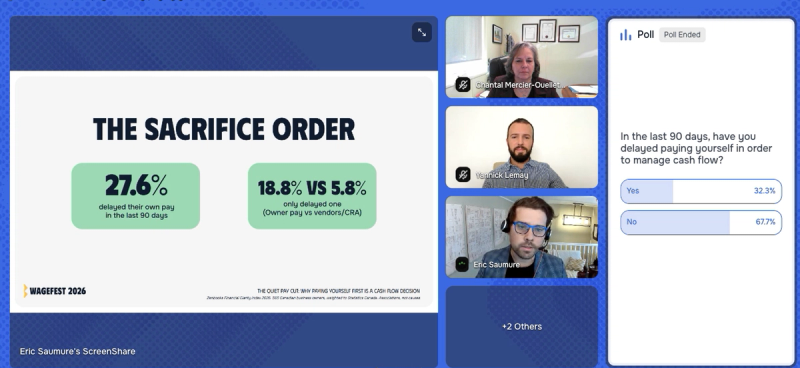
Before showing any data, we ran an anonymous poll: in the last 90 days, did you hold or delay your own pay?
Nationally, the ZFCI found that 27.6% of Canadian business owners had. In the WageFest session, 32.3% of the hundreds in attendance who answered said yes.
A second poll asked how much cash runway attendees' businesses had. [ROOM RESULTS: 13.5% with no reserve, 9.2% who don’t know, hundreds in attendance] Nationally, 18.1% of owners have no runway or don't know what it is.
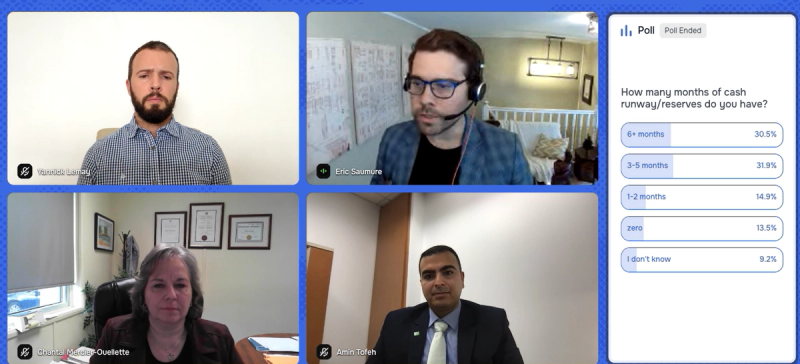
The ZFCI itself is built on a survey of 565 Canadian business owners, weighted to Statistics Canada by region, size and sector. The WageFest polls weren't a representative sample, and they weren't intended to validate the national research. But seeing similar patterns emerge in a different setting was encouraging. More importantly, it gave us a starting point for a conversation that business owners rarely have publicly.
The paycheque nobody notices
What I see in practice looks like this. A month goes badly. The owner doesn't call a meeting. They send a short note to whoever runs payroll: hold mine, just this time. Staff don't know. Often the spouse doesn't know either. The payroll person is usually the only one who sees it.
There is a reason it happens this way. Vendors call when you're late. CRA charges interest. Staff who don't get paid on Friday aren't in on Monday. The owner's draw is the only line where nothing happens when you skip it, so that's where the bad month gets absorbed. Among owners who held back money, they delayed their own pay three times as often as they delayed vendors or CRA.
A few other findings from the index:
- It isn't only very small businesses. Owners of businesses with more than $1 million in revenue delayed their own pay at a rate of 19.7%.
- E-commerce had the widest gap. 35.5% of e-commerce owners delayed their own pay, while only about 10% delayed vendors or CRA. My read, which is not part of the data: without stock and good supplier relationships, there is no business, so suppliers get paid first.
- It tracks with financial clarity. Owners who delayed their pay scored 46.7 out of 100 on the index. Those who didn't scored 60.5.
- A budget didn't help. Owners with a written budget delayed their pay at the same rate as owners without one.
- Cash reserves did. Owners with no reserves delayed their pay at 62%. Owners with more than six months of reserves were at 8.5%. Owners who didn't know their reserve position landed in about the same place as those with two to three months.
One more number explains why this stays quiet. 77.2% of owners rated their own understanding of their finances as good or excellent, but the average index score was 43.5. A problem that feels solved doesn't get solved. If one of your employees missed a paycheque, it would be fixed by the end of the day. When it's the owner, the month ends, everyone else got paid, and the underlying cash problem is still there.
What the panel sees further down the line
The data shows how often owners skip their pay. To show what happens next, the panel brought together three professionals who see the consequences at different stages: at tax time, at the bank, and when a business runs out of options.
Yannick Lemay, Senior Tax Training Specialist, H&R Block Canada
Yannick leads training for H&R Block Canada's business tax experts and is the company's resident specialist on T2 corporate income tax. He is also one of H&R Block's official spokespeople. Before H&R Block, he ran his own accounting practice in Quebec, and his work spans Canadian, Quebec and US tax rules.
Yannick sees the problem at tax time. Owners who vary their pay month to month break the plan they set at the start of the year, whether that was salary, dividends, RRSP contributions or installments. He also flagged the year many owners don't budget for: the first year of tax installments, when you pay the prior year's balance and the current year's installments at the same time. "It is as if you're paying taxes twice during that year."
When cash is tight, payroll remittances are tempting to stretch. Yannick was clear on the cost. CRA charges 3% to 7% on remittances up to seven days late and 10% beyond that, plus interest. A repeat failure in the same calendar year can draw a 20% penalty where it was made knowingly or through gross negligence. None of it is tax deductible.
Amin Torfe, Account Manager, Small Business, TD
Amin is a small business account manager with TD in Kanata, where he works with owners on cash flow, financing and day-to-day banking.
Amin sees owners before and after they need credit. His point was that being profitable and having cash in the bank are not the same thing, and that the time to talk to your banker is before the pressure comes. When we asked whether an owner should build a cash reserve or set up a line of credit first, he said reserves first, since it's the owner's money and carries no interest, but arrange the line of credit before you need it. His floor for reserves: three months of expenses. On our budget finding, he agreed a budget is useful but is only a plan on paper. What changes the outcome is comparing the plan to actual results and acting early.
Chantal Mercier-Ouellette, Licensed Insolvency Trustee, D. & A. MacLeod Company Ltd.
Chantal has worked in insolvency since 1998 and has been a Licensed Insolvency Trustee since 2015. She practises with D. & A. MacLeod Company Ltd. in Ottawa, where she advises individuals and micro, small and medium-sized businesses on consumer, commercial and corporate insolvency, including proposals as an alternative to bankruptcy. She is a member of the Canadian Association of Insolvency and Restructuring Professionals (CAIRP).
Chantal sees where it ends up. By the time owners reach her, there is usually external pressure: a frozen bank account, a maxed line of credit, CRA arrears. In a two-income household, the spouse has often been carrying more than their share for a while. Personal guarantees, source deductions and director's liability all come into play. Her advice was to set yourself a deadline for how long you'll keep things going, stick to it, and have the honest conversation with your spouse before personal assets are on the line. She also wanted owners to hear this: "It's not an automatic death sentence when the bank says no."
What does this mean for small business owners?
If you've held your own pay this year, you're in a large group, and most of that group has never said it out loud. Treat it as a signal about cash, not a decision about compensation, and act on it before the next bad month.
What we tell our own clients, separate from the index data:
- Make owner compensation predictable. Work with your accountant to set a regular salary, dividend or combination that fits your tax plan and cash flow. The goal is to stop using household income as the business's emergency cash reserve.
- Build reserves before anything else. The index points to cash reserves, not budgets, as the factor most associated with owners getting paid.
- Arrange credit before you need it. A first-time line of credit request after a bad quarter is a harder conversation for everyone.
- Don't stretch remittances. Late source deductions get expensive quickly, and directors can be held personally liable for them.
If you want to see where your own business sits against the national data, the Financial Clarity Assessment is anonymous. No email required and no follow-up.
Financial Clarity AssessmentThank you to Chantal, Amin and Yannick for joining the panel, to Jenna Hart Rachiele for hosting, and to the Wagepoint team for having us back at WageFest.
We're running the same format at SaaS North on November 5 in Ottawa, with a first look at the ZFCI data for SaaS and tech businesses followed by a panel. If you're attending, come find us.

Eric Saumure, CPA, CA, is co-founder and Principal of Zenbooks, an online cloud-native accounting firm started in 2015 to serve 300+ Canadian small and mid-sized businesses. Before Zenbooks, Eric spent 3 years at KPMG. He specializes in financial strategy for growth-stage companies in the $1M-$10M revenue range, with a particular focus on marketing and creative agencies, SaaS, and professional services firms, e-commerce and non-profits.
Eric's commentary on Canadian small business, tax policy, and open banking has appeared in the Toronto Star, Canadian Press, CTV, CBC, Le Devoir, Policy Options, The Conversation, and Canadian Accountant. He was named to the OBJ Ottawa Forty Under 40 and recognized on both the Financial Times Americas' Fastest Growing Companies 2026 list and the Globe and Mail's Report on Business Top Growing Companies 2024. He is the principal researcher behind the Zenbooks Technology in Accounting Study, a national survey of 500 Canadian SMEs on accounting technology adoption, and the founder of OpenSME, a Canadian open banking advocacy organization. He serves on the board of Cystic Fibrosis Canada and member of the Montfort Hospital Association.
Subscribe for Updates


Business Clarity That Helps You Breathe Easy
Achieve your business goals and peace of mind with Zenbooks. As both your finance team and business advisor, we empower you every step of the way.
