


What Does a Cloud Accounting Firm Actually Do? (And What They Don't)

If you have ever Googled 'cloud accounting firm' and walked away more confused than when you started, you are not alone. The term gets thrown around constantly, often by people who use it to mean very different things.
Some people use it to mean a bookkeeper who works from home. Some use it to mean software like Xero or QuickBooks Online. Some use it to mean a low-cost, automated alternative to a 'real' accountant.
None of those definitions are quite right.
This post is for business owners who are familiar with the traditional accounting model: the year-end accountant you see once in April, maybe a family member handling your books, and a shoebox of receipts somewhere in between. If you have heard that cloud accounting firms exist, but you are not sure what they actually do differently or whether the model is right for you, this is for you.
What Is a Cloud Accounting Firm, Really?
A cloud accounting firm is a modern accounting practice built from the ground up on cloud-based software. That distinction matters more than it sounds.
Traditional accounting firms evolved their practices over decades, often layering digital tools onto workflows that were designed in an era of paper ledgers, filing cabinets, and once-a-year client meetings. Cloud accounting firms did not inherit that infrastructure. They were born in it.
The core difference is this: when your accountant operates entirely on cloud platforms, the relationship with your finances changes from reactive to continuous. Your books are reconciled weekly. Your reports exist in real time. Your accountant can see the same numbers you see, at the same moment you see them, regardless of whether you are in Ottawa and they are in Vancouver.
That sounds simple. The implications are not.
Once a firm operates continuously on cloud-based tools, the range of what it can offer expands dramatically. Weekly bookkeeping becomes viable. Monthly financial reviews become standard. Cash flow conversations, payroll, accounts payable, controller services, and fractional CFO work can all be layered in, because the infrastructure supports it. None of that is practical when your accountant's model depends on a once-a-year file handover.
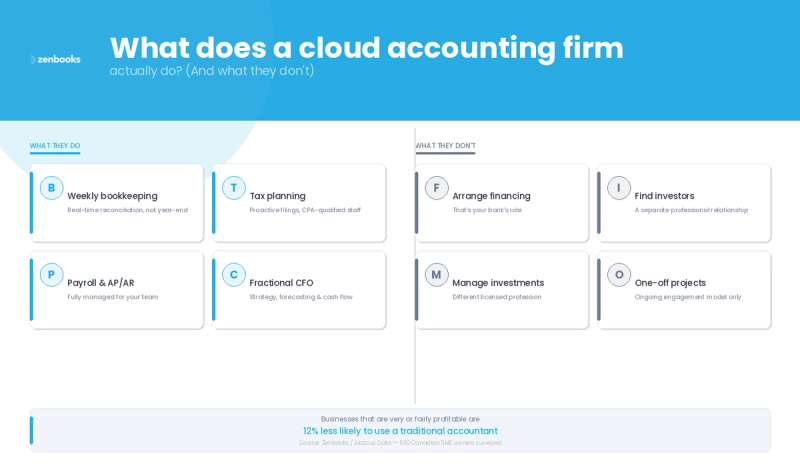
This is not just our observation. Zenbooks' research on technology in accounting, conducted in partnership with Abacus Data and surveying 500 Canadian SME owners, found a clear link between cloud accounting adoption and business profitability. The firms that embraced digital accounting tools were not just more organized. The data is direct: businesses that are very or fairly profitable are 12% less likely to use a traditional accountant than those that are breaking even or losing money. The direction of that relationship matters.
What a Cloud Accounting Firm Actually Does
This is where a lot of prospects are surprised. Cloud accounting firms are not just digitized bookkeepers. A full-service cloud accounting firm can, and should, offer the following.
Bookkeeping and Month-End Close
This is the foundation. Real-time reconciliation of your bank accounts, credit cards, and revenue streams. Done weekly or monthly, not annually. The goal is that you always know where you stand financially, not just at the end of your fiscal year.
Tax Planning and Compliance
This is where the 'just a bookkeeper' misconception falls apart. A cloud accounting firm with CPA-qualified professionals on staff handles the full scope of tax work: corporate tax filings, GST/HST compliance, mid-year tax check-ins, CRA audit protection, and strategic tax planning that looks years ahead. At Zenbooks, that includes complex work like transfer pricing, U.S. tax filings for Canadian companies expanding south, and HoldCo structuring for founders approaching a liquidity event.
Our case study with Menos, a Shopify app developer that grew from $156K to over $12M in annual revenue, illustrates this well. Their engagement included establishing a U.S. corporation, creating a transfer pricing agreement, and setting up a HoldCo to protect retained earnings. That is not bookkeeping. That is full-scale financial architecture.
Payroll
Managing payroll for your employees, calculating source deductions, completing CRA remittance forms, and handling benefits administration. For businesses with teams across provinces or borders, this gets complex fast. Cloud tools make it manageable.
Accounts Payable and Receivable
Some cloud accounting firms, including Zenbooks, take on the operational side of managing who you owe and who owes you. This is a genuine time-saver for founders who are currently the ones chasing invoices.
CFO and Controller Services
For businesses that are growing but not yet at the scale to justify a full-time CFO, cloud accounting firms can provide fractional CFO support: cash flow forecasting, KPI reporting, board-level financial summaries, and strategic advisory. This is the service category that surprises people the most.
The Moniker Partners case study shows what this looks like in practice. A corporate travel company growing from $5M to over $20M in four years needed more than clean books. They needed foreign exchange management, deferred revenue tracking, and a recurring balance sheet review process. A traditional once-a-year accountant cannot deliver that.
What a Cloud Accounting Firm Does Not Do
Equally important is being honest about scope. A good cloud accounting firm will tell you plainly what falls outside the engagement, rather than letting you assume it is covered. The traditional accountant charges hourly, so if you give them work they will charge you for their time to figure it out. Here is what you should not expect.
- Cloud accountants do not arrange financing, negotiate credit facilities, or communicate directly with your lender on your behalf. We can prepare the financial documentation that supports a loan application. We are not the relationship manager at your bank.
- Find you investors. A cloud accounting firm is not a fundraising advisor or a venture broker. If you are looking for equity financing, that is a separate professional relationship.
- Manage your investments. Personal or business investment portfolios are the domain of registered investment advisors. Accounting and investment management are distinct professions.
- Take over your finances completely. There will always be some level of engagement required from you as the business owner. You will answer questions, provide context, upload receipts, and participate in conversations about your business. The idea that you can hand off your finances and never think about them again is not realistic with any responsible accounting firm.
- Do one-off projects or quick reviews. Cloud accounting firms work on an ongoing engagement model. If you are looking for a one-time review of a competitor's financials or a quick sanity check on another firm's work, that is not a service most cloud accounting firms offer.
- Train your internal team. If you have an in-house bookkeeper or finance coordinator, a cloud accounting firm will work alongside them. But hands-on training of your staff is generally outside scope.
Cloud Does Not Mean Cheap. It Means Modern.
There are cheap traditional accountants or tax shops on your street corner, but not all are the same. You need to do your research.
Cloud accounting firms do not operate out of a downtown high-rise with expensive overhead. There is no head office with a lobby, a receptionist, and a corner office for the senior partner. The senior partners/owners are often just regular people working in their homes, wearing comfortable shirts and pants, while delivering phenomenal service. That cost savings gets passed on in some ways by having less revenue expectations on staff and more invested in customer experience. But cloud accounting is not a discount category.
What you are paying for is access to a team of qualified professionals using enterprise-grade technology, delivering services that would have required a full in-house finance department a decade ago. A CPA-qualified accounting firm that does your books weekly, files your taxes proactively, runs your payroll, prepares your monthly management reports, and provides CFO-level guidance is not a cheap service. It is a modern one.
The comparison is not 'cloud accounting vs. traditional accounting.' The comparison is 'cloud accounting vs. hiring a bookkeeper, a controller, and a tax accountant separately,' or 'cloud accounting vs. doing it yourself on software you are not sure you are using correctly.'
When you look at it that way, the value proposition of a cloud accounting firm becomes clearer. Our reviews and client success stories consistently point to the same outcome: business owners who finally feel in control of their finances, often for the first time.
Why a Distributed Team Is an Advantage, Not a Compromise
One thing business owners rarely think to ask about is the composition of the team working on their file. Cloud accounting firms are built on distributed teams, meaning your accountants, payroll specialists, tax managers, and CFO advisors are not all sitting in the same downtown office. They are working remotely, from wherever they do their best work. Read more from Zenbooks’ article in the Toronto Star on this.
This has a practical consequence that benefits you directly: cloud accounting firms tend to have lower staff turnover than traditional firms. When professionals are not commuting to a rigid office environment, are trusted to manage their own schedules, and are working with modern tools instead of legacy systems, they stay longer. That matters for your business because continuity of relationship is one of the things clients of traditional firms complain about most. A revolving door of junior staff means someone new is always getting up to speed on your file. A stable, distributed team means the person who knows your business in January is the same person handling your year-end in December.
Is a Cloud Accounting Firm Right for You?
The cloud accounting model is particularly well suited to business owners who are currently experiencing one or more of the following.
• You see your accountant once a year and feel like you are flying blind the other eleven months.
• You or a family member are handling bookkeeping in-house, and it is taking time you do not have.
• You are growing, but your financial infrastructure has not kept pace with your revenue.
• You are approaching a decision, whether a hire, an acquisition, or a market expansion, and you do not have the financial clarity to make it confidently.
• You have used Xero or QuickBooks and found the software helpful, but you know you are not using it correctly or to its full potential.
The model is less suited to businesses that are genuinely micro-scale with very simple finances, or owners who prefer a deep personal relationship with a single local accountant above all else. That is a legitimate preference, and we would rather be honest about fit than oversell the engagement.
Frequently Asked Questions
Is a cloud accounting firm the same as virtual accounting?
Largely yes. The terms are used interchangeably. 'Virtual accounting' emphasizes the remote delivery model. 'Cloud accounting' emphasizes the technology infrastructure. A cloud accounting firm is delivered virtually, and a virtual accounting firm, if it is doing the job properly, is operating on cloud-based tools.
Does a cloud accounting firm do personal tax returns?
Not always, and this is a common source of confusion. A cloud accounting firm's core engagement is typically structured around your business entity. Personal T1 returns for the owner are often offered as a separate, additional service. Always clarify this upfront when you are evaluating a firm.
How is a cloud accounting firm different from just using Xero or QuickBooks?
Xero and QuickBooks are tools. A cloud accounting firm is the team of professionals who operates those tools on your behalf, interprets the data, ensures compliance, plans your taxes, and advises your business. Buying accounting software and having a cloud accounting firm are not the same thing, any more than buying a stethoscope is the same thing as seeing a doctor.
Do I need to be in the same city as my cloud accounting firm?
No. That is the point. A properly built cloud accounting firm can serve clients anywhere in the country. Zenbooks serves over 300 Canadian businesses from coast to coast, entirely remotely. Geography is not a constraint.
What does onboarding with a cloud accounting firm look like?
Typically, it starts with a discovery call to understand your business, your current financial setup, and what you need. From there, you will complete an onboarding process that migrates your existing books onto the firm's preferred platform, establishes your reporting cadence, and defines the scope of services. A good cloud accounting firm will give you a clear checklist and timeline so you know exactly what to expect.
Are cloud accounting firms regulated?
They should be. In Canada, tax and assurance services can only be provided by Chartered Professional Accountants (CPAs) governed by CPA Canada and provincial bodies like CPA Ontario. When evaluating a cloud accounting firm, always confirm that the professionals handling your tax work are licensed CPAs. The technology is important. The credentials behind it matter just as much.
The Bottom Line
A cloud accounting firm is not a bookkeeper with a better website. It is not software with a customer service number. And it is not the cheap alternative to a 'real' accountant.
It is a modern accounting practice, built on cloud infrastructure, staffed by qualified professionals, and designed to serve your business continuously rather than reactively. If your current accounting setup has you seeing your accountant once a year and guessing the rest of the time, it is worth understanding what the alternative actually looks like.
Book a complimentary call with the Zenbooks team to see what a cloud accounting engagement would look like for your business.

Eric Saumure, CPA, CA, is a Principal here at Zenbooks. With experience at KPMG and over a decade partnering with business owners and executive teams, Eric focuses on financial strategy, succession planning, and operational efficiency. He’s often invited to share insights at industry events and in the media.
Subscribe for Updates


Business Clarity That Helps You Breathe Easy
Achieve your business goals and peace of mind with Zenbooks. As both your finance team and business advisor, we empower you every step of the way.
