


What to Actually Look for in an Accountant for Your Creative Agency

Most agency founders pick their accountant the same way they pick a plumber. Someone in their network had a good experience, the price seemed reasonable, and the person on the other end of the call seemed competent enough. That was good enough at the time.
The problem is that "good enough at the time" has a shelf life. And for creative and marketing agencies specifically, that shelf life tends to expire somewhere between $500K and $1.5M in revenue, right when the business is getting interesting, right when the financial decisions actually start to matter.
I've been working with Canadian SMEs for over a decade. The agency founders who come to us in the worst shape financially are rarely the ones who never had an accountant. They're the ones who had an accountant who wasn't right for them, and stayed too long.
This post is about how to avoid that. Specifically: what to actually look for, what questions to ask, and what answers should send you straight to the door.
The Startup-Phase Bookkeeper Problem
Here's the mistake I see most often: an agency founder hires a bookkeeper or generalist accountant early on, usually someone affordable and responsive, and builds a real working relationship with them. That person does solid work. The founder trusts them.
Then the agency grows. Billing gets more complex. Project deposits start hitting the account before the work is done. Retainer clients are renewing on staggered cycles. Subcontractors are being brought in on a project-by-project basis. Foreign clients are paying in USD and nobody has had a real conversation about HST.
The bookkeeper is still doing what they always did. The founder assumes everything is fine because the person they trust is still in the seat.
"The bookkeeper who got you to $300K will actively hold you back at $1.5M." — Eric Saumure, CPA, CA, Principal, Zenbooks
This isn't a knock on early-stage bookkeepers. It's a structural reality. Agency finances at scale require a different skill set, different tooling, and frankly a different level of proactive thinking than most generalist practitioners are set up to provide.
The risk isn't that they'll do something wrong. The risk is that they won't do the right things at all and you won't know what you're missing until the damage is already done.
Not sure if you've hit this inflection point? Our free Financial Clarity Assessment takes two minutes and tells you where the gaps are.
Why Agency Accounting Is Actually Hard
Before we get to the selection criteria, it's worth being clear about why agencies are genuinely more complex to account for than most business types.
The billing model is a moving target
A typical agency runs some mix of project-based fees, monthly retainers, hourly work, and performance arrangements, sometimes all four simultaneously on different client relationships. Each billing structure has different implications for how and when revenue should be recognized. Most generalist accountants treat all of it the same way: money in, revenue recognized. That's wrong, and it costs agencies real money.
Cash flow and revenue are almost never the same number
When a client pays a $40,000 deposit on a six-month project, that money hits your bank account. It feels like revenue. It isn't. It's a liability, deferred revenue you haven't yet earned. Agencies that book project deposits as income are lying to themselves about their cash position. And when the project ends, the tax bill arrives, and the cash is already spent, they learn that lesson the hard way.
Retainer gaps are a structural cash flow risk
The space between retainer renewals, especially when two or three clients renew at different points in the calendar, creates predictable cash crunches that a good accountant should be able to see coming and plan around. This requires someone who understands your billing cycle, not just your bank balance. For a deeper look at how leading agencies manage this, see our post on the KPIs every marketing agency owner should track.
Foreign clients create HST complexity that most founders ignore
If you're billing U.S. or international clients, the rules around HST/GST collection are not straightforward. Whether you charge HST depends on the nature of the service and where it's consumed. According to the CRA's guidance on exported services, advertising and creative services supplied to non-resident businesses that are not registered for GST/HST are generally zero-rated, meaning you don't charge it. But the rules have specific conditions and exceptions. Many Canadian agencies are either over-collecting (annoying their foreign clients) or under-collecting (creating a CRA exposure). A generalist accountant often doesn't have a strong opinion on this because they've never had to.
Contractor classification is not a grey area
If you're regularly engaging the same individuals on a project basis, paying them without source deductions, and directing their work, there is a real risk that the CRA views those relationships as employment. An accountant who treats this as a minor administrative detail doesn't understand the stakes.
The One Question You Must Ask
You can run a long interview process, check credentials, ask about software, and do reference calls. But if you ask only one question, make it this:
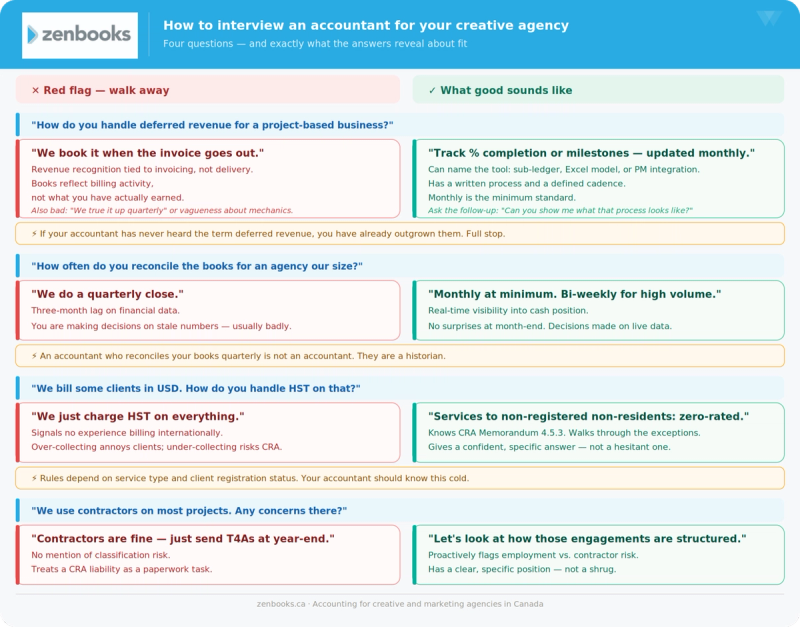
"Can you explain how you handle deferred revenue for a project-based business?"
Listen carefully to what comes next.
The worst answer is "we book it when the invoice goes out." That tells you everything you need to know, and none of it is good. Revenue recognition tied to invoicing rather than delivery means your books are reflecting billing activity, not business reality. You have no idea what you've actually earned at any given point.
But a bad answer doesn't have to be that obvious. Watch for these too:
- "We adjust it at year-end." Annual adjustments mean your books are wrong for eleven months out of twelve. You're making operational decisions on inaccurate numbers.
- "We do a quarterly true-up." Better, but still not good enough for an agency actively managing project pipelines and cash flow.
- Vagueness about the mechanics. A competent accountant should be able to tell you whether they track deferred revenue against percentage of completion, against milestones, or against a monthly accrual schedule, and they should be able to tell you what tool they use to do it (a proper sub-ledger, a dedicated spreadsheet, a project management integration). If the answer is "we handle it" with no specifics, the honest translation is "we handle it badly."
"If your accountant is still manually keying in receipts or asking you to mail physical folders, you’ve already outgrown them. A modern firm doesn't spend time typing in numbers; we spend time telling you what those numbers actually mean for your growth." — Jessica Wong, Director of Operations, Zenbooks
The follow-up question is equally important: "How often do you update it, and what does the process look like?" Monthly is the minimum standard for any agency doing meaningful project volume. The tooling matters too, a well-maintained Excel model built around your project schedule is far better than a vague promise to sort it out at year-end.
What Good Actually Looks Like
We work with project-based businesses at Zenbooks across a range of industries, and the ones that achieve real financial clarity share a few things in common in terms of how their accounting is set up.
Moniker Partners, a corporate travel and retreat planning company that grew from $5M to over $20M in revenue over four years, is a useful example. When they came to us, their books had been left disorganized by a previous cloud accounting firm, accounts receivable was inconsistent, deferred revenue wasn't being tracked properly, and month-end close was unreliable. The financial blind spots created by those gaps weren't theoretical. They had real consequences for cash flow visibility and tax planning.
What changed wasn't just the technical fix. It was building a recurring review process that actually matched the rhythm of their business, regular check-ins, clean month-end closes, and financial reporting that reflected what was actually earned rather than what had been invoiced. That's what a good accounting relationship looks like for a project-heavy service business.
See more client results on our case studies page or read what clients say on our reviews page.
The Selection Criteria That Actually Matter
When you're evaluating accountants for your agency, here's what should be on your list:
- They work with service businesses with variable billing. Not just "small businesses." Not just "professional services." Specifically businesses where the timing of revenue recognition is complicated by project structures, deposits, and milestone billing. Ask for examples.
- They have a written process for deferred revenue. Not a vague commitment to handle it. A documented approach, a defined cadence, and a clear answer about tooling. If they can't describe it in concrete terms, they don't have one.
- They do monthly bookkeeping, not quarterly. An accountant who reconciles your books quarterly is not an accountant. They're a historian. By the time they tell you what happened, the decisions you needed to make have already been made, usually badly.
- They proactively flag cash flow risks. The right accountant for your agency should be able to look at your retainer renewal schedule and your project pipeline and tell you which months are going to be tight before they arrive. That requires someone who understands your business model, not just your chart of accounts.
- They have a real opinion on contractor classification. If they shrug when you ask about it, that's a red flag. Canadian tax rules on worker classification are not ambiguous, and the consequences of getting it wrong compound quickly. You want someone who will give you a clear position and help you structure your engagements accordingly.
- They understand HST on international billings. This is a niche area that a surprising number of generalists get wrong or ignore. Ask directly: "We bill clients in the U.S. and occasionally other countries. How do you handle HST on those invoices?" A confident, specific answer is a good sign. Hesitation is not. The CRA's GST/HST memorandum on exported services is the governing reference here, your accountant should know it cold.
A Note on Technology
This matters more than most founders realize. According to Zenbooks' national study of 500 Canadian SMEs conducted with Abacus Data, nearly 1 in 3 business owners feel they have outgrown their accountant and technology adoption is one of the clearest dividing lines between firms that add strategic value and firms that are just processing transactions.
For agencies specifically, the question isn't just whether your accountant uses cloud accounting software. It's whether they're integrated with the tools you actually use your project management platform, your time tracking software, your invoicing system. A modern accounting stack should be pulling data from your operations automatically, not waiting for you to export a spreadsheet at month-end. You can see exactly how we've built our own stack in our post: The Zenbooks Tech Stack: Every Accounting App We Use (and Why).
The same study found that business owners who are profitable are 12% less likely to use a traditional accountant than those who are breaking even or struggling. That correlation isn't accidental. The firms that invest in modern accounting infrastructure tend to have better visibility into their numbers, which tends to drive better decisions.
When to Make the Switch
If any of the following are true, you've probably already waited too long:
- Your accountant has never initiated a conversation about deferred revenue
- Your books are reconciled quarterly or less frequently
- You have no clear picture of what you've earned versus what you've invoiced at any given moment
- You're making pricing and staffing decisions without reliable monthly financials
- Your accountant has never asked about your project pipeline or retainer renewal schedule
The switch feels disruptive. It rarely is. A well-run transition to the right accounting partner typically pays for itself within the first year, both in recovered margin and in tax planning that wasn't happening before. Our post on how to switch accountants in Canada without losing your data walks through exactly what that process looks like.
Frequently Asked Questions
What's the difference between a bookkeeper and an accountant for a creative agency?
A bookkeeper records what happened. An accountant interprets what happened, tells you what it means, and helps you make decisions accordingly. For an agency at scale, you need both functions but the person overseeing the accounting work needs to understand revenue recognition, tax planning, and the financial mechanics of project-based billing. A bookkeeper alone isn't enough. For a full breakdown of the distinction, see What Does a Cloud Accounting Firm Actually Do?
At what revenue level should a creative agency upgrade their accounting support?
There's no universal number, but the inflection point is usually somewhere between $500K and $1.5M. That's when billing complexity typically increases meaningfully, more clients, more varied billing structures, more contractors, often the first foreign clients. If your accounting setup hasn't changed since you started the business and you're past $750K, it's worth having an honest conversation about whether it still fits.
How often should my agency's books be reconciled?
Monthly, at minimum. For agencies with high project volume or complex billing, bi-weekly is better. Quarterly reconciliation means you're operating with a three-month lag on your financial data. In a service business where cash flow visibility is everything, that lag is genuinely dangerous.
Do Canadian agencies have to charge HST to U.S. clients?
Generally no. Under the CRA's rules for exported services, services supplied to non-resident businesses that are not registered for GST/HST are typically zero-rated, meaning you don't charge it. Advertising and creative services to non-resident, non-registered clients fall under this category under section 8 of Part V of Schedule VI of the Excise Tax Act. But the rules depend on the specific nature of the service and the registration status of your client, and there are exceptions. This is exactly the kind of question your accountant should be able to answer with confidence. If they can't, that's a problem.
What should I actually look for in an accounting firm's tech stack?
Cloud accounting software (Xero or QuickBooks Online) is table stakes. Beyond that, look for integration with your invoicing and project management tools, automated bank reconciliation, and a document management system that doesn't rely on email attachments. The goal is real-time financial visibility, not a monthly package of PDFs. Zenbooks has published a full breakdown of the tools we use and why at The Zenbooks Tech Stack.
How do I know if my current accountant is handling deferred revenue correctly?
Ask them to show you your deferred revenue balance right now and explain how it was calculated. If they can't pull it up immediately, or if the answer is "we'll true it up at year-end," you have your answer. The number should exist, it should be current, and your accountant should be able to walk you through the methodology in plain language.
If you're running a creative or marketing agency in Canada and you're not sure whether your accounting setup has kept pace with your growth, we're happy to take a look. The conversation is free, and we'll give you a straight answer either way, even if that answer is that you're in good shape.

Jessica Wong, CPA, CA, is Director of Operations at Zenbooks, where she has led the firm's accounting services and client operations since 2020. She brings over a decade of experience working directly with small and mid-sized business owners, with a focus on building efficient financial processes, improving month-end close cycles, and translating complex numbers into clear operational insights.
Before joining Zenbooks, Jessica held senior accounting roles across the hospitality and professional services sectors, including Corporate Controller at Hawksworth Restaurant Group and Manager of Client Onboarding at a national cloud accounting firm. She began her career in public accounting at Crowe. She holds a Bachelor of Business Administration from Simon Fraser University and her CPA, CA designation.
Jessica's writing on accounting operations and the future of remote work has appeared in the Toronto Star.
Subscribe for Updates


Business Clarity That Helps You Breathe Easy
Achieve your business goals and peace of mind with Zenbooks. As both your finance team and business advisor, we empower you every step of the way.
