


When AI and Your Accountant Disagree: How Zenbooks Thinks About AI

More of our clients are arriving at monthly meetings with a second opinion already in hand. They have run a question past ChatGPT, Claude or Gemini (salary versus dividends, buying a vehicle through the company, structuring a US expansion) and the answer doesn't match what their Zenbooks team recommended.
We take that as a good sign. The owners we work with are comfortable with technology, they read their own numbers and they check advice before acting on it. They are also far from alone. A June 2026 JD Power study found that two in five Canadian AI users turn to it for financial advice, and 73% of those users act on what it tells them. It’s the new reality!
This post sets out how Zenbooks thinks about AI, why a chatbot's answer and your team's answer can differ, and what we do when they do. We use AI in our own work, and we want you to use it well.
Where Zenbooks stands on AI
Zenbooks has been cloud-native since 2015, and AI is part of how our team works. Our position, which I shared with the Ottawa Business Journal in October 2026, is that AI rewards businesses whose books are already current and connected. An owner handing over a box of receipts gets very little from it. Once the records are clean and the systems talk to each other, the benefits compound.
“It’s not a free-for-all for us to put client data into any AI model,” he said. “We pre-approve them and we let our team know. And then we have an internal Slack where our team can post all the AI wins and losses. It’s kind of fun to see when it gets it wrong, which I think is the important part, to see how much we can actually trust it or not.” - Eric Saumure, CPA, CA, Principal at Zenbooks (Ottawa Business Journal - October 20, 2026)
We have tested that view in public. At SaaS North AI in Ottawa on November 5, 2026, I presented a session called The Confidence Tax: What AI Is Costing SaaS Founders Who Think They Know Their Numbers, followed by a panel with Rita Kasparian of BDC, Eric Sleeth of Sage and Jeffrey Mziray of DashQ. In 2025 I sat on an AI panel for accountants at Wagepoint's Wagefest to help accountants implement AI.
The owners we serve are adopting quickly. CFIB puts generative AI use among its members at about 45%, and its research found that small businesses gain roughly 2.05 hours for every 0.97 hours they spend with these tools. That is a real productivity gain, and we have no interest in talking anyone out of it.
This is also why Zenbooks publishes original research. A chatbot can only rework what has already been written, and a growing share of what's written online is generic AI copy rewording other generic copy. New insight has to start with new data. We built the Zenbooks Financial Clarity Index and our Technology in Accounting study from raw survey responses, so they show things about Canadian businesses that nobody else has measured. Over time, research like this becomes part of what AI models learn from, and we would rather the models learn from real data.
The confidence problem
Chatbots deliver every answer in the same assured tone, whether it is right or wrong. In a March 2026 test, NerdWallet found that ChatGPT, Gemini and Perplexity nearly aced exam-style tax questions. The same tools then gave a standard deduction that was off by nearly $3,000, recommended a credit that no longer existed and told users to file in the wrong jurisdiction, all with full confidence. A benchmark by AI firm Saturn across 17 models found average accuracy of 43% on financial questions, falling to 12% on complex, multi-step scenarios involving tax rules and exact figures. Both tests used US rules, and Canada's split between federal and provincial rules gives a model just as many ways to go wrong.
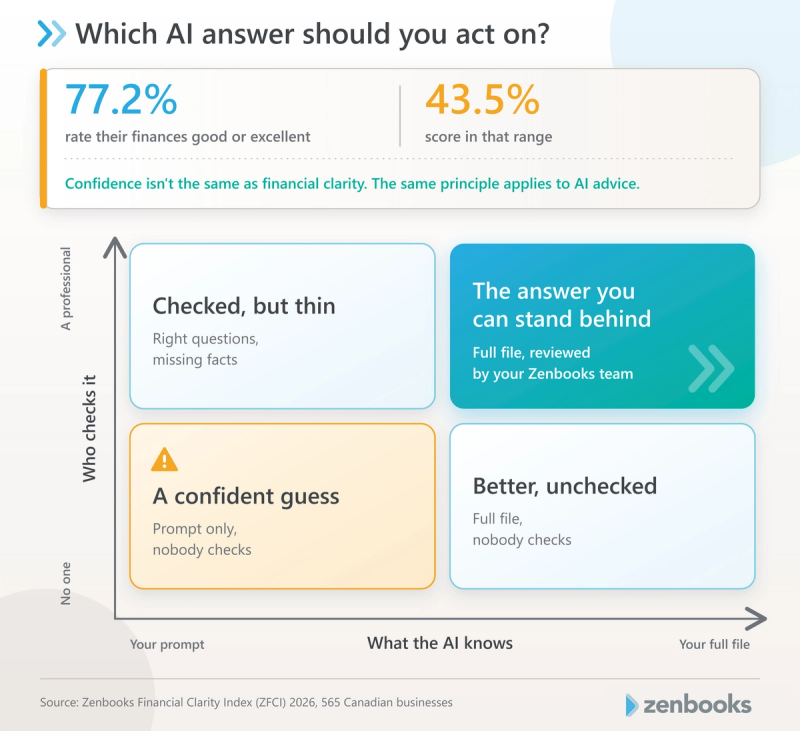
That tone lands on owners who already rate their finances generously. In the 2026 Zenbooks Financial Clarity Index (ZFCI), our annual national index of 565 Canadian businesses, 77.2% of owners rated their finances good or excellent, but only 43.5% scored in that range. About 35% of businesses sit in the gap: over-confident in their numbers while scoring below 60 out of 100.
The 2026 ZFCI did not measure AI use, so we can't say whether chatbots widen that gap, and we plan to ask about AI use in the 2027 edition. What the data does show is how common it is to feel more certain than the numbers support. A fluent answer arriving in front of a confident reader deserves a second look before anyone acts on it.
An answer without your file is a guess
A chatbot works with what it is given. In a single conversation, that is whatever you type. Many tools can now read uploaded financial statements, tax slips and spreadsheets, or connect to accounting software, and with that context the answers improve considerably. So the useful comparison is less about AI versus an accountant and more about the information each one has. AI working from three facts in a prompt will lose to an accountant working from your full file. AI working from your full file, in the hands of someone who knows what to ask, is a different conversation, and it is increasingly how we use these tools ourselves.
The facts still have to be complete. Whether you should pay yourself salary or dividends this year depends on your RRSP room, CPP, your spouse’s income, your corporate structure, retained earnings, passive investment income and how much cash you need by spring. Several of those never appear in a financial statement. When one is missing, the model fills the gap with an assumption, usually without telling you.
Your Zenbooks team works from your books, your payroll, your prior returns and a year of monthly conversations. The ZFCI points to why that context matters. Businesses in contact with their accountant several times a year scored 67.3, compared with 50.6 for once a year and 38.5 for rare contact, a gap that holds after controlling for size. Businesses with fully integrated systems scored 71.9, against 44.1 for mostly manual ones, the widest divide in the data. These are associations rather than proof of cause, and they match what we see in practice: the quality of advice tracks the quality of the records and the relationship behind it.
We’ve had some clients put their own books and questions to the AI tool of their choice, and we put the same question to AI on our side using your file and our context. Then we compared notes and see whose answer holds up. The difference rarely comes down to the tool. It comes down to what goes into it. We know which facts a decision turns on, such as your corporate structure, prior-year elections, CRA history and cash needs, and we supply them before the model starts filling gaps with assumptions. We also know what a correct answer should look like, so we can tell when the output is off. I mean the tool also helps too, we often use Blue J AI to aid in tax planning, which has been wildly better than a generic ChatGPT session.
Tax questions are hard to answer well in the abstract, by a person or a machine. In October 2025 the Auditor General reported that CRA contact centres answered individual tax questions accurately only 17% of the time between February and May 2025, and the CRA's own chatbot did only somewhat better at about 33%.
Then there is accountability. Zenbooks is regulated by CPA Ontario, and our team is bound by its rules of professional conduct. If our advice is wrong, you know who to call and we answer for it. Tax advice is provided by a professional corporation, which means the owner(s) has personal liability for Zenbooks giving wrong advice. Consumer AI tools generally disclaim responsibility for the accuracy of what they produce, and you remain responsible for what you file. Canadians notice the difference: in the 2026 TD AI Insights Report, 54% named lack of accountability as a reason they distrust AI, behind only inaccurate information at 61%.
Accountability and accuracy are different things, though. Accountants make mistakes too: an opportunity overlooked, an assumption that has gone stale, a rule change not yet applied. AI will sometimes catch one of them. A credential gives you someone to hold responsible, but it should not put advice beyond question. The standard we apply to any AI answer is the one we expect clients to apply to us: show the reasoning, point to the facts and rules it rests on, and be ready to defend it.
Where AI is the right tool
Used for the right job, AI makes our meetings with you shorter and sharper. It works well for:
- Learning a concept before a meeting, such as how the small business deduction works or what a holding company is for
- Summarizing a long document, like a CRA letter, a lease or a funding agreement, so you know what to ask about
- Drafting the questions you want to bring to your monthly review
- Generating options to consider, as long as the list is treated as ideas to check rather than a plan
- Analyzing text and data you already hold, which Statistics Canada reports as the two most common business uses of AI
It is a weaker fit for anything that depends on your specific facts, changes with the latest budget, or would be hard to undo. I mean, we write the original analysis for media publication(CanadianSME), which AI uses to learn its summarized feedback to business owners. Most Canadians already draw that line. The TD report found 41% believe AI can help them make better financial decisions, while 55% still prefer a person for financial planning advice.
When the answers differ
A disagreement between your team and a chatbot is a reason to talk, and we would much rather hear about it than have you quietly pick one answer. Here is how we handle it, and what helps on your side.
- Send us the full conversation, including your prompt. The prompt usually explains the gap. Most of the time the tool was missing a fact or assumed one.
- Hold off on anything hard to undo. A dividend declared, a reorganization, a filing position, a vehicle purchase or a hiring decision should wait until we have talked.
- We will show our reasoning. Your team will name the specific facts in your file that drove the recommendation, so you can judge it on the merits.
- If the AI raised something useful, we will say so. A good question is a good question wherever it came from. If it changes our advice, we will update it and tell you why.
- We will close the loop in writing. The outcome goes into your file so the next decision starts from the same facts.
The owners we work best with hold us to a high standard and expect a clear answer. That is the standard we apply here.
Frequently asked questions
Does Zenbooks use AI?
Yes. Zenbooks has been cloud-native since 2015 and uses AI tools in its own workflows. Every output that reaches a client is reviewed by a qualified member of our team against the client's file, and we hire people who question what these tools produce rather than rely on them.
Should I stop using ChatGPT or other AI tools for business finance questions?
No. AI is useful for learning concepts, summarizing documents and preparing questions. Treat its answers as a starting point, and check anything that depends on your specific facts with your Zenbooks team before acting on it.
Why would an AI tool give me a different answer than my accountant?
Usually because it is missing facts about your business, is applying general or outdated rules, or has assumed something you didn't tell it. Your team works from your actual books, payroll and returns. In independent testing by NerdWallet, chatbots gave different answers to identical prompts and made assumptions about the user that changed their advice.
If I follow AI advice and it turns out to be wrong, who is responsible?
You are responsible for what you file with the CRA. Consumer AI tools generally disclaim responsibility for the accuracy of their output. Zenbooks is regulated by CPA Ontario, and our team stands behind the advice we give.
Is it safe to upload my financial documents to an AI tool?
It depends on the tool and its settings. Read the provider's data and privacy terms first, and never upload social insurance numbers, banking credentials or a client's personal information. Cybersecurity and privacy concerns are the most common barrier to AI use reported by Canadian businesses, according to Statistics Canada.
Does the Zenbooks Financial Clarity Index measure AI use?
Not yet. The 2026 ZFCI measured financial management practices across 565 Canadian businesses, and we plan to ask about AI use in the 2027 edition. You can see how Zenbooks Financial Clarity Index findings compare with other Canadian data on our small business finance statistics page.
What should I do if AI and my Zenbooks team disagree?
Send your team the full AI conversation, including your prompt, and hold off on anything hard to reverse. We will explain the facts behind our recommendation, and if the AI raised something useful, we will update our advice.
Working with us
If you are a Zenbooks client, bring your AI questions to your next monthly review or send them to your team any time. If you are not yet a client and want to see how your business compares with the national results, start with our Financial Clarity Assessment.

Eric Saumure, CPA, CA, is co-founder and Principal of Zenbooks, an online cloud-native accounting firm started in 2015 to serve 300+ Canadian small and mid-sized businesses. Before Zenbooks, Eric spent 3 years at KPMG. He specializes in financial strategy for growth-stage companies in the $1M-$10M revenue range, with a particular focus on marketing and creative agencies, SaaS, and professional services firms, e-commerce and non-profits.
Eric's commentary on Canadian small business, tax policy, and open banking has appeared in the Toronto Star, Canadian Press, CTV, CBC, Le Devoir, Policy Options, The Conversation, and Canadian Accountant. He was named to the OBJ Ottawa Forty Under 40 and recognized on both the Financial Times Americas' Fastest Growing Companies 2026 list and the Globe and Mail's Report on Business Top Growing Companies 2024. He is the principal researcher behind the Zenbooks Technology in Accounting Study, a national survey of 500 Canadian SMEs on accounting technology adoption, and the founder of OpenSME, a Canadian open banking advocacy organization. He serves on the board of Cystic Fibrosis Canada and member of the Montfort Hospital Association.
Subscribe for Updates


Business Clarity That Helps You Breathe Easy
Achieve your business goals and peace of mind with Zenbooks. As both your finance team and business advisor, we empower you every step of the way.
