


How Zenbooks Is Structured to Support $1M–$10M Canadian Businesses

Most growing businesses outgrow their accountant before they realize it.
The issue is rarely competence. It is structure. One or two people cannot reliably handle bookkeeping, tax strategy, payroll, reporting, and systems as a business scales from $1M to $5M. Complexity compounds. Files pile up. Communication gaps widen. And founders end up carrying anxiety that should be off their plate entirely.
According to Zenbooks' national research of 500 Canadian SMEs, 1 in 5 business owners using an external accountant say they've outgrown them. That's not a reflection on any individual's skills. It's a structural problem. A firm built around one or two senior people simply cannot scale with you the way a properly organized team can.
This post explains how Zenbooks is structured, why we built it this way, and what that means practically for how your work gets done.
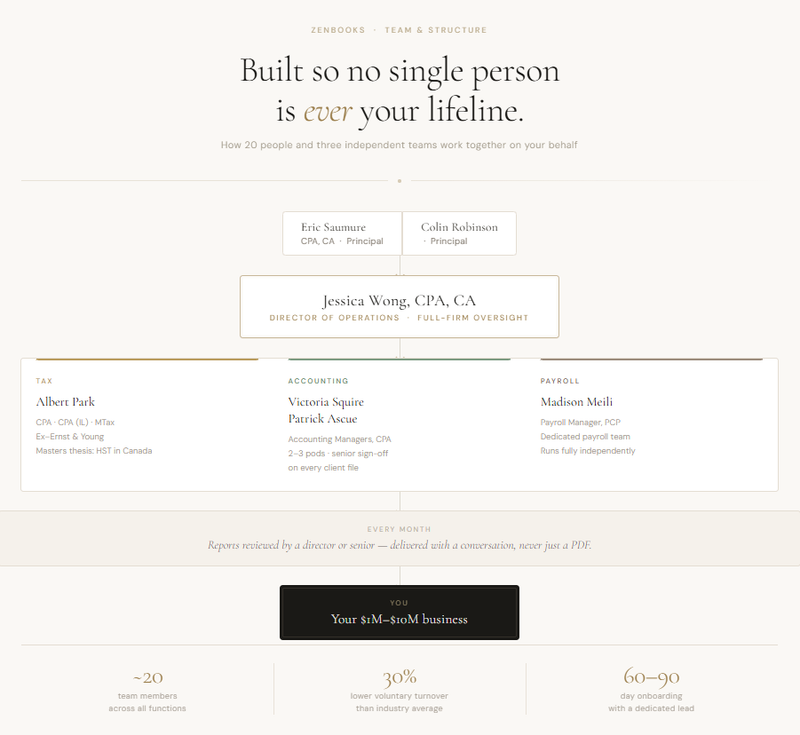
A 20-Person Team, Built Around Layers
Zenbooks has grown to approximately 20 people across accounting, tax, payroll, and operations. More important than the headcount is how those people are organized.
Every active client is supported by a layered team structure:
- Staff Accountant -- transaction accuracy, reconciliations, day-to-day entries
- Senior Accountant or Accounting Manager -- reporting, cash flow, monthly close
- Senior Tax Accountant or Tax Manager -- corporate tax planning and CRA compliance
- Director of Operations -- oversight, escalation, quality control
- Payroll Analyst – run payroll, handle CRA matters
No client ever relies on a single person. That's a deliberate structural choice, not a talking point.
Our accounting group is organized into two to three pods, each led by an Accounting Manager. These pods allow us to compartmentalize client files by team, maintain focused accountability, and train junior staff in a more structured environment. Pods also mean that if someone is unavailable, another team member within that pod already knows your file.
The Management Team Is the Story
When Zenbooks was smaller, Colin Robinson and I were involved in most client interactions. That was fine at six or seven employees. It doesn't scale, and we knew it.
We made a deliberate choice to hire managers early, before it felt strictly necessary, because we understood that growing without proper management structure meant serving clients poorly during the transition. That investment has paid off significantly.
Today our management team is experienced, credentialed, and operates independently:
Jessica Wong, CPA, Director of Operations oversees the entire firm. She was previously our Director of Accounting Services, and her promotion to Director of Operations reflects how central her role has become to every part of how we run. Jessica has a byline in the Toronto Star and has been responsible for our onboarding process for years. She now leads a team that can handle onboarding entirely without Colin or me in the room.
Albert Park, CPA (Canada), CA, CPA (IL), MTax, Senior Tax Manager leads our tax function. He came to us from Ernst and Young and holds both a Canadian CPA and US CPA designation, along with a master's degree in taxation. Albert's work goes well beyond compliance, he handles complex planning scenarios that many boutique firms would refer out. He has been published in Canadian Accountant and has written for Wagepoint. He wrote his Masters thesis on HST Issues in Canada. Having someone with that depth in-house, who can write in-depth tax memos and complex reorg instruction letters, rather than on a referral basis, is a material difference for clients with cross-border exposure or complex corporate structures.
Madison Meili, PCP, Payroll Manager leads a dedicated payroll team that includes payroll analysts and a People and Culture generalist with her own PCP and CPHR designations. The payroll function runs completely independently of the accounting team. Clients with complex payroll requirements: benefits, records of employment, year-end reconciliation, CRA remittances, work directly with Madison's team under a workflow that doesn't route through our accounting pods.
Victoria Squire, CPA, Accounting Manager (Technical) and Patrick Ascue, Accounting Manager (People) lead our two primary accounting pods. Victoria focuses on technical accuracy and process; Patrick manages the people side of how pod teams operate and develop. Between them they cover both the technical and relational elements of managing a growing team.
Rebecca Williams, Senior Accountant, Learning and Development Lead manages internal training. All accountants are trained on standardized processes before handling client files, and senior staff review junior work before delivery. Rebecca's role means training is a system, not an ad hoc exercise.
Colin Robinson, Co-Founder continues to work closely with clients on accounting and strategy. He also has a byline in Le Droit, the French-language Ottawa publication, which reflects the bilingual and regional market we serve.
“What sets us apart is that our managers are true subject matter experts," notes Jessica Wong, CPA, CA, Director of Operations. "If there’s a nuanced payroll question, it goes straight to Madison. If we’re dealing with international tax complexities, Albert handles it. We offer the kind of high-level technical bench strength you typically only find at much larger firms.”
Redundancy Is Built Into the Model
Key-person dependency is a legitimate concern when evaluating any service provider. A founder who has been burned by a single-contact firm, where everything stops when one person goes on leave, is right to ask hard questions about this.
Our answer is structural, not a promise.
Each client account has a primary contact and a secondary contact within their pod. All files are documented and accessible internally through Karbon, our practice management platform. If your primary accountant is unavailable, a team member who already knows your file can step in. That's not a theoretical backup, it's how we are built.
This also reflects why we were deliberate about being overstaffed at the management level during earlier growth stages. It affected our margins in the short term. It meant we consistently had the capacity to serve clients well and respond quickly, which protected our reputation and our retention rate.
Onboarding Is a System
New clients, particularly those in the $2M to $5M range, need significantly more senior-level attention during onboarding. We have seen firms rush this process and pay for it in client churn within the first year.
Our onboarding now has a dedicated lead in Beata, who works alongside Jessica to manage each new client's transition. A typical onboarding for a $2M to $5M business takes 60 to 90 days and follows a structured process:
Initial session: A 45-minute live onboarding call with your Accountant, Payroll Manager, Senior Tax Accountant, and onboarding lead. We gather CRA access, accounting records, incorporation documents, and details specific to your business. You receive a Karbon checklist covering every step so nothing gets missed.
Weeks 1 to 2: System access, data migration, chart of accounts review and standardization. We contact your previous accountant directly to obtain transition information so you don't have to manage that handoff.
Weeks 3 to 4: First close, reporting setup, and identification of any cleanup required from prior periods.
Weeks 5 to 8: Review, optimization plan, and alignment call to confirm KPIs, cash reserve guidelines, and reporting cadence.
We back this process with a 30-day satisfaction guarantee. To date, zero clients have asked for their money back.
A Track Record That Shows Up in Our Retention
We have a voluntary staff turnover rate approximately 30% lower than the industry average for accounting firms. That's a meaningful number given that turnover in accounting practices typically runs 15 to 20% annually.
The reasons are not mysterious. Our team works reasonable hours. They are compensated fairly. They have genuine career paths, including thought leadership opportunities like published bylines and conference participation. They work with clients who are, on the whole, pleasant to work with because we’ve been selective on who we work with. And the firm runs on EOS, the Entrepreneurial Operating System, which gives every team member clarity on their accountabilities and a structured rhythm for identifying and solving problems.
Low staff turnover means consistency for clients. The same people who onboard you are still working on your file two years later. That matters in accounting, where institutional knowledge about your business compounds over time.
Our national research found that 34% of Canadian SMEs report that managing cash flow causes at least moderate difficulty, and 32% struggle to pull together multiple sources of financial data for reports. Those are problems that a stable, experienced team solves better than one in constant transition.
What This Looks Like in Practice
One of our clients, a $3M professional services firm, came to us after years with a solo practitioner. Their books were consistently two months behind, they had no cash flow visibility, and their year-end tax filings were reactive rather than planned.
Within 90 days of onboarding:
- Monthly close was reduced to under 10 business days
- A rolling 13-week cash flow forecast was implemented
- Albert's team identified a tax adjustment that had been missed for two prior years
- The client's management team had a weekly dashboard they could actually use
Marie Haynes of Marie Haynes Consulting, a long-standing Zenbooks client, described the impact this way: "Zenbooks has been an important part of the growth of our business. We have grown from a solo consultancy to now having ten people on payroll, thanks to the advice from Colin, Eric, and the Zenbooks team." (Read more client reviews here.)
"What I see from new clients is usually the same thing: data exists somewhere, but no one has built the system to organize it properly before" says Albert Park, CPA, CA, CPA (US), MTax. "That's the first thing we fix. Everything else, tax planning, cash strategy, gets cleaner once the foundation is right."
How Work Actually Flows Each Month
For accounting clients, your monthly work follows a consistent four-step process:
- Preparation: Your staff accountant handles transaction coding, reconciliations, and data integrity checks
- Senior review: Your Accounting Manager reviews the work, flags anything requiring judgment, and prepares the reporting package
- Tax layer: Where relevant, the tax team gets consulted for planning opportunities or compliance flags
- Delivery: You receive reports with a conversation, not just numbers in a PDF. Every single engagement we take on comes with a regular call. We don’t ever have clients where we just send them a PDF. That’s useless.
Every month, a director, manager or senior signs off before anything reaches you. That's not optional depending on who is available. It is the process.
Frequently Asked Questions
What happens if my main accountant leaves Zenbooks?
Because every file is documented in Karbon and every client has both a primary and secondary contact, a team member who already knows your business can step in without disruption. Our low turnover rate also means this scenario is genuinely uncommon, but our structure means it doesn't create a crisis when it does happen.
Is Zenbooks regulated?
Yes. Services provided by Zenbooks Tax Services Professional Corporation are governed by the standards of CPA Ontario. Our team includes multiple CPAs regulated under CPA Ontario, as well as PCP-designated payroll professionals.
How does the CRA compliance side work?
Our standard service packages include mid-year tax check-ins, CRA payment management on your behalf, audit protection, and handling CRA correspondence so you don't have to deal with the Canada Revenue Agency directly. Our Senior Tax Manager Albert Park oversees all corporate tax planning and compliance.
We're a $4M business. Is Zenbooks structured to handle that complexity?
Yes. Our typical client is in the $1M to $10M range. At the $3M to $5M level you will typically work with an Accounting Manager as your primary contact, with Senior Tax Accountant involvement on planning, payroll handled by Madison's team, and senior review before anything is delivered. The structure is designed for exactly that level of complexity.
How long does it take to get onboarded?
For a business in the $2M to $5M range, plan for 60 to 90 days for a complete onboarding -- that includes cleanup, system setup, first close, and optimization planning. The process is documented and led by a dedicated onboarding lead, so it is structured from day one. You can read the full detail on our onboarding process here.
Can I see who would actually work on my account before signing?
Yes. Our discovery process includes a consultation with senior team members before any engagement is formalized. Meet the full Zenbooks team here.
The Question Worth Asking
When you're evaluating an accounting firm, the question isn't just "who does my accounting?" It's "how is that work structured when something goes wrong, when complexity increases, or when a team member is unavailable?". It’s all about the team, structure and firm’s processes, not any single superstar person you talk to.
Structure determines accuracy, responsiveness, and long-term value. Most firms don't show you their structure because it doesn't hold up to scrutiny. We've spent ten years building one that does.
If you want to see where your current financial management stands, take our two-minute Financial Clarity Assessment. Or if you'd prefer to talk directly, book a complimentary consultation with our team.

Eric Saumure, CPA, CA, is co-founder and Principal of Zenbooks, an online cloud-native accounting firm started in 2015 to serve 300+ Canadian small and mid-sized businesses. Before Zenbooks, Eric spent 3 years at KPMG. He specializes in financial strategy for growth-stage companies in the $1M-$10M revenue range, with a particular focus on marketing and creative agencies, SaaS, and professional services firms, e-commerce and non-profits.
Eric's commentary on Canadian small business, tax policy, and open banking has appeared in the Toronto Star, Canadian Press, CTV, CBC, Le Devoir, Policy Options, The Conversation, and Canadian Accountant. He was named to the OBJ Ottawa Forty Under 40 and recognized on both the Financial Times Americas' Fastest Growing Companies 2026 list and the Globe and Mail's Report on Business Top Growing Companies 2024. He is the principal researcher behind the Zenbooks Technology in Accounting Study, a national survey of 500 Canadian SMEs on accounting technology adoption, and the founder of OpenSME, a Canadian open banking advocacy organization. He serves on the board of Cystic Fibrosis Canada and member of the Montfort Hospital Association.
Subscribe for Updates


Business Clarity That Helps You Breathe Easy
Achieve your business goals and peace of mind with Zenbooks. As both your finance team and business advisor, we empower you every step of the way.
