


How Zenbooks Made the Financial Times Americas' Fastest Growing Companies 2026 List (And What It Says About Cloud Accounting in Canada)

Zenbooks has been named to the Financial Times Americas' Fastest Growing Companies 2026 list. The annual ranking, compiled by the Financial Times in partnership with Statista, recognizes companies across North and South America with the highest compound annual revenue growth between 2021 and 2024. Zenbooks is among a small number of Canadian accounting firms on the list and, to our knowledge, the only fully remote cloud accounting practice serving small and medium-sized Canadian businesses to receive the recognition.
We did not grow by doing what traditional accounting firms do, faster. We grew by doing something categorically different. Since the recognition has prompted questions from Canadian business owners about what a cloud accounting firm actually is and whether it is right for them, this post answers those questions through the lens of what enabled the growth.
in this post we talk about what enabled the recognition. For a more detailed explanation of what a cloud accounting firm is and how the model works, see our overview of cloud accounting firms in Canada.
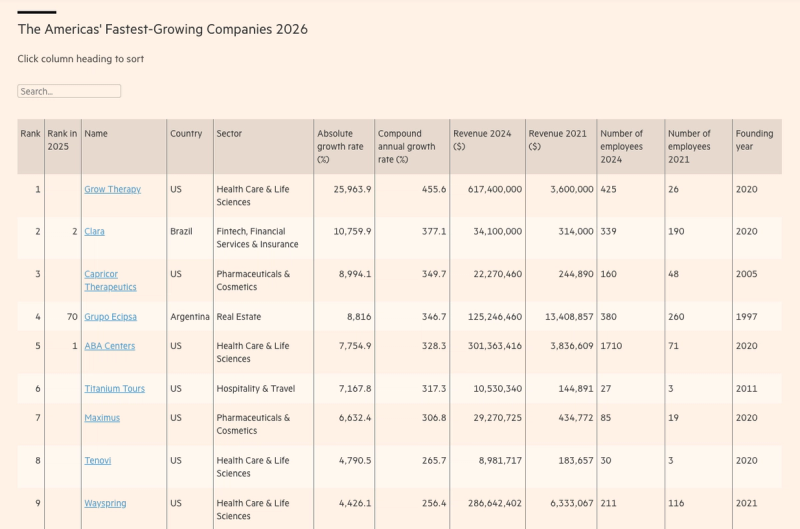
What the FT Americas' Fastest Growing Companies methodology measures
The Americas’ Fastest Growing Companies ranking is published annually by the Financial Times in partnership with Statista. It identifies companies headquartered in North and South America that have achieved strong organic revenue growth over a multi-year period.
To be eligible, companies must be independent (not subsidiaries or branches of larger entities), meet minimum revenue thresholds in both the base and most recent reporting years, and demonstrate substantial revenue growth over the period considered. The exact revenue thresholds and reporting years may vary slightly by edition.
Companies are ranked based on their compound annual growth rate (CAGR) over the defined period, typically spanning three to four years. For the 2026 edition, the analysis generally reflects growth over a recent multi-year window (such as 2021 to 2024), though final parameters are set by the publishers.
Revenue figures are primarily based on data submitted directly by participating companies. Submissions must be certified by a senior executive (such as a CEO or CFO), and Statista may request supporting documentation or perform plausibility checks. While audited financial statements can strengthen verification, they are not required in all cases.
Why a fully remote, platform-agnostic firm grew at FT-list rates
Most accounting firms that use the word cloud mean one of two things. Either they have moved their files to a hosted server instead of a physical one, which is infrastructure, not a business model. Or they use cloud accounting software like Xero or QuickBooks Online, which describes their tools, not their approach.
A genuine cloud accounting firm is something different. It is a practice built from the ground up around the assumption that the client's financial data lives online, is accessible in real time, integrates with the software the client already uses to run their business, and can be acted on continuously rather than reviewed annually.
At Zenbooks, that means your books are not something we visit at year end. They are something we are inside every month, connected to your Shopify store or your Stripe account or your Wagepoint payroll, reconciling in real time, and producing reports you can actually use to make decisions. The accounting is not the product. The financial clarity is the product.
That distinction matters more than most business owners realize until they experience the difference.
Why platform agnosticism is the defining characteristic, not a feature
The most common question we get from Canadian SMEs evaluating accounting firms is some version of: "Are you a Xero firm or a QuickBooks firm?"
It is the wrong question, and the fact that so many business owners ask it reveals something important about how traditional accounting works. Most firms align with one platform, get certified, and recommend it to nearly everyone regardless of fit. There are financial incentives to do this. There are also workflow efficiencies for the firm. It is easier to train staff on one system, build templates around one system, and sell one system.
We deliberately chose not to do that.
Zenbooks is a Xero-certified practice and one of the longest-standing Xero partners in Canada. We were there when Xero was establishing its Canadian presence. We introduced TaxCycle's founder to Xero's team, a relationship that eventually led to Xero's acquisition of TaxCycle. We worked directly with Xero's development team on GIFI mapping, a uniquely Canadian tax requirement that had been a gap in the platform. We have been inside this ecosystem for over a decade and our relationship with it is deep.
We are also QBO certified. We work in QuickBooks Online daily, including QuickBooks Advanced, which is genuinely a different product from the QBO that accountants dismissed in 2016. Colin Robinson, our co-founder, watched Intuit rebuild QBO from the ground up after their V1 failed, and the result is a platform with serious capabilities, particularly for product businesses, businesses with larger internal teams, and businesses running in the Microsoft ecosystem who want a live Excel sync rather than a manual export.
When a new client comes to us, we recommend the platform that is right for their business. Sometimes that is Xero. Sometimes that is QBO. The clearest signal toward Xero is multi-currency and international operations. The clearest signal toward QBO is inventory management, integrated payroll, and teams that live in Excel. Any accountant who tells you one platform is right for every business either is not paying attention or has a partnership incentive they are not disclosing.
That honest position is core to how we operate, and it is part of what the Financial Times growth recognition reflects. We did not grow by locking clients into a preferred platform. We grew by giving them the right answer.
What the FT list actually measures, and why it matters for this conversation
The Financial Times Americas' Fastest Growing Companies list measures compound revenue growth over a multi-year period, independently verified. It is not a self-nomination award. It is not based on reviews or voting. It is a revenue growth ranking across thousands of companies across North and South America, and the methodology is rigorous.
For an accounting firm to appear on a list like this alongside technology companies, logistics businesses, and high-growth consumer brands is notable because professional services firms, particularly in accounting, do not typically grow at the rates that attract this kind of recognition. The traditional model structurally limits growth. You are billing hours. You are constrained by headcount. You add clients slowly and carefully because complexity compounds.
Cloud accounting firms grow differently because the model scales differently. When your workflows are built around integrations rather than manual data entry, when your team operates remotely and can serve clients from Halifax to Vancouver without a physical office in each city, when your clients are onboarded onto a standardized tech stack that your team already knows inside and out, the economics of growth change.
Zenbooks now serves over 300 Canadian SMEs with a team of 20 people, operating fully remotely.
The three things a cloud accounting firm does that a traditional firm structurally cannot
Real-time financial visibility. Your books are current. Not current as of last quarter, not current as of whenever your accountant last visited your file, but current as of this week. When you connect your bank feeds, your payment processor, your payroll platform, and your accounts payable tool to a properly configured accounting system, reconciliation is continuous rather than periodic. The result is that you know your cash position, your margin, and your outstanding receivables at any point in the month, not just after year end.
Our research on technology adoption among Canadian SMEs found that fewer than half of small business owners review their financial statements monthly, and a significant share report low confidence in their numbers even when they have accounting software running. That confidence gap is not a software problem. It is a setup and service problem. The software is capable of producing reliable real-time data. Most implementations do not unlock that capability.
Proactive advisory, not reactive compliance. Traditional accounting is structured around events: year-end filing, tax season, the occasional call when something goes wrong. Cloud accounting, done properly, is structured around ongoing financial management. We use Float for cash flow forecasting on top of Xero and QBO data. We use Spotlight Reporting and Fathom for management reporting packages. We run monthly check-ins. The work happens throughout the year because the data is available throughout the year.
A tech stack that speaks to itself. The most underappreciated capability of a genuine cloud accounting practice is integration depth. Zenbooks works with Dext and Hubdoc for document capture, Plooto and Wise for payments, Wagepoint and Payworks for Canadian payroll, Stripe and Square and Shopify for revenue, ApprovalMax for internal controls, and Avalara and TaxJar for sales tax compliance across borders. Every one of those tools connects to Xero or QBO and pushes data into the general ledger cleanly. The alternative is manual entry, manual exports, and the errors and delays that come with them.
If your accountant knows Xero but does not know Stripe reconciliation, they know half of your business. If they know QBO but have never configured Shopify Payments correctly, they are guessing at your revenue. The platform is only as useful as the integrations surrounding it.
What this means if you are evaluating accounting firms right now
The question to ask any accounting firm you are considering is not which software they use. It is how they use it, what they connect to it, and what you will actually see from the relationship on a monthly basis. For a complete framework on evaluating cloud accounting firms in Canada visit our guide.
Specific questions worth asking:
What does your onboarding process look like, and do you run a full file review before taking over ongoing work? At Zenbooks, we do. In a majority of new client files we review, we find at least one material issue that has been compounding quietly, whether that is a chart of accounts that has grown without structure, HST configuration that was never set up correctly for a Canadian business, or bank feeds treated as a substitute for actual bookkeeping. We document what we find, explain it in plain language, and fix it before we take over.
What integrations does your team know, and which ones do you actively manage versus hand off? The answer tells you whether the firm understands your business or just your balance sheet.
What will I receive each month, and who will I talk to? If the answer is a year-end package and a call when there is a problem, that is a traditional firm using cloud software. It is not a cloud accounting firm.
A note on what we are building next
The Financial Times recognition arrives at a moment when Zenbooks is in the middle of something we think will matter for Canadian SMEs beyond our own client base. The Zenbooks Financial Clarity Index is a national benchmark of SME financial management practices, surveying businesses across five industry verticals on how they manage cash flow, use financial data, engage with their accounting function, and plan ahead. It follows our 2023 Technology in Accounting study, which surveyed 500 Canadian SMEs on accounting technology adoption and found significant gaps between having accounting software and actually using it to run a business.
The Financial Clarity Index will give Canadian SMEs a way to benchmark their financial management practices against peers in their industry for the first time. We are building it because the data we see inside 300+ client files tells us there is a significant and measurable difference between businesses that manage their finances actively and businesses that manage them reactively, and that difference compounds over time into real outcomes.
A cloud accounting firm should be able to tell you not just where your numbers are, but where they should be. That is the direction we are moving.
Frequently Asked Questions
What is the Financial Times Americas' Fastest Growing Companies list?
The Financial Times Americas' Fastest Growing Companies list is an annual ranking published by the Financial Times in partnership with Statista. It identifies companies headquartered in North and South America that have achieved strong organic revenue growth over a multi-year period. The 2026 edition generally reflects growth over a recent multi-year window such as 2021 to 2024, though final parameters are set by the publishers. Submissions are certified by a senior executive of each participating company, with Statista performing plausibility checks and requesting supporting documentation as needed.
How is the Financial Times Americas' Fastest Growing Companies ranking calculated?
Companies are ranked based on their compound annual growth rate over the defined period, typically spanning three to four years. To be eligible, companies must be independent rather than subsidiaries or branches of larger entities, meet minimum revenue thresholds in both the base and most recent reporting years, and demonstrate substantial revenue growth over the period considered. The exact revenue thresholds and reporting years vary slightly by edition. Revenue figures are primarily based on data submitted directly by participating companies, certified by a senior executive such as the CEO or CFO. Statista may request supporting documentation or perform plausibility checks, and audited financial statements can strengthen verification though they are not required in all cases.
How many Canadian companies appeared on the FT Americas' Fastest Growing 2026 list?
Canadian companies represent a small share of the overall list, which is dominated by United States and Brazilian companies. Only a handful of Canadian accounting firms appeared on the 2026 list, and Zenbooks is, to our knowledge, the only fully remote cloud accounting firm serving small and medium-sized Canadian businesses to receive the recognition.
What enabled Zenbooks' growth into the FT Americas' Fastest Growing 2026 list?
Three structural choices. First, a fully remote operating model that removed geographic constraints on client acquisition and let Zenbooks serve businesses from British Columbia to Newfoundland with the same team. Second, a platform-agnostic approach that recommended Xero or QuickBooks Online based on client fit rather than firm preference, which built trust with founders who were tired of being sold whatever software their accountant had a partnership with. Third, a tech stack built on integrations between accounting platforms and the operational tools clients already used, which made real-time financial visibility the default rather than an upsell. Zenbooks now serves over 300 Canadian SMEs with a team of approximately 20 people.
How does Zenbooks serve clients across Canada if it is based in Ottawa?
Zenbooks is a fully remote practice. Every client engagement, from onboarding through ongoing bookkeeping, reporting, and advisory, is conducted remotely. Zenbooks serves Canadian SMEs from British Columbia to Newfoundland, with the cloud-first model removing geography as a constraint on service quality. Clients meet with their accounting team through video calls, share documents through secure cloud portals, and have continuous access to their financial data through the same accounting platform their team uses to work on their books.
What size of business is Zenbooks best suited for?
Zenbooks primarily serves Canadian small and medium-sized businesses with revenues between $1 million and $10 million. The firm is particularly well suited for businesses that have outgrown a generalist bookkeeper or part-time accountant and need a finance partner that can scale with them, deliver management-level reporting, and handle the complexity of a real business operation. Zenbooks works across five core verticals: marketing and creative agencies, professional services firms, SaaS companies, e-commerce businesses, and nonprofits.
Zenbooks is a fully remote cloud accounting firm based in Ottawa, serving 300+ Canadian SMEs. We are a Xero-certified practice, QBO-certified, and a Financial Times Americas' Fastest Growing Companies 2026 honoree. Book a discovery call to talk about whether we are the right fit for your business.

Colin Robinson is co-founder and Principal of Zenbooks, which he built starting in 2015 into one of Canada's leading cloud accounting firms for small and mid-sized businesses. He leads Zenbooks' CFO advisory practice, working directly with founders and executive teams on financial strategy, cloud migration, and the kind of complex, non-standard situations that fall outside the playbook.
Before co-founding Zenbooks, Colin worked at Ernst & Young, one of the world's leading professional services firms. He holds a Bachelor of Commerce in Accounting.
Over a decade building and running Zenbooks, Colin has advised hundreds of Canadian entrepreneurs, from solo founders scaling past their first million to established businesses navigating ownership transitions and operational restructuring. His commentary on small business financial strategy has appeared in Le Droit.
Subscribe for Updates


Business Clarity That Helps You Breathe Easy
Achieve your business goals and peace of mind with Zenbooks. As both your finance team and business advisor, we empower you every step of the way.
