


Income Splitting in Canada: What's Actually Legal, and What the CRA Will Allow

Most of what you will read online about income splitting in Canada is out of date, half-right, or both.
The rules changed materially in 2018 when the Tax on Split Income (TOSI) regime was expanded, the prescribed rate has moved through a full cycle since 2020, and the attribution rules that actually govern whether a strategy works have sat in the Income Tax Act since 1986 largely unchanged. Articles written against the old rules are still circulating. Strategies that worked in 2017 do not work in 2026. Strategies that did not work in 2017 still do not work, no matter how confidently your brother-in-law describes them at the barbecue or you see on instagram.
This post is a practitioner's guide to what is actually legal, what the CRA will disallow, and what an incorporated business owner or higher-earning Canadian should actually be doing. I will be direct about which strategies work, which do not, and why the "just give your spouse the money" approach that many owners reach for first is a fast way to pay tax twice.
What Income Splitting Is, and Why It Is Worth Doing
Income splitting is the practice of shifting income from a higher-earning family member to a lower-earning family member to reduce the household's combined tax bill. Canada's tax system is progressive, which means marginal rates increase as income rises. A dollar of income taxed in the hands of a spouse earning $50,000 costs meaningfully less than the same dollar taxed in the hands of a spouse earning $200,000. The federal and provincial brackets published by the Canada Revenue Agency put the combined top rate above 53% in most provinces and the lowest bracket below 25%, depending on the province. The spread is real. Moving income across it legally is one of the highest-leverage personal tax strategies available to Canadian families.
The challenge is that Parliament saw this coming. Sections 74.1 through 74.5 of the Income Tax Act, commonly called the attribution rules, exist precisely to prevent the obvious approach. If you transfer or lend money to your spouse and they earn investment income on it, the attribution rules push that income back to you for tax purposes. The entire field of legitimate Canadian income splitting is, in effect, the set of strategies that navigate around the attribution rules rather than through them.
The Strategies That Actually Work
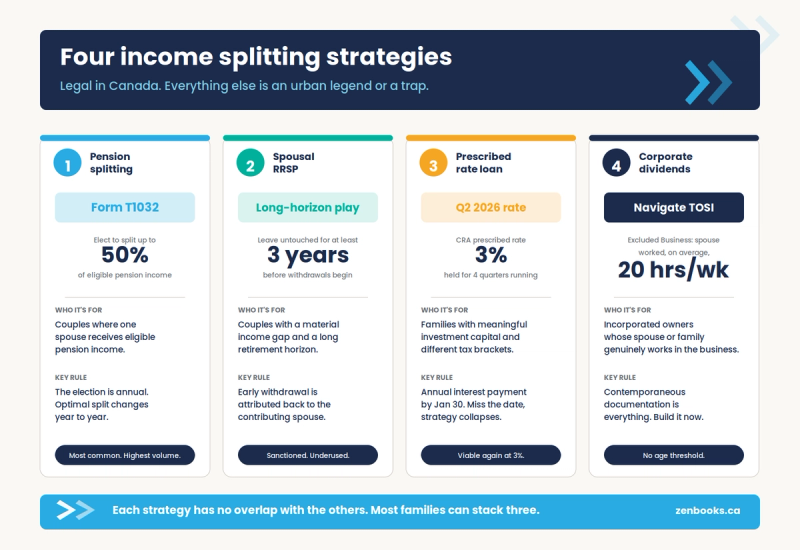
There are four mechanisms that genuinely let a Canadian household split income with the CRA's blessing, that we implement for tax clients. Most everything else is either an urban legend or a trap.
1. Pension Income Splitting (Form T1032)
This is the highest-volume income splitting tool in Canada, and it is available to any couple where one spouse receives eligible pension income. The mechanics are set out on Form T1032, Joint Election to Split Pension Income, which you file jointly with your spouse's return. You can elect to split up to 50% of eligible pension income with your spouse or common-law partner, and the elected amount is deducted from the transferor's income and added to the transferee's.
Two notes on optimization. First, the optimal split is not always 50%. Personal tax software like UFile, TurboTax, and Wealthsimple Tax runs the calculation automatically and will suggest the split that minimizes combined tax, accounting for the Age Credit clawback, OAS recovery tax, and provincial bracket interactions. If you file with a competent preparer or decent software, you are already capturing most of this value. Second, the election is annual. Your optimal split in one year is not your optimal split in the next, especially if there is a material change in either spouse's non-pension income.
Most business owners don't have a pension, but you can set up an individual pension plan for you and your family…
2. Spousal RRSPs
A spousal RRSP is a registered retirement savings plan opened in the lower-earning spouse's name but contributed to by the higher-earning spouse, using the higher earner's own RRSP room. On withdrawal, subject to a three-year attribution rule, the income is taxed in the lower-earning spouse's hands. The CRA fully sanctions this, and the rules are documented in the CRA's RRSP and RRIF guidance.
The three-year rule matters and is the most common way owners trip themselves up. If the contributing spouse makes a spousal RRSP contribution in 2024, 2025, or 2026, and the receiving spouse withdraws funds in 2026, the withdrawal is attributed back to the contributing spouse up to the amount of those recent contributions. This means spousal RRSPs are a long-horizon strategy, best funded aggressively when there is a significant income gap and left untouched for at least three full calendar years before withdrawals begin.
The reason this strategy is underused in my experience is that most couples set up one spousal RRSP at some point, make sporadic contributions, and then never revisit the strategy as incomes diverge. A couple with a $150,000 and $70,000 earner should be using the spousal RRSP aggressively. Most are not.
3. Prescribed Rate Loans
A prescribed rate loan is a formal loan from the higher-earning spouse to the lower-earning spouse or to a family trust, at the CRA's published prescribed interest rate. The lower-earning spouse invests the loaned capital, earns investment income on it, and pays the higher-earning spouse the prescribed interest amount annually by January 30 of the following year. The spread between what the investments earn and the prescribed rate is taxed in the lower earner's hands rather than being attributed back under section 74.1.
The mechanics depend entirely on the prescribed rate. As of the second quarter of 2026, the CRA prescribed rate is 3%, unchanged for four consecutive quarters. At 3%, the strategy is viable again for families with meaningful capital bases. A $500,000 prescribed rate loan invested in a portfolio earning 7% produces a 4-point spread, or $20,000 a year, that is taxed in the lower earner's hands rather than the higher earner's. Over a decade, the cumulative tax savings for a couple in different brackets can easily run into six figures.
Three practitioner notes. The rate locked in at the time the loan is made is the rate for the life of the loan, so a loan made at 1% in 2021 is still a 1% loan. You cannot refinance an existing loan at a lower current rate without triggering attribution. And the interest payment deadline is hard. Missing it by a day collapses the strategy and results in all investment income being attributed to the lender for that year and all subsequent years.
For a deeper walkthrough of the strategy and the tax mechanics, see our detailed post on income splitting using prescribed rate loans.
4. Dividends from a Corporation, Navigated Around TOSI
This is where things get interesting for the owner-operator cohort of Canadian taxpayers, and where the "you cannot income split in Canada under 65" narrative is most obviously wrong.
The TOSI rules, expanded in 2018, treat dividends and certain other amounts paid to family members as subject to tax at the top marginal rate unless one of several enumerated exceptions applies. The CRA's TOSI guidance describes the framework. For incorporated owners with spouses or adult family members genuinely involved in the business, two exceptions do the heavy lifting.
The Excluded Business exception applies when a family member has worked an average of at least 20 hours per week in the business, either in the current year or in any five prior taxation years. Once the five-year test is met, dividends paid to that family member are excluded from TOSI for the rest of their lives, not just for that year.
The Excluded Shares exception applies to family members aged 25 or older who own at least 10% of the votes and value of the corporation, provided the corporation is not a professional corporation and less than 90% of its business income comes from the provision of services. For a business with meaningful product or resale revenue, this exception is available and often overlooked.
We covered the TOSI mechanics and the five excluded amount tests in detail in our guide to TOSI rules in Canada. The short version: the 2018 expansion of TOSI eliminated aggressive dividend sprinkling to uninvolved adult children, but legitimate income splitting within a family that is genuinely running a business together is still available, and is still one of the most valuable planning opportunities in the Canadian owner-manager toolkit.
"What I tell business owner clients is that the 'nobody can split income anymore' story is simply wrong," says Tara Robertson, CPA, CGA, Senior Tax Accountant at Zenbooks. "What changed in 2018 is that the onus shifted onto the owner to document the exception. Time records, meeting minutes, contemporaneous task logs. The exception is still there. You just have to earn it on paper."
What Does Not Work, and What the CRA Will Claw Back
A clean list, because owners keep trying these.
Gifting cash to your lower-earning spouse to invest. The attribution rules immediately route any investment income back to you. The lower-earning spouse does not become the taxpayer on the income just because the money sat in their account.
Paying your spouse a "salary" above fair market value. The CRA can and does disallow salaries paid to a related party that exceed what you would pay a non-related third party for the same work. If your spouse does 10 hours a week of administrative work, a market-rate salary of around $13,000 to $18,000 is defensible. A $60,000 salary for the same work is not. Assessments on this are retrospective, which means you can be reassessed three years later for salaries that have already been paid and spent.
Transferring investments to your spouse and claiming they are now their property. Same problem. Both investment income and capital gains are attributed back under sections 74.1 and 74.2. The only way around this is the prescribed rate loan, which is not a transfer.
Dividend sprinkling to uninvolved adult children or a spouse who does not meet a TOSI exception. This is the strategy TOSI specifically eliminated in 2018. Paying a dividend to a 28-year-old child who has no involvement in the business means the dividend is taxed at the top marginal rate regardless of their personal bracket. Paying a dividend to a spouse who has never worked in the business means the same thing. The CRA's TOSI analysis is not subjective.
The "Before Age 65" Question
We know that a lot of pre-retirement Canadians are wondering whether the pension splitting strategy is available to them. The plain answer is that under age 65, pension splitting is narrow. Only lifetime annuity payments from a Registered Pension Plan (typically a defined benefit or defined contribution RPP) qualify as eligible pension income. RRIF and RRSP annuity withdrawals do not qualify until the recipient turns 65.
But here is what the generic search results miss. Pension splitting is one of four mechanisms. For incorporated business owners under 65, the entire dividend-splitting toolkit is available right now. A 45-year-old physician operating through a professional corporation cannot access the excluded shares exception (professional corporations are carved out), but the excluded business exception is fully available if their spouse does bona fide work in the practice. A 50-year-old marketing agency founder whose spouse handles client onboarding and billing can pay dividends to that spouse outside of TOSI, indefinitely.
And for any higher-earning Canadian with meaningful investment capital, the prescribed rate loan strategy has no age threshold. It works at 35, 45, 55, and 75.
The "cannot income split before 65" answer is technically correct only if you read "income splitting" to mean "pension splitting." It is meaningfully wrong if you read it as the full set of legitimate household tax strategies.
A Practical Example
Consider a common setup. The higher earner runs a marketing agency operating through an Ontario CCPC. Their personal income from the corporation is around $200,000, and the corporation generated an additional $250,000 of retained earnings after tax in 2025. Their spouse works in the business roughly 15 hours a week managing client onboarding, contracts, and operations, and has done so consistently for the past five years. There is no written employment agreement and no time records.
Without a documentation trail, paying the spouse a dividend risks TOSI reassessment at the top marginal rate. A CRA review would ask for evidence of the 20-hours-per-week threshold under the excluded business test. "We both just work on it together" is not a defence.
The fix is straightforward and should be done now, not later. Build a contemporaneous log of the spouse's hours and activities. Draft an employment or contractor agreement that reflects the actual working relationship. Issue dividends from a separate class of shares. Run the dividend strategy with full documentation. The five-year Excluded Business test, once met, travels with the spouse for life. The cost of setting this up correctly is a few hours of work and the fee for a proper share restructuring. The benefit is a compounding annual tax saving for as long as the business operates.
"The worst place to be on TOSI is right in the middle of it," says Eric Saumure, CPA, CA, Principal of Zenbooks. "Owners who document nothing have a reassessment risk. Owners who do nothing have a leaving-money-on-the-table cost. The middle group, owners who have a legitimate exception but have not documented it, have the worst of both: full reassessment exposure with none of the benefits captured. That is the group we see most often."
Why This Conversation Matters
Income splitting is one of the most concrete examples of the difference between compliance accounting and strategic tax planning. Our Technology in Accounting study of 500 Canadian SMEs, conducted with Abacus Data, found that only 32% of Canadian business owners report being very satisfied with how their accounting and bookkeeping are handled, and that 1 in 3 feel they have outgrown their current accountant. Strategic tax planning, including income splitting, is one of the specific places where that gap shows up.
The same study found that only 6% of Canadian SMEs using an external accounting provider receive a regular monthly check-in with their accountant. Income splitting is not a one-time structural decision. Incomes change, rules change, the prescribed rate changes. A TOSI strategy set up in 2018 and not revisited since is running against eight years of evolved practice.
Stefano Manzoni, a Zenbooks client who has worked with us for five years on his real estate investment corporations, has described the value directly: "I rely on them for sound tax advice and guidance. When it comes to investment properties, they know how to structure the corporate ownership." That structural advice, which is where income splitting fits, is the kind of work that does not show up on a compliance-only engagement but pays for itself several times over each year when it is done right.
For an independent review of our approach, see Zenbooks' reviews page, our Trustpilot profile, and Clutch case studies.
Frequently Asked Questions
What is income splitting in Canada?
Income splitting is the practice of shifting taxable income from a higher-income family member to a lower-income family member in order to reduce the household's combined tax bill. Because Canada's tax system is progressive, the same dollar of income taxed in the lower earner's hands produces a lower total tax bill. The Canada Revenue Agency's federal and provincial tax bracket guidance shows the spread between brackets that drives the strategy.
What income can be split between spouses in Canada?
Four main categories work legally: eligible pension income (via Form T1032), spousal RRSP withdrawals (subject to a three-year attribution rule), investment income earned on a properly structured prescribed rate loan, and dividends paid to a spouse or family member who meets a Tax on Split Income exception. Ordinary employment income and most forms of investment income cannot simply be transferred to a spouse for tax purposes, because of the attribution rules in sections 74.1 through 74.5 of the Income Tax Act.
Is pension income splitting the only form of income splitting available in Canada?
No. Pension income splitting (Form T1032) is the most commonly used form, but it is one of four. Spousal RRSPs, prescribed rate loans, and dividend strategies that navigate around TOSI are all legitimate and are available to Canadians well before age 65. The CRA's TOSI guidance describes the corporate dividend framework.
Can I split income with my spouse before age 65?
Yes, through spousal RRSPs, prescribed rate loans, and corporate dividend strategies. Pension income splitting is more restricted under age 65 and generally limited to lifetime annuity payments from a Registered Pension Plan. But the other three mechanisms have no age threshold and are particularly valuable for incorporated business owners whose spouses work in the business.
What is the CRA's prescribed rate right now?
As of the second quarter of 2026, the CRA prescribed rate is 3%. The rate is reviewed quarterly and is based on the three-month Treasury bill yield from the first month of the preceding quarter. It has held steady at 3% for four consecutive quarters.
What happens if I just gift money to my lower-earning spouse?
The attribution rules in sections 74.1 through 74.5 of the Income Tax Act route any investment income earned on the transferred property back to you for tax purposes. The strategy does not work, and the CRA will reassess it if discovered.
Can I pay my spouse a salary from my business?
Yes, but the salary must be reasonable, meaning it must approximate what you would pay a third party to do the same work. The CRA can and does disallow salaries that exceed fair market value for the work performed. Retrospective reassessment up to three years back is standard.
Does TOSI mean I cannot income split if I have a corporation?
No. TOSI eliminated aggressive income sprinkling to uninvolved family members, but the Excluded Business, Excluded Shares, and other TOSI exceptions remain fully available for family members who are genuinely involved in the business. The key requirement under TOSI is contemporaneous documentation.
Am I eligible for income splitting?
Eligibility depends on your household structure, your income sources, and in the case of corporate dividend strategies, how your business is set up. Our TOSI Eligibility Screener walks you through the key tests in about three minutes and tells you which exceptions you may qualify for. It is not a substitute for professional advice, but it is a useful first-pass diagnostic.
Where to Go Next
If you have a corporation and a spouse or adult family member involved in the business, the first step is figuring out whether any of the TOSI exceptions apply to your situation. That determination drives almost every other planning decision, from compensation structure to share classes to dividend policy. The Zenbooks TOSI Eligibility Screener walks you through it in plain language.
If you want the broader context on how income splitting fits into the rest of your Canadian tax compliance picture, our Canadian Small Business Resources hub brings the CRA forms, rules, and program accounts into a single reference page.
Income splitting is not a one-size strategy. It is an annual optimization that depends on who earns what, what the prescribed rate is, what the TOSI rules currently require, and what your household's investment picture looks like. The legal strategies are real and the tax savings are substantial. What they require is a CPA who is willing to run the math.

Albert Park holds a Master of Taxation from the University of Waterloo and a Bachelor of Commerce from the Rotman Commerce program at the University of Toronto. He is a Chartered Professional Accountant in Canada and a licensed CPA in the State of Illinois. One of a small number of practitioners in Canada to hold both designations. His MTax research focused on GST/HST compliance and administrative design.
Before joining Zenbooks, Albert spent eight years in the tax practice at Ernst & Young (EY), where he advised clients across a range of industries on Canadian and cross-border tax matters. He now serves as Senior Tax Manager at Zenbooks, specializing in Canadian corporate tax, owner-manager tax planning, and Canadian-US cross-border structures for small and mid-sized businesses.
Albert's analysis of Canadian tax policy has been published in Canadian Accountant and Wagepoint.
Subscribe for Updates


Business Clarity That Helps You Breathe Easy
Achieve your business goals and peace of mind with Zenbooks. As both your finance team and business advisor, we empower you every step of the way.
